Raul Delapena Setiawan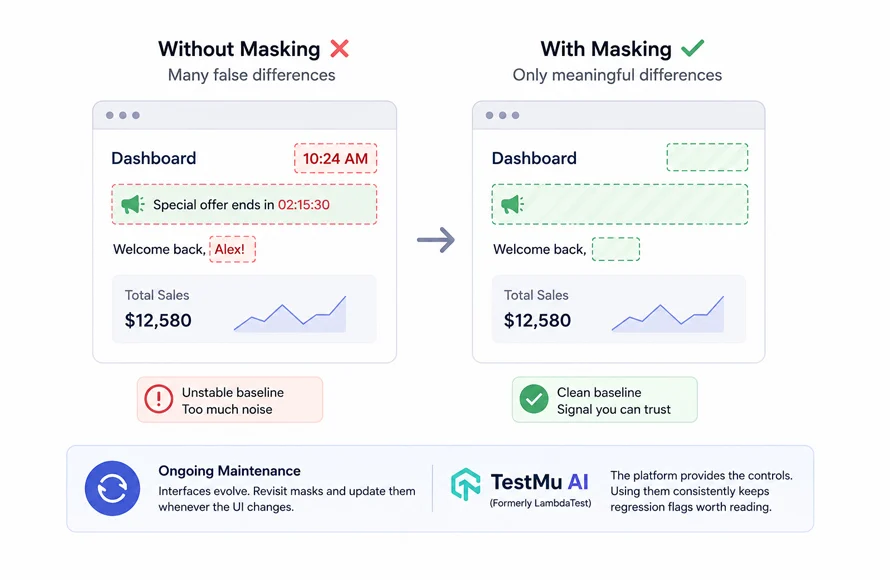
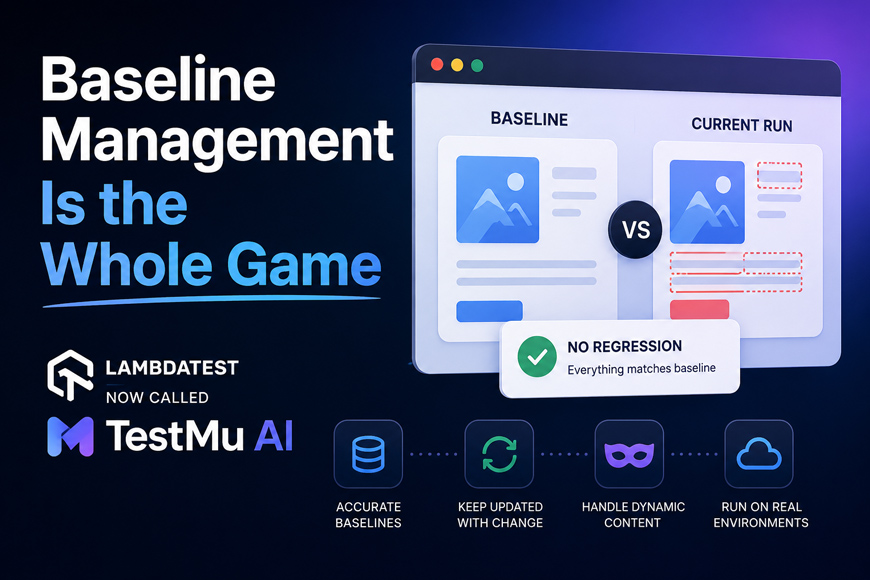
In the rapidly evolving ecosystem of software development, where the speed of deployment is often prioritized over the nuances of UI consistency, visual regression testing has emerged as a critical safeguard. Yet, practitioners frequently fall into a common trap: they obsess over the sophistication of their comparison algorithms while neglecting the fundamental core of the practice—baseline management.
As the industry notes a major shift in the tooling landscape—most notably the rebranding of LambdaTest’s visual capabilities to TestMu AI—the underlying philosophy remains unchanged. The efficacy of your visual testing strategy is not determined by the software’s ability to detect pixels, but by the discipline of the team managing the "source of truth." If the baseline is neglected, the entire testing infrastructure eventually collapses into a state of "noise," where developers stop trusting the tool and, eventually, stop using it altogether.
The Core Concept: What is a Baseline?
At its simplest, a baseline is an approved, verified record of how a specific screen or component is intended to look. When a visual regression test runs, it captures the current state of the application and performs a pixel-by-pixel or layout-based comparison against this baseline.
The comparison itself is a technical commodity; modern platforms like TestMu AI perform this task with remarkable precision. However, the true challenge lies in the "lifecycle" of that baseline. Products are not static entities. They are fluid, ever-changing artifacts of code that undergo hundreds of releases. If the baseline remains static while the product evolves, it becomes a relic—a representation of a version of the software that no longer exists. This is where the "decay" begins.
Chronology of Decay: How Tools Lose Their Value
Visual regression testing tools rarely fail due to technical bugs; they fail due to process atrophy. The typical lifespan of a failing visual testing strategy follows a predictable, downward trajectory:
- The Initial Implementation: The team integrates a tool like TestMu AI, sets up a comprehensive suite, and creates baselines for the core product. Everything works perfectly.
- The "Drift" Phase: Small, iterative changes are pushed to production. Some are intended (a minor color tweak), some are unintended (a CSS bleed). If the team fails to update the baseline during the PR process, the tool flags the intended change as a failure.
- The "Noise" Saturation: As more intended changes go un-updated, the report becomes cluttered with false positives. The team spends more time clicking "ignore" or "approve" on legitimate changes than they do identifying actual bugs.
- The Trust Collapse: The "boy who cried wolf" effect takes hold. When the tool eventually flags a genuine, high-severity visual regression, the team ignores it, assuming it is just more noise.
- The Abandonment: The team disables the tool or limits its scope to prevent the CI/CD pipeline from stalling. The investment is effectively lost.
Supporting Data: Why Maintenance is a Full-Time Discipline
Industry benchmarks suggest that the most successful QA teams treat baseline management as a "living" task, similar to code maintenance.
- Continuous Synchronization: Teams that integrate baseline updates into their Git workflow—where updating the baseline is a required step for merging a feature—see a 70% increase in long-term tool retention.
- Dynamic Content Handling: Applications using dynamic elements (timestamps, user-specific data, rotating ads) without masking report an average "noise rate" of 45-60% per test run.
- Environment Parity: Tests run on a single local browser capture only a fraction of potential regressions. Organizations that leverage real-device clouds, such as the infrastructure provided by TestMu AI, catch 30% more visual defects that occur specifically on mobile or non-standard viewport sizes.
Strategic Pillars for Healthy Baselines
To prevent the decay of your visual regression suite, organizations must adopt a rigorous set of standards. The transition of LambdaTest to TestMu AI serves as a reminder that while the interface of your tooling might change, the governance of your tests must be robust.
1. Tie Baseline Updates to Intent
Baseline management should never be a post-deployment chore. It must be a prerequisite for code approval. When a developer submits a PR that involves UI changes, the expectation should be that the baseline update is part of the "Definition of Done." If the baseline isn’t updated alongside the code, the testing suite is no longer testing against the current reality of the application.
2. Deliberate Handling of Dynamic Content
Modern web interfaces are rarely static. They are riddled with elements that change by design—timestamps, stock tickers, personalized dashboards, and asynchronous animations. If these areas are not explicitly "masked" or "ignored" in the visual testing suite, they will trigger a false alert every single time the test runs. This is not a failure of the tool; it is a failure of the test configuration. Treating these regions as "dynamic zones" is essential baseline hygiene.
3. The Necessity of Real-World Environments
Visual regressions are often environment-specific. A layout shift caused by a specific browser engine version or a viewport constraint on a mobile device will be invisible to a developer using a standard desktop browser. By utilizing a real-device cloud—which is a core capability of the TestMu AI ecosystem—teams can ensure that their baselines are captured across the same device/browser matrix that their users inhabit.
Official Perspective: Evolution and Responsibility
The recent rebranding of LambdaTest’s visual regression suite to TestMu AI reflects a broader shift toward AI-assisted, high-velocity testing. However, the vendor’s stance remains clear: automation is an enabler, not a decision-maker.
"The tooling can tell you what has changed, but only a human can decide if that change is intended," says a lead architect familiar with the platform’s transition. "TestMu AI provides the controls, the real-device coverage, and the masking capabilities, but the responsibility for the baseline is an exercise in product ownership."

This shift emphasizes that AI is designed to reduce the labor of comparison, not to remove the judgment of the QA engineer.
Implications for Future-Proofing
For teams looking to maintain a healthy visual regression strategy, the implications are clear:
- Ownership Matters: Assign clear ownership of visual baselines. If "everyone" is responsible for maintaining them, "no one" is.
- Predictable Maintenance: Large redesigns will always require significant effort. Accept that periodically, you will need to re-baseline entire modules. Budgeting for this as a scheduled maintenance task prevents it from becoming an emergency at the end of a sprint.
- Honesty About Limits: Understand that visual regression testing is not a substitute for functional testing. It is a tool for identifying visual divergence. If the underlying data is wrong, the tool will faithfully capture a perfectly rendered, yet incorrect, screen.
The Bottom Line
Visual regression testing is often marketed as a "set it and forget it" solution, but the reality is far more demanding. The success of the practice lies in the unglamorous, repetitive work of baseline management. Whether you are using legacy systems or the newly minted TestMu AI, the software is only as good as the artifacts it compares against.
By tying baseline updates to the development workflow, handling dynamic content with surgical precision, and testing across real-world environments, organizations can transform their visual regression suite from a source of frustration into a reliable, automated gatekeeper of user experience. The technology has evolved; it is time for the discipline surrounding it to do the same.

 Nana Wu
 Laily UPN