Evan Lee Salim
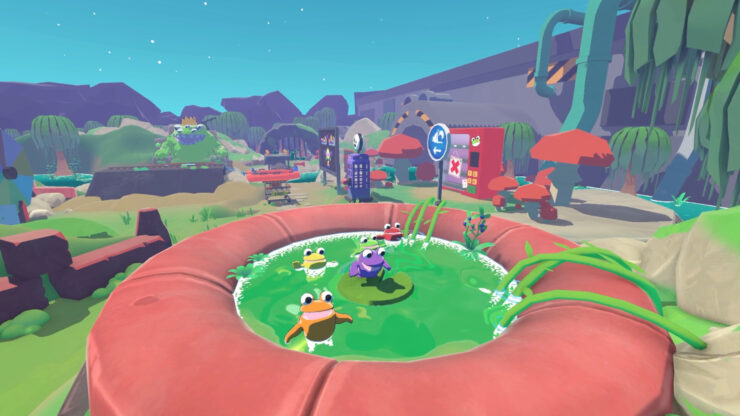
In the ever-expanding landscape of cooperative party games, titles that balance mechanical precision with pure, unadulterated absurdity often find the most success. Enter Frog Sqwad, a title that tasks players with the noble, if slightly bizarre, mission of feeding a demanding monarch known as the Swamp King. Whether you are playing solo or wrangling a group of up to seven friends, this chaotic romp through vibrant, procedurally generated environments offers a uniquely frantic experience that tests both your tongue-eye coordination and your patience.
The Core Concept: Serving the Swamp King
At its heart, Frog Sqwad is a physics-based, cooperative platformer where the primary tool for interaction is the humble, sticky frog tongue. Players take control of a colorful amphibian with a singular goal: gathering enough human food—hamburgers, French fries, giant eggs, and crisp apples—to satisfy the daily quota set by the Swamp King.
While the premise sounds straightforward, the execution is anything but. The game demands a delicate balance of resource management and navigation. As you traverse levels, smaller food items can be consumed to restore health or, more importantly, to trigger a physical transformation. Eating enough food causes your frog to swell in size. While a giant frog might lose its ability to jump with grace, it gains the sheer mass required to smash through walls and roll over obstacles, effectively turning the game from a platformer into a high-speed bowling simulation.
The larger items, such as the aforementioned giant eggs, require a more collaborative approach. You cannot simply eat them; you must ensnare them with your tongue and physically drag them across treacherous terrain to a designated collection bowl. Because some items are fragile, the "offering" process becomes a tense exercise in teamwork, where one wrong move can turn a gourmet offering into a pile of useless debris.
A Chronology of Chaos: From Development to Release
The journey of Frog Sqwad from a conceptual prototype to a fully realized Steam release has been one of iterative design. The developers focused heavily on the "party" aspect of the game, recognizing early on that the magic of the experience scales exponentially with the number of players.
- The Conceptual Phase: The initial design focused on the mechanics of the tongue-latch. The team wanted to create a feeling of weight and elasticity, ensuring that the movement felt "floaty" enough to be whimsical but precise enough to allow for genuine skill expression.
- The Beta and Playtesting Era: Throughout its development, the game was featured at various indie showcases, including a notable appearance at New Game Plus. It was here that the community provided critical feedback regarding the movement physics. Playtesters noted that the floaty, momentum-based movement was a "love-it-or-hate-it" mechanic—one that required a steep learning curve but rewarded players who could master the game’s unique inertia.
- The Official Launch: Following months of balancing and level refinement, Frog Sqwad launched on Steam, inviting players to join the ranks of the Swamp King’s royal catering staff.
Supporting Data: The Mechanics of Frustration and Fun
To understand why Frog Sqwad is gaining traction, one must look at the data behind its design. The game utilizes procedurally generated maps, which ensures that no two play sessions are identical. However, the developers have baked in specific environmental variables that keep the difficulty curve aggressive:
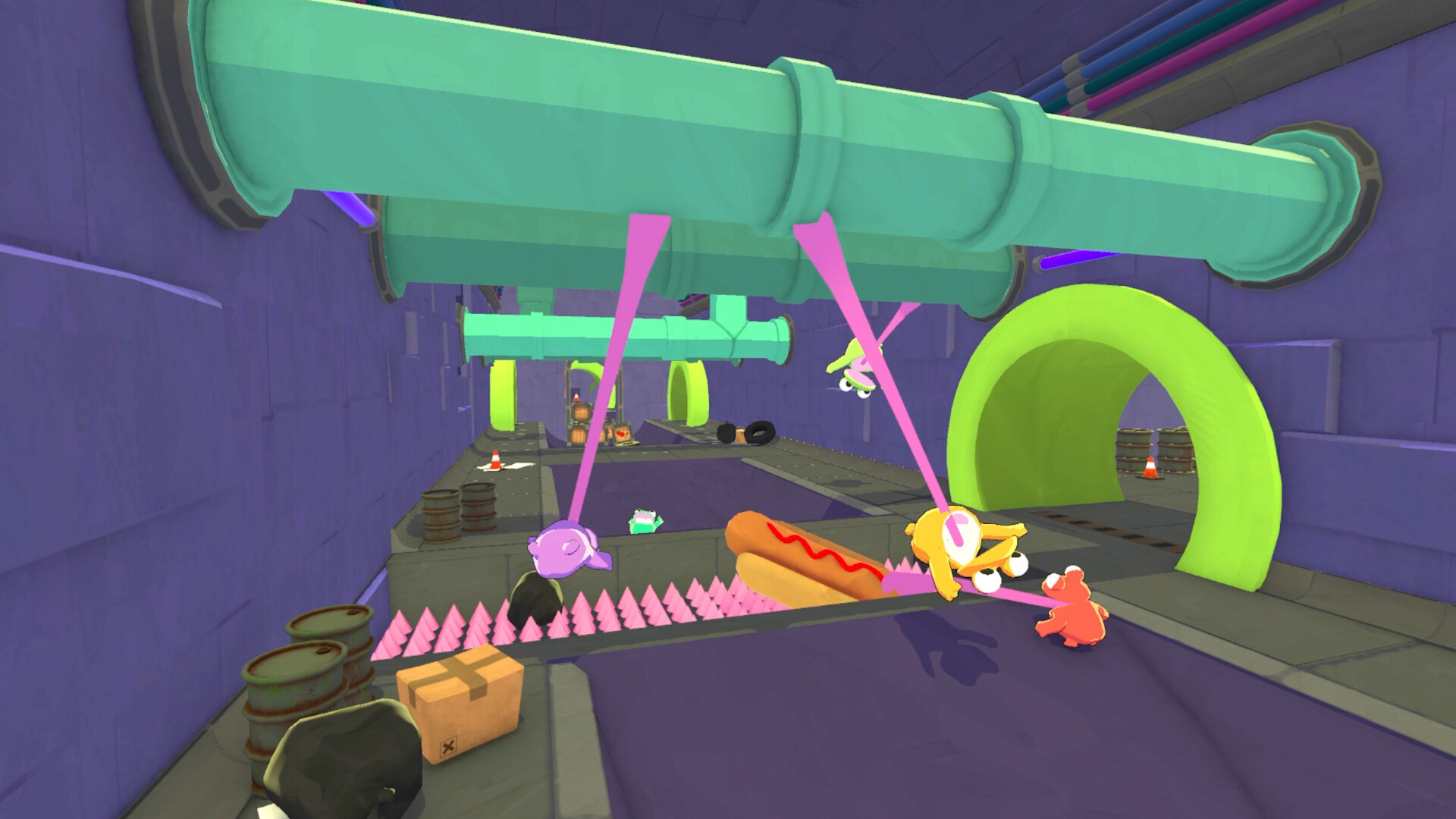
- Environmental Hazards: The levels are littered with hazards that serve as "run-killers." Toxic ooze acts as a death sentence for any frog unlucky enough to touch it, while predatory slime monsters roam the maps looking for a snack.
- Puzzles and Utility: Navigation is not just about jumping; it is about problem-solving. Scattered throughout each level are buttons and levers that trigger environmental shifts, such as moving platforms or barriers, which are essential for navigating the more complex, food-rich areas.
- The Scale of Play: While the game supports solo play, the data suggests that the intended "sweet spot" for gameplay is the 4-to-8 player range. In these high-density sessions, the screen becomes a tapestry of sticky tongues and colliding frogs, creating a chaotic "party game" atmosphere that mirrors the success of titles like Overcooked or Human: Fall Flat.
Official Perspectives and Critical Reception
The reception of Frog Sqwad has been largely defined by its distinct "personality." Critics and players alike have praised the visual design—which leans into a bright, cartoonish aesthetic—and the game’s commitment to its absurd premise.
When discussing the movement physics, lead designers have often pointed to the "floatiness" as a feature rather than a bug. By removing the rigid, gravity-heavy controls of standard platformers, the team forces players to rethink their approach to jumps and momentum. It is not a game about precise, pixel-perfect movement; it is a game about managing chaos.
In a recent interview, early playtesters noted that while the movement can feel disorienting at first, it creates a "force multiplier" effect when playing with friends. If one player is struggling to navigate a platform, a teammate can often act as a tether, using their tongue to assist in a maneuver or clear a path. This collaborative dependency is what elevates Frog Sqwad from a simple platformer to a legitimate social experience.
The Implications: Why Party Games Are Evolving
Frog Sqwad represents a broader trend in the indie gaming sphere: the "high-friction cooperative" genre. Unlike traditional multiplayer games that focus on competition, these games introduce mechanics that are intentionally difficult to control, creating humor through failure.
The Rise of "Physics-Based Comedy"
The industry has seen a massive surge in titles where the player’s inability to perfectly control their character is the main source of entertainment. By making the frogs in Frog Sqwad feel slightly unmoored from reality, the developers ensure that even a simple task—like carrying a fry to a bowl—becomes a hilarious ordeal. This design philosophy acknowledges that players are often looking for a shared laugh rather than a strictly competitive challenge.
Accessibility vs. Mastery
One of the most interesting implications of Frog Sqwad is how it handles skill floors and ceilings. The skill floor is low enough that anyone can pick up a controller and start pulling items with their tongue. However, the skill ceiling is surprisingly high. Mastering the arc of a jump, understanding how to use your tongue to swing around corners, and knowing when to grow into a "giant ball" to break walls requires significant time and coordination. This dichotomy ensures the game remains accessible for casual parties while offering depth for dedicated groups of friends.
Final Verdict: Is It Worth the Leap?
For those looking for a new title to break out during a game night, Frog Sqwad offers a refreshing, albeit sometimes infuriating, experience. Its strengths lie in its commitment to its theme: it never tries to be a serious platformer, and it never tries to hide the chaos of its physics engine.
The game is a testament to the fact that you don’t need complex narratives or photorealistic graphics to keep players engaged. Sometimes, all you need is a sticky tongue, a giant egg, and seven friends shouting at each other to get the food into the bowl before the Swamp King loses his temper.
As the indie market continues to become more saturated, games like Frog Sqwad serve as a reminder that the "party" in "party game" is the most important element. It is a title that thrives on communication, coordination, and the ability to laugh at yourself when you accidentally jump your team’s hard-earned burger into a pit of toxic ooze.
If you are prepared to embrace the chaos and have a few friends who are just as clumsy as you are, Frog Sqwad is available now on Steam. Whether you master the art of the tongue or spend the entire session bumping into walls, one thing is certain: the Swamp King will be waiting, and he is very, very hungry.
Summary of Key Features
- Genre: Cooperative physics-based party game.
- Player Count: Supports solo play up to 8-player cooperative multiplayer.
- Core Mechanic: Use sticky tongues to grab food items and deposit them into the Swamp King’s bowl.
- Progression: Procedurally generated levels, growth mechanics (eating food to become a giant ball), and environmental puzzles.
- Availability: Available now via the Steam storefront.


 Reynand Wu
 Nila Kartika Wati