

In the high-stakes arena of 2026 hardware, the landscape for artificial intelligence development has become increasingly bifurcated. At the pinnacle of performance sits Nvidia’s RTX 5090—a titan of silicon engineering boasting 21,760 CUDA cores and 32GB of cutting-edge GDDR7 memory. Yet, for the average developer, researcher, or AI enthusiast, this flagship card has become a symbol of both immense power and exclusionary pricing. With street prices often ballooning to double its $2,000 MSRP, the "consumer-grade" RTX 5090 is increasingly out of reach, forcing a desperate scramble for older, memory-rich alternatives like the RTX 4090, 3090 Ti, or 3090.
Amidst this hardware scarcity and the escalating memory requirements of modern large language models (LLMs), a surprising contender has emerged from the shadows: Intel’s Arc Pro B70. While the industry fixates on the high-end duopoly, the B70 is quietly positioning itself as the most practical solution for those whose primary concern is "VRAM per dollar" rather than raw, top-tier compute performance.
The State of the Market: A DRAM Crisis
The "DRAM crisis" in the local AI space is not merely a supply chain failure; it is a fundamental mismatch between the demands of modern AI models and the affordability of high-bandwidth hardware. As parameter counts in LLMs climb, the bottleneck for local inference is almost always the amount of accessible VRAM.
When a model cannot fit entirely into the GPU’s memory, performance craters. Consequently, builders are forced to choose between the prohibitively expensive enterprise-grade cards or settling for aging hardware that lacks the latest architectural optimizations. Into this vacuum steps Intel, a company traditionally associated with CPU dominance, now attempting to carve out a permanent niche in the workstation and AI-inference market with the "Battlemage" architecture.
Chronology of a Challenger: From B770 to B70
The path to the Arc Pro B70 was not linear. Initially, industry analysts and enthusiasts were abuzz with rumors regarding the Arc B770, a GPU intended to compete in the mid-range gaming segment. However, strategic pivots within Intel’s graphics division led to the cancellation of the B770 as a consumer-facing product.
Instead, the underlying silicon—the BMG-G31 "Big Battlemage" chip—was repurposed for the professional-leaning Arc Pro B70. This transition marked a significant shift in Intel’s strategy: rather than fighting for scraps in the saturated gaming market, Intel opted to address the "AI-workstation" vacuum. By stripping away the bells and whistles required for a "gamer" card and focusing on stable, high-capacity VRAM configurations, Intel effectively bypassed the price-gouging cycles that currently plague Nvidia’s enthusiast offerings.
Supporting Data: Performance and Capacity
The technical merit of the Arc Pro B70 lies in its deliberate design philosophy. Priced at a reference point of $950—a fraction of the real-world cost of a 5090—the card offers a robust 32GB of GDDR6 memory.
Recent stress testing conducted by industry experts at Puget Systems provides a clear, data-driven comparison. When configured in a four-card array, the B70 setup demonstrates remarkable utility. While the RTX 5090 remains superior in pure compute tasks—boasting a massive memory bandwidth of 1792 GB/s compared to the B70’s 608 GB/s—the comparison shifts when considering specific deployment scenarios.
For AI inference, where memory capacity is the primary constraint, a multi-B70 configuration offers a lower cost-of-entry and higher total VRAM capacity than a single or even dual-GPU 5090 setup. In decode-heavy tasks, the disparity is evident, but for developers working with large models that require high parameter storage, the B70 is a triumph of efficiency over sheer horsepower.
Software Ecosystem: The Final Frontier
Despite the hardware’s impressive specifications, the "Nvidia Tax"—the premium paid for the superior CUDA software ecosystem—remains the greatest barrier to Intel’s adoption.
Nvidia has spent over a decade perfecting a software stack that is virtually plug-and-play for researchers. Intel’s ecosystem, centered around oneAPI, OpenVINO, and IPEX (Intel Extension for PyTorch), is improving at a rapid pace but remains fundamentally disconnected from the CUDA-native workflows that dominate the industry. Even AMD’s ROCm stack, which has seen massive investment, is still considered a "second-tier" option in terms of ease-of-use and library compatibility.
For an AI developer, choosing Intel means committing to a more rigorous, experimental workflow. It requires manual optimization and, in many cases, rewriting or porting code that is hard-coded for Nvidia libraries. While this is not an issue for large-scale enterprise deployments with dedicated DevOps teams, it is a significant deterrent for individual developers or small startups.
Official Responses and Strategic Implications
Intel’s messaging surrounding the Arc Pro B70 has been focused on "Professionalism" and "Value." By distancing the B70 from gaming marketing, Intel is signaling to the market that they are not interested in fighting Nvidia in frame-rate benchmarks. Instead, they are targeting the professional user who needs to run inference locally—whether for chatbots, coding assistants, or data analysis—without spending the equivalent of a used car on a single GPU.
Industry analysts suggest that Intel’s strategy is a long game. By filling the mid-range professional void, Intel is building an install base that, while currently limited by software compatibility, is becoming increasingly familiar with the Intel graphics architecture. If the company continues to refine its software stack, it could eventually pose a legitimate threat to Nvidia’s dominance, particularly if the "AI bubble" forces smaller companies to seek more cost-effective hardware solutions.
The Verdict: Who is the B70 For?
The Arc Pro B70 is not a "Nvidia Killer." It does not have the raw compute power of an RTX 5090, nor does it have the plug-and-play ease of the CUDA ecosystem. However, it is the only card in its price bracket that offers a substantial 32GB of VRAM in a modern architecture.
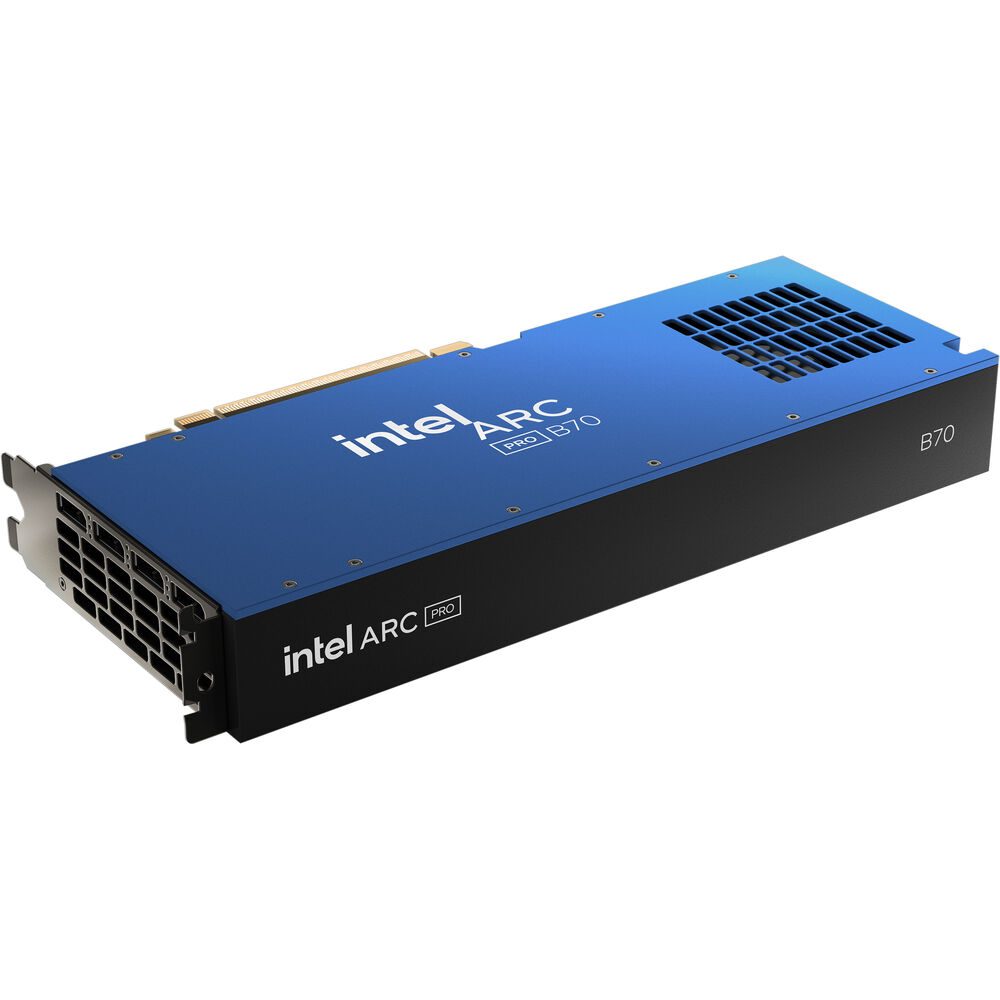
For the cost-sensitive AI builder, the decision boils down to a simple trade-off: time versus money. If you have the budget, the RTX 5090 remains the gold standard for performance and software support. But if you are a developer looking to maximize your memory capacity to train or run larger models without the exorbitant cost of high-end consumer cards, the Intel Arc Pro B70 is not just a viable alternative—it is the most logical choice in a market that has largely forgotten the value of the mid-range.
As 2026 progresses, the success of the Arc Pro B70 will likely serve as a barometer for how much the AI community values affordability over brand-name software dominance. If developers continue to flock to the B70, it may force Nvidia to reconsider its pricing strategy, or at the very least, it will provide a necessary competitive pressure that keeps the GPU market from becoming a playground solely for the wealthy.
For now, Intel has successfully identified a gap in the market, providing a high-VRAM workstation card that bridges the divide between entry-level hobbyist hardware and unattainable enterprise equipment. It is an imperfect, bold, and necessary piece of hardware that proves there is still room for competition in the age of AI.











