The traditional social media marketing funnel—that tidy, inverted triangle of awareness, consideration, and conversion—is buckling under the weight of modern consumer behavior. For decades, marketers operated under the assumption that a customer journey was a predictable, linear path: a user sees an ad, clicks a link, visits a landing page, and completes a purchase.
But in 2026, the path to purchase is less of a straight line and more of a chaotic, multi-channel web. Today, a customer might see a product on a creator’s feed, search for the brand on TikTok, pivot to a Reddit thread to verify the claims, and finally ask an AI assistant for a side-by-side comparison. They may abandon the process for three weeks, only to finalize the purchase after a peer drops a referral link in a private group chat.
As this behavior evolves, the old model of "capturing" leads has become increasingly ineffective. In response, industry leaders are shifting toward a more dynamic, sustainable framework: The Proof of Reality Flywheel.

The Evolution of the Consumer Journey
The transition from a funnel to a flywheel isn’t just a change in jargon; it is a fundamental acknowledgment that trust has become the scarcest resource in the digital economy.
A Chronology of Declining Linearity
- The Early 2010s: The "Click-to-Convert" era. Brands controlled the narrative, and consumers followed predictable paths from display ads to e-commerce checkouts.
- The Mid-2020s: The Rise of Fragmented Discovery. Social media began competing with traditional search engines. Consumers started using platforms like TikTok and Reddit as their primary research engines.
- The Current Landscape: The AI-Mediated Journey. With AI-generated content flooding feeds, consumers are hyper-alert to "corporate" messaging. Trust is now earned through peer validation, community sentiment, and human-verified expertise.
The Broken Funnel: Why Old Tactics Fail
The traditional funnel was designed for a world where brands held the microphone. Today, that microphone is shared with millions of creators, AI bots, and skeptical community moderators.
The Fragmentation of Discovery
According to Sprout Social’s Q2 2026 Pulse Survey, the dominance of traditional search engines is waning. While Google remains a starting point for many, 21% of all searches—across every age demographic—now originate on social media platforms. For younger consumers, this percentage is significantly higher. If a brand builds its marketing funnel solely around traditional SEO keyword targeting, it is effectively invisible to a massive segment of the population that begins their journey in a social feed.
The Trust Deficit and AI Saturation
The saturation of AI-generated content has created a "authenticity tax" on brands. With 83% of consumers encountering AI-generated content on social media, the ability to distinguish between a genuine recommendation and a generic, automated ad has become a core consumer skill. Polished, corporate-approved creative is increasingly ignored. Audiences are now looking for "Proof of Reality"—evidence that actual humans are using, liking, and criticizing a product.
The "Dark Social" Problem
Perhaps the most significant challenge to the traditional funnel is "Dark Social"—the private channels like WhatsApp, Slack, and Discord where most real product discussions happen. Because these interactions are invisible to public metrics, brands often believe a lead came from a last-click ad, when in reality, the conversion was the result of a week-long conversation in a private group chat.
The Proof of Reality Flywheel: A New Framework
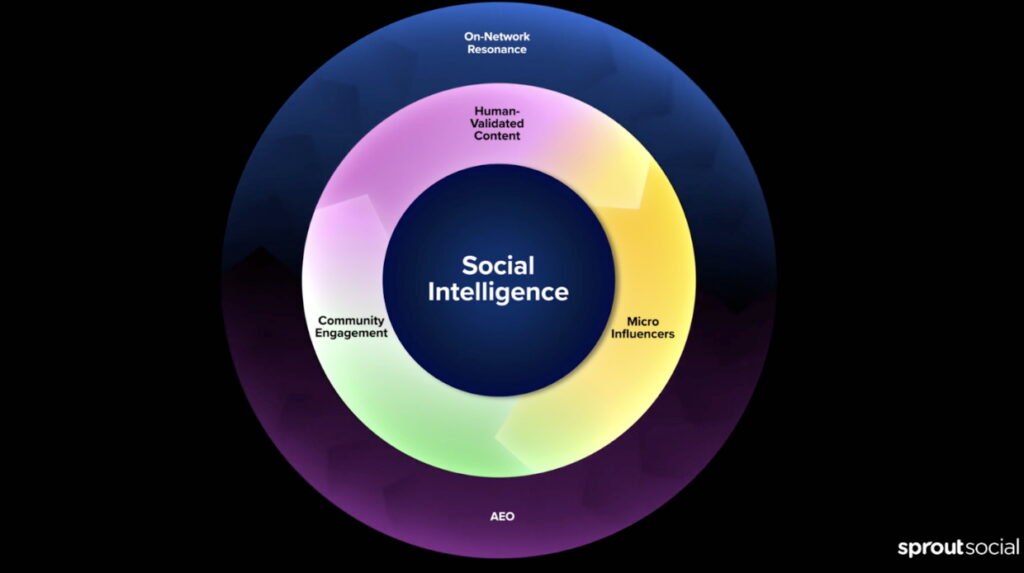
Sprout Social’s "Proof of Reality Flywheel" replaces the linear, one-way funnel with a circular, self-sustaining system. It is built on three pillars: Social Intelligence, Human-Validated Content, and Influence Networks.

1. Social Intelligence: The Engine Room
In the old model, strategy began with brand priorities. In the flywheel, it begins with social listening. By analyzing audience sentiment, competitive activity, and shifting market trends, brands can identify the exact questions their customers are asking. This turns the process on its head: instead of creating content and hoping for an audience, brands create content to answer an existing demand.
2. Human-Validated Content
Content that feels automated is content that gets skipped. The flywheel prioritizes "Human-Validated" assets—behind-the-scenes footage, authentic tutorials, and community-driven resources. This content is not just designed to go viral; it is designed to build authority that AI answer engines (like ChatGPT or Google’s AI Overviews) can cite as a credible source of information.
3. Influence Networks
The flywheel moves beyond the "brand-to-consumer" dynamic by leveraging niche communities and micro-influencers. These networks provide the social proof that a potential buyer needs to move from consideration to purchase. When a trusted creator or a Reddit community endorses a product, it acts as a shortcut through the traditional middle-of-the-funnel friction.
Implications for Modern Business
Adopting the flywheel model requires a structural overhaul of how marketing teams operate.
Cross-Functional Collaboration
Data from the 2026 Social Intelligence Report suggests that while 98% of professionals agree that social data helps achieve business outcomes, only 36% actually integrate this data across the organization. The flywheel requires marketing, product, and customer care teams to share the same insights. For example, if the marketing team spots a recurring complaint in the Reddit community, that insight should immediately inform the product team’s development roadmap.
The Shift to AEO (Answer Engine Optimization)
As AI tools increasingly curate the internet for users, brands must optimize for "Answer Engines." This means moving away from keyword stuffing and toward providing clear, direct answers to common user queries. By aligning content with how humans actually talk and ask questions, brands increase their chances of being surfaced by AI in the consideration phase.

Measuring What Matters
Traditional KPIs like "clicks" and "impressions" are no longer sufficient. To measure the flywheel effectively, teams must track:
- Community Sentiment: How are people talking about us when we aren’t in the room?
- Share of Voice in Niche Communities: Are we a leader in the forums where our customers actually spend time?
- AI Citations: Are we appearing in the summarized responses of AI tools?
- Engagement Velocity: How quickly does our content move from an owned channel into a community conversation?
Conclusion: Turning Attention into a Renewable Resource
The traditional funnel treats attention as a finite, depleting resource—a commodity to be captured and discarded. The Proof of Reality Flywheel views attention as a renewable resource that compounds over time.
Every share, every save, and every authentic comment serves as fuel for the next cycle. By grounding every action in social intelligence and validating it through human connection, brands can create a flywheel that not only grows visibility but builds a moat of trust that competitors cannot easily cross.

In a world where consumers are increasingly skeptical of everything they see, the most effective marketing strategy is no longer to broadcast a message—it is to prove that your brand is worthy of the conversation.