Rifan Muazin
In the quiet landscape of Bloomington, Indiana, artist Caleb Weintraub is engaged in a radical reimagining of the painted surface. Moving beyond the traditional two-dimensional confines of the canvas, Weintraub creates elaborate, highly saturated scenes that occupy a precarious middle ground between painting and sculpture. His work is a collision of the classical and the carnivalesque, a visual language that speaks in the tongues of action cinema, devotional iconography, and historical allegory.
Main Facts: The Architecture of the Painted Relief
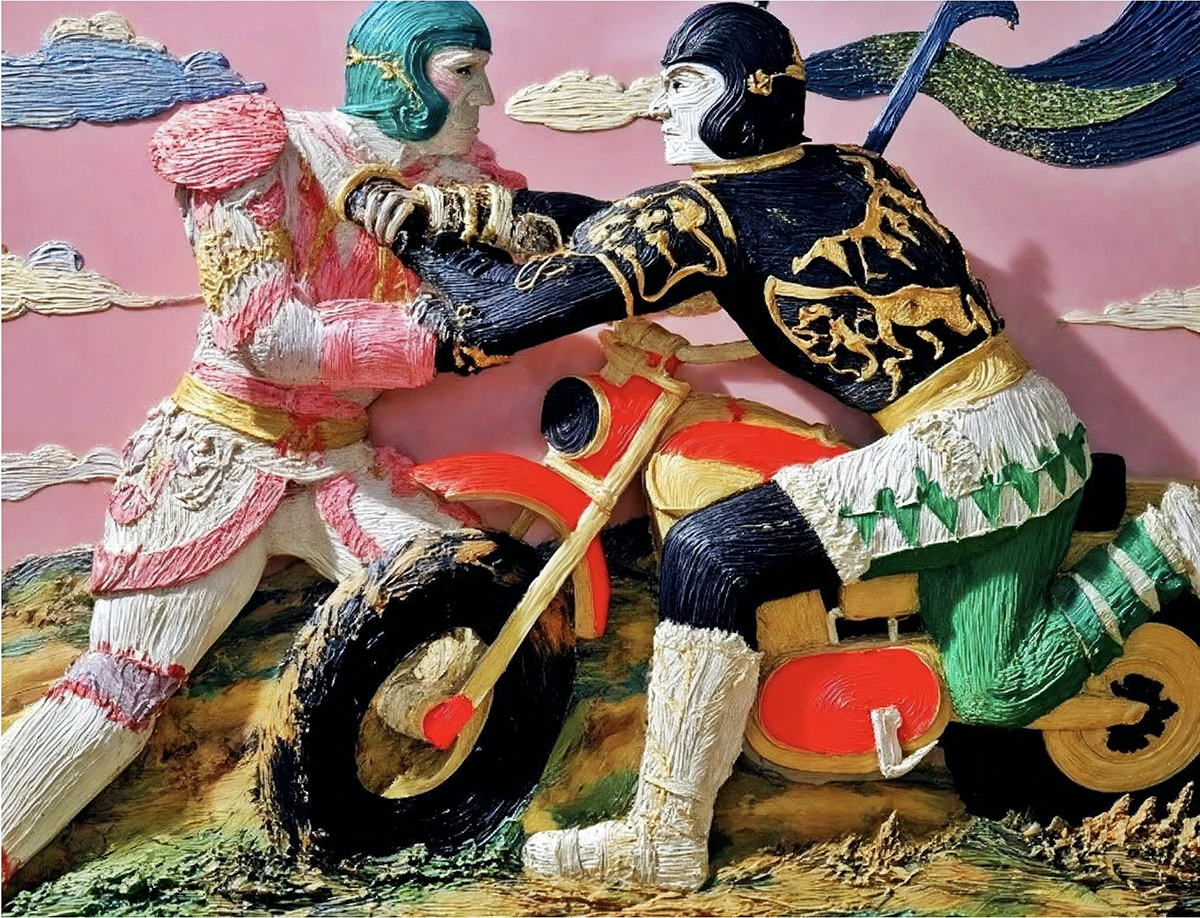
Weintraub’s practice is defined by a rigorous material experimentation. Holding a BFA from Boston University and an MFA from the University of Pennsylvania, he has developed a unique vocabulary that utilizes oil, acrylic, epoxy clay, aqua-resin, and foam applied to shaped panels. The result is a series of works that possess an exaggerated sense of relief, where paint is not merely applied to a surface but cast into real and artificial shadows.
These paintings do not merely depict subjects; they encroach upon the viewer’s physical space. By manipulating depth, Weintraub creates a tactile experience where the imagery feels as though it is pushing outward, demanding a confrontation. His work functions as a physical manifestation of memory and cultural inheritance, rendering the anachronistic in a way that feels simultaneously ancient and startlingly immediate.
Chronology: The Evolution of a Multi-Disciplinary Practice
The trajectory of Caleb Weintraub’s career reflects a persistent curiosity regarding the boundaries of the art object.
- Formative Years: Weintraub’s academic foundation at Boston University and the University of Pennsylvania provided him with the rigorous technical grounding necessary to master traditional oil and acrylic techniques.
- The Shift to Relief: Early in his professional career, the limitations of the flat canvas became a point of inquiry. Weintraub began experimenting with structural additions—foam and resin—that allowed his narratives to break the rectangular plane.
- The Integration of Salvage: As his practice matured, Weintraub introduced the concept of the "reliquary" into his studio process. He began harvesting scraps from abandoned palettes and sections of earlier, discarded paintings, cutting them away and recombining them into new compositions. This act of recycling serves as a bridge between the artist’s history and his current production.
- Recent Developments: In his most recent cycles, Weintraub has fully embraced the "carnivalesque," blending disparate symbols—motorcycles, heraldic armor, leather jackets, and chainsaws—into a cohesive, if disruptive, visual narrative.
Supporting Data: Symbols, Motifs, and the Anatomy of the Work
Weintraub’s imagery is characterized by a deliberate disorder. As the artist notes, "The symbols arrive out of order." This lack of linear chronology is central to the viewer’s experience. By juxtaposing a martyr’s pose with the mechanical grit of a chainsaw, or placing a motorcycle gang at a holiday dinner, Weintraub highlights the "clumsy" nature of our cultural inheritance.
The Iconography of the "Throttle and Fang"
The recurring motifs in Weintraub’s work serve as psychological markers:
- The Motorcycle and the Horse: Often presented as interchangeable, these symbols represent movement, escape, and the nomadic search for selfhood.
- The Animal Messengers: Birds and snakes populate the rubble of his compositions, serving as omens, witnesses, and catalysts for action.
- The Architectural Disruption: Figures in his works frequently move through mountain divides or desert plains, arriving in environments that appear identical yet are "slightly disrupted and askew." This suggests a commentary on the recursive nature of human experience.
The Titling Strategy
Weintraub’s titles function as a bridge between high and low culture. By mixing sports commentary (Clutch Decision), action cinema, and devotional religious language (Parry Parry Pray, In Good Faith), he forces a reconciliation of disparate value systems. In his universe, a throttle, a fang, and a feather are all instruments used to close the distance between the figure and their desire.
Official Perspectives: The Artist’s Philosophy
In describing his process, Weintraub emphasizes the role of the body and the weight of history. The figures in his paintings are constantly reaching for force, ceremony, or protection—themes that are transmitted through the clothes they wear, their tattoos, and their posture.

"The inheritance is clumsy," Weintraub explains. This sentiment is the core of his artistic inquiry. We move through the world carrying the weight of past symbols, trying to integrate the leather jacket with the heraldic armor, the motorcycle with the horse. By externalizing these internal conflicts through sculpture-paint hybrids, Weintraub suggests that our identities are not fixed, but are constantly being re-sculpted by the remnants of our past.
Implications: The Future of Narrative Painting
The implications of Weintraub’s work reach beyond the gallery walls. He is part of a growing movement of contemporary artists who are challenging the "purity" of the medium. By incorporating epoxy clay and aqua-resin, he validates the idea that painting is not a static tradition, but a dynamic, evolving process that can encompass sculpture, craft, and assembly.
Furthermore, his work addresses the modern condition of information overload. By presenting symbols "out of order," he mirrors the fragmented way in which the contemporary observer consumes history and culture. His paintings do not offer a solution or a moral lesson; rather, they offer a space for the viewer to navigate the wreckage of symbols, allowing them to find their own meaning within the "flock and awe" of his saturated, textured worlds.
The Broader Impact on the Bloomington Art Scene
As an artist based in Bloomington, Weintraub contributes to a regional identity that is increasingly connected to national and international dialogues. His presence in the Midwest serves as a reminder that profound, boundary-pushing work is not confined to the major coastal hubs. By maintaining a studio-centric practice, he fosters a sense of artistic permanence that is often lost in the rapid turnover of the global art market.
Conclusion: Closing the Distance
Caleb Weintraub’s paintings are acts of "closing distance"—between the classical and the contemporary, between the physical object and the metaphorical narrative, and between the artist and the viewer. His work acts as a mirror, reflecting our own clumsy inheritance of symbols back at us with an energy that is as beautiful as it is unsettling.
Whether it is a marauder quietly watering a houseplant or a martyr holding a chainsaw, Weintraub invites us to see the absurdity of our own existence. His commitment to materiality ensures that these scenes are not just seen, but felt—a tactile experience that lingers long after the viewer has left the presence of the work. As we look toward the future of narrative art, Weintraub’s sculpted, shadow-cast world stands as a testament to the enduring power of the painted image to evolve, disrupt, and define the human condition.


 Neng Nana
 Asro
Asro