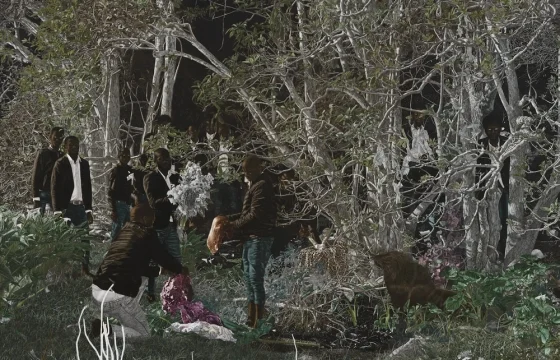
In the hushed, cavernous spaces of contemporary art, few practitioners command the existential gravity of South African artist Cinga Samson. His latest exhibition, Ukuphuthelwa, is not merely a collection of oil paintings; it is a profound meditation on the boundaries of perception and the inadequacy of the visual sign. Currently on view through April 18, 2026, the series invites viewers into a nocturnal world rendered in a palette of near-blacks, carbon, and deep Prussian blues—a visual language that challenges the traditional viewer-object relationship.
The Semantic Depth of ‘Ukuphuthelwa’
The title of the exhibition, Ukuphuthelwa, is derived from the artist’s native isiXhosa. While it translates broadly to "unable to sleep," the term shares none of the clinical or pathological weight of the English "insomnia." For Samson, this state is not a deficiency to be corrected, but a heightened spiritual condition. It represents an aperture—a state of intense alertness that flourishes in the darkness.
By framing sleeplessness as a form of sensitivity rather than a disorder, Samson sets the stage for a series of works that demand slow, contemplative looking. The paintings depict figures, dogs in overgrown fields, and native South African flora, all submerged in an atmosphere that feels simultaneously ancient and perpetually in motion. The artist’s primary quandary is perhaps the most difficult challenge in contemporary art: how to produce a painting that is "true and honest" when the medium itself is inherently symbolic.
Chronology and Evolution: A Trajectory of Mystery
Samson’s artistic trajectory has long been defined by his ability to imbue the quotidian with an unexplained mystery. His 2026 series continues this exploration, refining a technique he has been perfecting for years: the manipulation of light as a "magic trick."
- Early Development: Samson began his career by exploring the tension between the figure and the landscape, often utilizing dark, moody palettes that hinted at the unseen.
- Refinement of Technique (2020–2024): The artist moved toward more complex, ritualistic compositions, experimenting with the "occluded palette" that would become his hallmark.
- The Current Series (2026): In Ukuphuthelwa, the "trick" of painting becomes explicit. Samson leaves large sections of under-drawing visible, creating moments of transparency that destabilize the viewer’s perception. By applying and wiping back glazes, he creates a brooding chromatic density that gives his figures a spectral, porous quality.
Supporting Data: The Anatomy of the Image
The technical mastery displayed in the 2026 works is undeniable, yet it serves a purpose that transcends aesthetic pleasure. Samson utilizes several distinct devices to maintain the instability of his subjects:
The Pupil-less Gaze
In all of Samson’s new figures, the pupils of the eyes are left unpainted. This is not merely a stylistic choice; it is a rejection of personification. By denying his figures a specific "gaze," Samson prevents the viewer from establishing a traditional psychological connection. These figures are not looking outward at the world; they are enmeshed within it. They exist as "human forms" that share the same atmospheric space as the bowing foliage and the night sky.
The Instability of Symbolism
Samson argues that there is an unbridgeable gulf between a painted sign and the reality it gestures toward. He uses the figure of the dog—a recurring motif—to demonstrate this. In Intsingiselo II (2026), the dog might be interpreted through a Western lens as a symbol of loyalty. However, within an amaXhosa context, the animal serves as a guide or a protective ancestral spirit. This dissonance is intentional. It forces the viewer to acknowledge that any interpretation is relative, and that the image can never be the equivalent of the truth it attempts to reflect.
Official Perspectives: The Artist’s Stance
In discussions surrounding the exhibition, Samson has been explicit about his role as a mediator between the known and the unknown. He views his works as "openings."
"The ritual itself is not the important thing," Samson noted regarding pieces like Umlindo (Watcher) (2026), which depicts figures gathered in a forest with flowers and fabric. "It’s an opening to what exists beyond."
For Samson, the aesthetics of ritual are tools for collective orientation. He posits that in a world where language often fails us, ritual—and by extension, art—acts as a bridge to a "vast unknown." He notes that his use of isiXhosa titles, such as Imfihlo (Secret) and Intsingiselo (Meaning), is a direct nod to the instability of language. These words carry a weight in his native tongue that English translations fail to capture, highlighting the slippage of meaning that occurs in the interstice between cultures.
Implications: The Sublime and the Divine
The implications of Ukuphuthelwa reach far beyond the gallery walls. By tackling the dilemma of representation, Samson is asking a fundamental question about the role of the artist in the 21st century.
The Aesthetics of the Sublime
Works such as Tshee (2026) and Sithini ngelilitye (2026) utilize the sublime—that terrifying, majestic sense of enormity. In Tshee, the void of the night is punctured by a moon-washed cloud. Samson’s ability to render this "brilliant white" against the "murky sky" creates an optical tension that is both physical and psychical. It speaks to the oscillation between the approachable and the overwhelming—a feeling that the sky is both a friendly companion and a frightening, heavy force.
The Divine in the Vernacular
Ultimately, Samson’s work seeks to reclaim the authority of the unnameable. He rejects the idea that the divine is a distant entity, preferring to find it in the "vernacular of all things." His paintings, with their forensic detail and haunting atmosphere, serve as a testament to the idea that magic is immanent.
By pulling back the curtain on his own process—leaving the under-drawing exposed and using the "trick" of light to animate his scenes—Samson is not stripping the mystery from his work. Instead, he is inviting the viewer into a state of hypersensitivity. He posits that if one looks closely enough, the ordinary—a bird in flight, a rocky crag, or a blade of grass—becomes a conduit for the sublime.
Conclusion: A Link to Everything
Cinga Samson’s Ukuphuthelwa is a triumph of conceptual and technical rigor. It provides a sanctuary for those who are willing to sit with the discomfort of the unknowable. In a time when the world is saturated with images that claim to provide answers, Samson’s paintings have the courage to ask questions.
They do not aim for individual transcendence, but for a shared, worldly understanding. As the exhibition continues its run through April 2026, it stands as a reminder that the most honest art is not that which captures the world in perfect detail, but that which acknowledges the limits of the frame. In the dark, nocturnal landscapes of his canvases, Samson has succeeded in creating "a thing that links us to God"—or, as he clarifies, "by God, I mean everything."
Through this series, the artist has proven that even in the absence of absolute truth, there is profound wonder to be found in the attempt to represent the unrepresentable. Whether viewed as a critique of colonial representation or as a deeply personal spiritual journey, Ukuphuthelwa remains one of the most significant artistic achievements of the decade.