In the quiet, meticulous workspace of San Antonio-based artist Jason Limon, the boundary between the superficial world of vintage ephemera and the profound reality of the skeletal frame is being systematically dismantled. Limon, an artist whose career has been defined by his exploration of the "otherworldly," has recently pivoted toward a sophisticated form of trompe l’oeil—a French term for "deceive the eye"—that challenges the viewer to look past the colorful, nostalgic veneer of advertisements and biological illustrations to find a complex, three-dimensional narrative unfolding beneath.
Main Facts: The Intersection of Nostalgia and Mortality
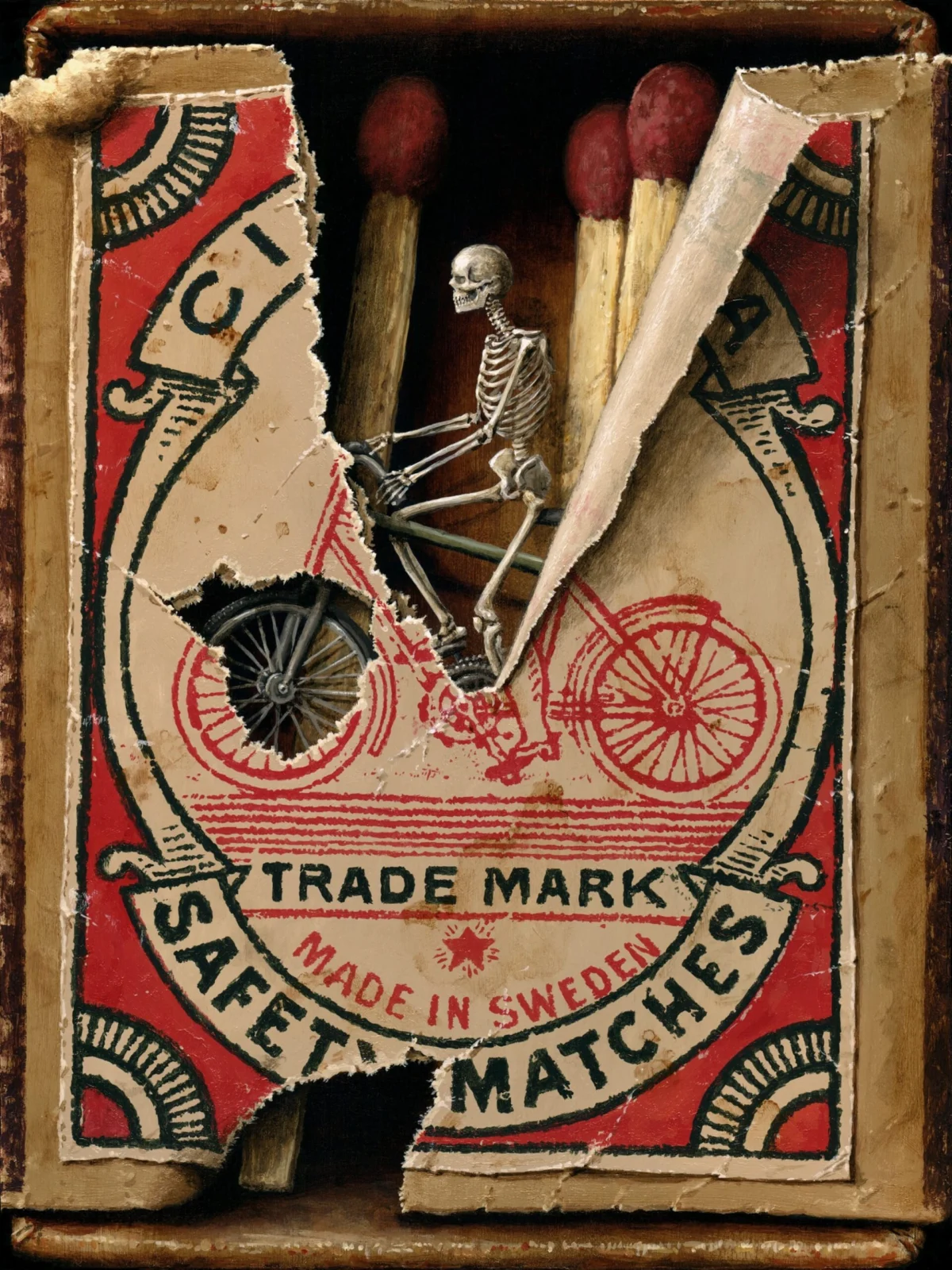
At the core of Limon’s latest series is a conceptual duality. He takes the familiar—the weathered cardboard of a matchbox, the vintage aesthetic of a classic advertisement, or the sterile precision of an old-world biological chart—and renders them with startling realism. However, the true narrative lies in the "damage." By painting these objects as if they are torn, ripped, or peeling, Limon creates a window into an alternate dimension.

In this hidden space, he places skeletons. These are not the macabre, menacing figures often associated with death in Western art. Instead, Limon’s skeletons are anonymous, playful, and deeply human in their posture. They are entities stripped of their societal identities, existing in a state of eternal, silent performance. Whether it is a tiny skeletal cyclist emerging from the confines of a matchbox or a skeletal figure performing circus feats, Limon’s work acts as a bridge between the vibrant aesthetic of the past and the universal, inevitable nature of the end.
Chronology: The Evolution of a Macabre Vision
Limon’s artistic trajectory has always leaned toward the uncanny, but the journey to his current trompe l’oeil mastery was a gradual evolution.

- The Early Period: Initially, Limon’s work focused on surreal, dark fantasy scenes that leaned heavily into dark, moody color palettes. His subjects were often creatures of his own invention, existing in environments that felt disconnected from the terrestrial world.
- The Introduction of the Anonymous Figure: Over the last decade, Limon began to shift his focus toward the skeleton as a primary subject. By removing the individualizing features—hair, skin, clothing—he discovered that the skeleton became a universal vessel for emotion. This allowed him to tap into deeper, more resonant themes of the human experience.
- The Shift to Illusion: Within the last few years, the "torn paper" technique became the centerpiece of his practice. Recognizing that the physical act of painting "backgrounds" provided a unique challenge, Limon began to integrate the illusion of surface damage. This technique was not merely a stylistic choice; it was a conceptual necessity, allowing him to hide his subjects behind the familiar before revealing them with a sense of discovery.
- The Present Day: His most recent works, including pieces like Matchbook Tiger and Circus Clown, represent a refined synthesis of these techniques. He has successfully slowed his creative pace, allowing for a more deliberate interaction between the surface layer and the subject hidden beneath.
Supporting Data: Techniques and Materiality
The technical prowess required to execute these works is substantial. Limon employs a hybrid approach, blending the fast-drying, vibrant nature of acrylics with the long-working, luminous properties of oils. This combination is critical to his trompe l’oeil effect.
- Texture and Depth: To achieve the "torn" look, Limon must master the shadow and light on the edges of the simulated paper. The highlights on the curled edges of the "torn" sections are essential for tricking the eye into believing the painting has physical depth.
- Scale and Scope: Ranging from intimate 8×8 inch pieces like Seen to larger 11×14 inch works such as Perle des Indes, the variety in size serves a specific purpose. Smaller works emphasize the feeling of a secret discovery, while larger works allow for more complex interactions, such as the skeletal figure reaching out toward a human, as seen in Brunette.
- Materiality: The choice of subject matter—matchboxes, vintage advertisements—is intentional. By using these as his "facade," Limon plays on the viewer’s nostalgia. When the viewer realizes that the "vintage illustration" is merely a shroud for a skeleton, the cognitive dissonance creates a powerful, lingering emotional response.
Official Responses and Artistic Philosophy
When asked about the evolution of his style, Limon speaks with a measured, reflective tone that mirrors his recent decision to "press the brakes" on his creative process.

"It took a bit to press the brakes on how I work," Limon notes. "I intentionally decided to slow the pace of how I create the art while also trying to keep a little bit of playfulness. As I play with painting in the background, it has taught me to loosen up in a variety of ways. At some point in the future, the two identities—the surface and the skeleton—will creatively and visually merge as one."
This philosophy of "slowing down" is central to his current success. By refusing to rush the transition between the mundane surface and the metaphysical subject, he allows the viewer to engage with the art as a narrative, rather than a singular image. His work is no longer just about the skeleton; it is about the process of uncovering that skeleton, a metaphor for the way time eventually peels away the layers of our own lives.

Implications: The Universal Symbolism of the Bony
The implications of Limon’s work reach beyond the gallery walls and the digital storefronts where his prints are sold. In an era where digital content is often consumed in milliseconds, Limon’s work demands a pause. It is a commentary on the transience of consumerism—represented by the matchboxes and advertisements—and the permanence of the skeletal form.
Cultural Significance
Limon’s work sits comfortably within a tradition of memento mori, a genre of art that reminds viewers of their mortality. However, his "cheeky" approach prevents the work from becoming morbid. By placing skeletons in circus acts or mundane domestic scenarios, he effectively "de-stigmatizes" the image of death. The skeleton is not a sign of fear, but a companion in the human experience.

Market and Accessibility
Limon’s commitment to making his work accessible through his online shop and his transparent engagement with his audience on platforms like Instagram has created a loyal following. By offering both original works and high-quality prints, he ensures that his exploration of the uncanny is not restricted to the elite art market, but is instead shared with a broad demographic that appreciates the intersection of classic technique and modern surrealism.
Future Trajectory
As Limon continues to merge his two artistic identities—the surface illustrator and the skeletal narrator—we can expect to see even more sophisticated illusions. His trajectory suggests a future where the "torn" layer might become even more integrated into the skeleton itself, potentially dissolving the boundary between the two entirely.

In conclusion, Jason Limon’s work is a testament to the power of artistic patience. By refining his trompe l’oeil technique and slowing his creative tempo, he has opened a door for the viewer to reconsider the relationship between the ephemeral objects we collect and the eternal reality that waits behind them. As he continues to "loosen up" his style, his work remains a compelling, often humorous, and always thought-provoking meditation on what it means to be human—and what remains when the surface is stripped away.