In an era defined by the rapid proliferation of synthetic media, the boundary between authentic reality and algorithmic generation has become increasingly porous. As generative AI models reach unprecedented levels of sophistication, the task of discerning truth from "AI slop"—the colloquial term for low-quality or deceptive automated content—has shifted from a niche technical challenge to a societal imperative.
Pangram, a firm already well-established in the text-analysis market, has taken a significant step toward addressing this digital crisis. This week, the company announced a major expansion of its detection suite, moving beyond its traditional domain of written text to launch comprehensive identification tools for AI-generated images and videos.
The Evolution of Synthetic Media Detection
The rise of generative AI has brought with it a cascade of challenges: deepfakes intended to manipulate public opinion, hyper-realistic imagery used in sophisticated phishing scams, and an endless stream of synthetic content flooding social media platforms. While text detection has existed for years, the visual and motion domains have remained notoriously difficult to police.
Pangram’s latest suite is designed to function as a frontline defense for both professional researchers and casual internet users. By integrating these new capabilities into their existing infrastructure, the company aims to provide a standardized approach to identifying synthetic manipulation across the most common forms of digital media.
A Chronology of Pangram’s Expansion
- The Textual Foundation: Initially gaining market traction for its high-accuracy detection of LLM-generated prose, Pangram established a reputation for identifying stylistic patterns common to Large Language Models.
- Research Preview (2024): The company launched a research-focused iteration of "Pangram Image 1.0," testing its efficacy on identifying stable diffusion and GAN-based imagery.
- Refinement and Calibration (Early 2025): Pangram encountered significant obstacles regarding "false positives" triggered by smartphone computational photography, specifically the AI-assisted post-processing found on high-end devices like the iPhone 18 Pro.
- The Launch (Current): Following months of iterative training, the company officially rolled out its video detection tool and the finalized version of its image-scanning Chrome extension.
Unpacking the Technology: Video and Image Analysis
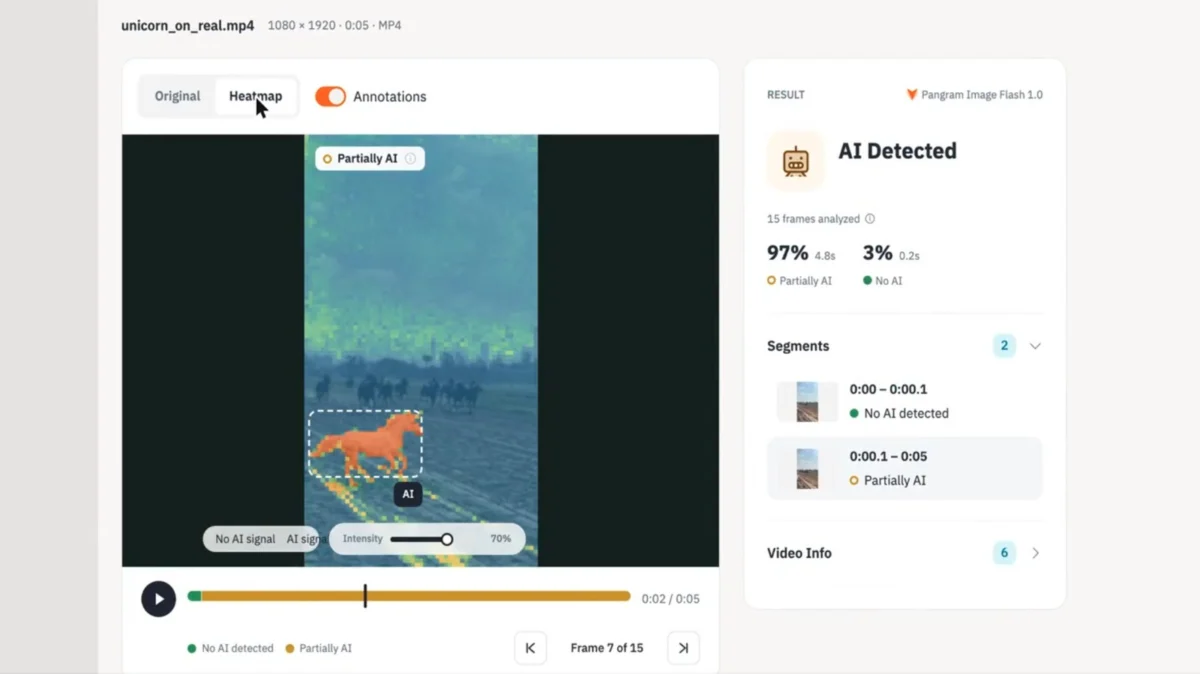
Pangram’s new tools employ a multi-layered diagnostic approach. For video, the platform allows users to upload files to receive a detailed breakdown of the clip’s origins. Unlike binary "real or fake" classifiers, the tool provides a nuanced assessment, distinguishing between content that is "partially AI"—perhaps a human-recorded clip with an AI-generated filter or background—and content that is entirely synthesized.
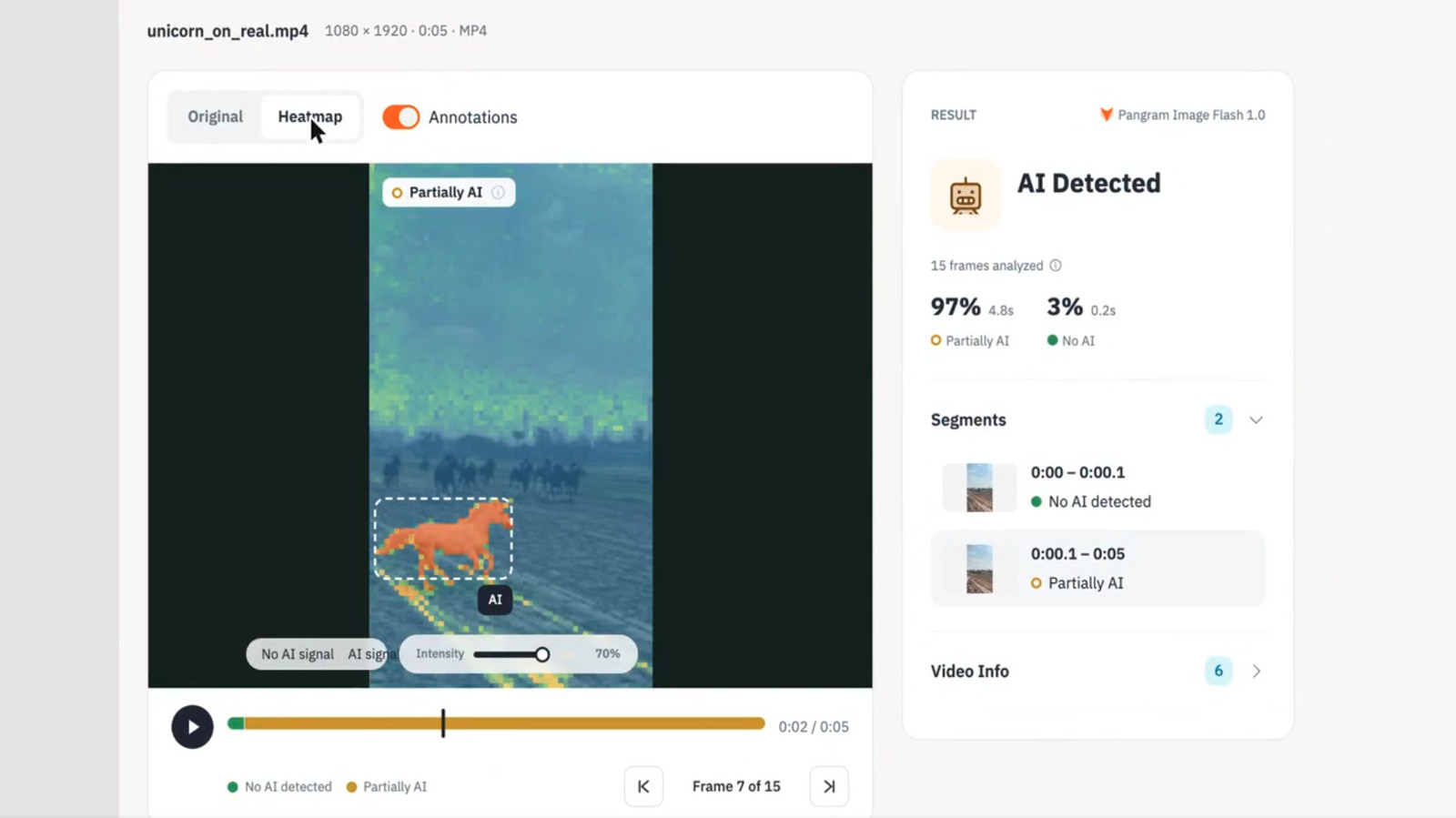
Perhaps the most innovative feature in the video tool is the "heatmap." This diagnostic overlay visually highlights specific regions or temporal segments within a video that the model flags as high-probability AI artifacts. This transparency is intended to help users understand why the tool arrived at its conclusion, rather than relying on a "black box" percentage score.
Data-Driven Accuracy
The company claims that its video detection model is specifically optimized for "frontier AI video," targeting the most advanced generation models currently available. According to internal benchmarks shared by the company, the video detection engine achieved a 98% accuracy rate in controlled testing environments.
The image detection model, now integrated into the company’s browser-based Chrome extension, boasts even higher precision, claiming to flag 99% of AI-generated imagery with a false-positive rate of only 0.27%. These figures, while impressive, come with important caveats regarding resolution. The company notes that for images smaller than 512 x 512 pixels, confidence intervals decrease, necessitating a "reduced confidence" disclaimer to prevent user error.
Navigating the "False Positive" Minefield
The history of AI detection is littered with failed attempts that proved unable to distinguish between "malicious" AI and "benign" software. Pangram’s development team encountered this exact problem while calibrating their tools for modern mobile photography.
Modern smartphone cameras do not simply capture raw light; they utilize advanced computational photography—AI-driven post-processing—to enhance color, sharpen edges, and reduce noise. In early testing, Pangram’s models flagged these legitimate, albeit enhanced, photos as "AI-generated."
CEO Max Spero has been candid about this hurdle, noting on social media that the development process involved rigorous testing against the iPhone 18 Pro to ensure the model could differentiate between the "AI-aided enhancement" of a physical camera and the "AI-generated creation" of a synthetic model. This distinction is critical; as camera software becomes more "intelligent," the definition of a "real" photo is undergoing a seismic shift.
Implications for the Information Ecosystem
The release of these tools signals a growing industry-wide shift toward "provenance-based" security. As platforms like X (formerly Twitter), Pinterest, and Facebook struggle to moderate the sheer volume of synthetic content, tools like Pangram’s provide a necessary, if imperfect, layer of verification.
The Challenge of the "Arms Race"
Critics of detection software often point to the "arms race" dynamic: for every detection tool that is released, generative model developers find new ways to bypass them. If Pangram’s tool can identify a specific watermark or latent pattern in an AI image, the next generation of AI models will likely be trained to avoid those specific signatures.
Pangram acknowledges this cycle, emphasizing that their models are designed for continuous learning. The integration of these tools into a browser extension suggests that the company is aiming for mass-market adoption, hoping to make verification a standard part of the web-browsing experience.
Ethical and Practical Considerations
The availability of these tools for free users—albeit in limited quantities—points to a democratization of verification. However, the presence of "unsure" results, as seen in recent demonstrations on Pinterest, highlights that users must still exercise critical thinking. The tool is a diagnostic aid, not an arbiter of truth.
As society becomes more reliant on digital media, the reliance on automated detection tools creates a new set of risks. If users become overly dependent on a "Pangram Verified" label, they may lower their natural skepticism, creating a new vulnerability if a malicious actor finds a way to exploit a loophole in the detection algorithm.
Looking Ahead: The Future of Verification
The move by Pangram to expand into video and imagery marks a pivotal moment in the fight against synthetic misinformation. As the technology continues to mature, the focus will likely shift from simple detection to "content provenance"—technologies like C2PA that aim to track the history and editing of a file from the moment of capture.
For now, Pangram’s tools represent the most practical solution available to the average user. By providing a "heatmap" of potential AI interference and a browser-based scanning mechanism, they are offering a proactive approach to a problem that many platforms have thus far failed to solve.
Whether these tools will be enough to stem the tide of synthetic content remains to be seen. What is clear is that the digital landscape is entering a new phase of hyper-scrutiny. As we move forward, the ability to confirm the origin of an image or video will be just as important as the content itself. In this new, precarious reality, companies like Pangram are betting that the demand for "digital truth" will be the defining economic and social trend of the coming decade.
As users navigate an increasingly synthetic internet, the tools for discernment are finally catching up—though the cat-and-mouse game between the creators of AI and the detectors of it has only just begun.