
The modern digital economy ground to a halt this afternoon as a cascading series of failures crippled Microsoft 365, the suite of productivity tools that serves as the operational backbone for millions of businesses, government agencies, and educational institutions worldwide. What began as localized reports of inaccessible email in Outlook rapidly spiraled into a systemic collapse, impacting a broad spectrum of services ranging from real-time communication platforms to advanced cybersecurity infrastructure.
As of this evening, Microsoft engineers are still grappling with what the company describes as "elevated load" issues—a technical euphemism for a massive, unmanaged surge in server strain that has rendered critical software unreachable for a significant portion of its global user base.
The Scope of the Disruption
The outage, which became apparent to the public early this afternoon, was not limited to a single application or geographical region. By 2:15 PM ET, the scale of the failure became undeniable. Even the official Microsoft service status page—the very portal designed to provide transparency during such events—was rendered inaccessible, leaving users in a digital information vacuum.
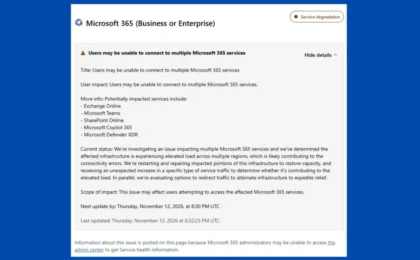
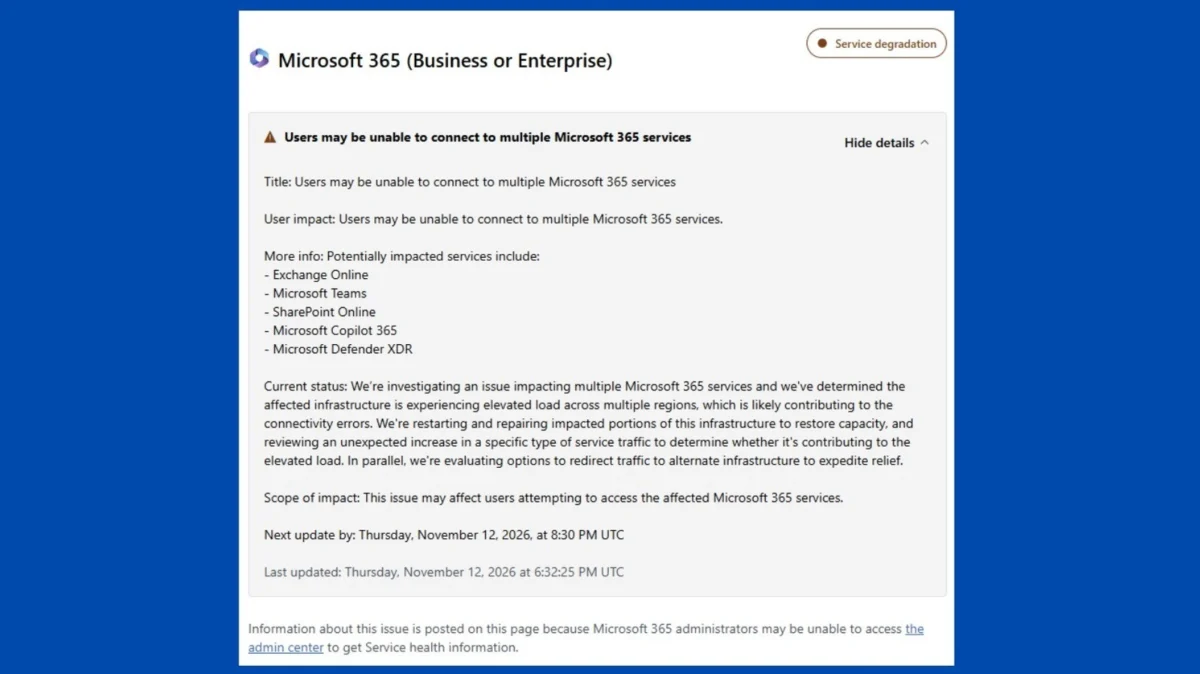
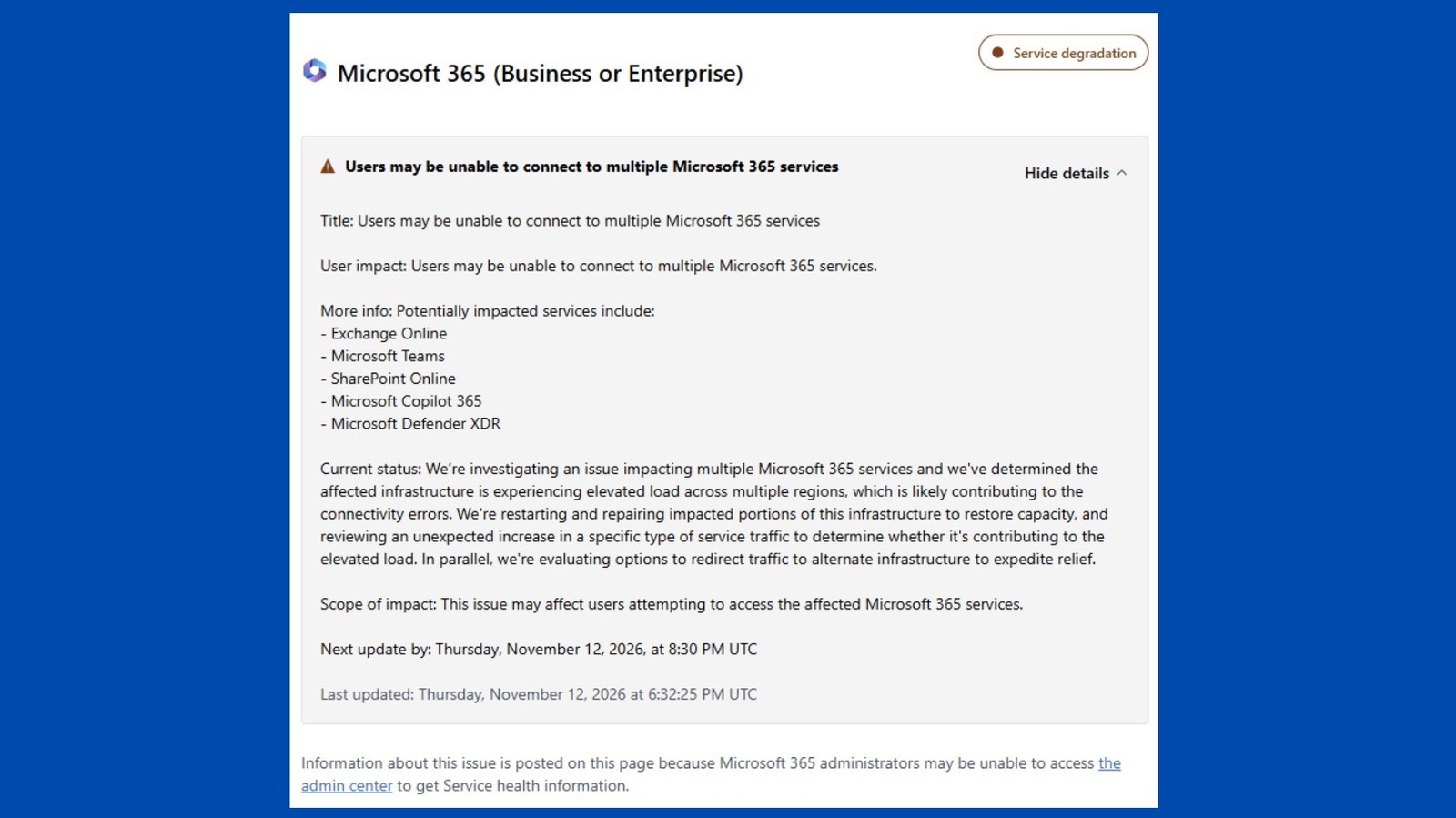
When the status dashboard finally stabilized, the breadth of the catastrophe was laid bare. Initially, the list of impacted services included:
- Exchange Online: The primary hub for enterprise email communication.
- Microsoft Teams: The central communication and collaboration hub for remote and hybrid work.
- SharePoint Online: The repository for corporate document management and intranet portals.
- Microsoft Copilot 365: The AI-driven assistant integrated into the productivity suite.
- Microsoft Defender XDR: The essential cybersecurity suite protecting organizational endpoints.
As the afternoon progressed, the ripple effect expanded. By 5:00 PM ET, Microsoft confirmed that the disruption had bled into additional secondary services, including Microsoft Planner, Microsoft To Do, Microsoft Intune (device management), Microsoft Defender for Office 365, and Microsoft Purview. Even administrative interfaces, such as the Microsoft 365 Apps Admin Center and Power BI, were effectively taken offline, stripping IT administrators of the tools required to troubleshoot the very systems currently failing.
A Chronology of the Collapse
The timeline of the outage highlights the struggle between Microsoft’s automated recovery protocols and the sheer intensity of the infrastructure overload.
1:00 PM – 2:00 PM ET: Initial Symptoms
Reports began to surface on social media and independent tracking platforms regarding "connectivity errors" within Outlook. Initially dismissed by many as localized ISP issues, the volume of complaints quickly reached a threshold that indicated a backend failure at the data center level.
2:15 PM ET: Public Acknowledgment
Microsoft’s official support account on X (formerly Twitter) issued its first formal acknowledgement of the incident. During this window, the Microsoft service status page effectively collapsed under the weight of traffic from frustrated users attempting to confirm the outage.
3:30 PM – 4:30 PM ET: The "Elevated Load" Diagnosis
Microsoft issued an internal update, confirming that its infrastructure was experiencing an "elevated load across multiple regions." The company revealed that it had begun a process of "restarting and repairing" affected infrastructure. At this stage, the company was also investigating an "unexpected increase in a specific type of service traffic," hinting at the possibility of a distributed denial-of-service (DDoS) event or an anomalous traffic spike that overwhelmed server capacity.
5:00 PM ET – Present: Escalation and Persistent Failure
The situation took a turn for the worse as the company admitted that initial mitigation efforts had failed. Microsoft announced that its attempts to redirect traffic to alternate infrastructure had not provided the "anticipated relief," signaling that the issue was more deeply rooted than a simple server spike.
Technical Root Cause Analysis: The Server "Black Hole"
While the investigation is ongoing, the technical details provided by Microsoft paint a picture of a "death spiral" within their server clusters. According to the latest status reports, a "core process" on the affected servers has become overwhelmed.
When this process reaches a critical load, the servers stop responding entirely. This creates a cascading failure: as one server goes offline, the traffic it was handling is redirected to the remaining healthy servers, which then immediately become overwhelmed by the redirected load. This cycle of failure has created a systemic bottleneck that traditional load-balancing techniques have so far failed to resolve.
Microsoft’s engineers are currently working to isolate the specific type of service traffic that triggered this cycle. Whether this is an external malicious event or a software update gone wrong remains the subject of intense speculation within the cybersecurity community.
Official Responses and Transparency
Microsoft has maintained a posture of cautious transparency throughout the event. In a statement released via their status portal, the company noted:
"We’re continuing to pursue all available pathways to restore service, as our actions taken thus far have not provided the anticipated relief. Our investigation has found that a core process on the affected servers is becoming overwhelmed, which causes the servers to stop responding and contributes to the capacity loss."
The company has emphasized that they are evaluating every option, including traffic rerouting and infrastructure patching. However, the lack of a projected "time to recovery" has drawn criticism from industry analysts, who argue that the total lack of redundancy for such a critical service reflects a dangerous level of reliance on a single provider.
The Economic and Operational Implications
The implications of this outage for the global business community cannot be overstated. For an organization like Engadget, which relies on these tools for real-time editorial workflow, the outage represents a direct hit to productivity. For larger enterprises—particularly those in finance, healthcare, and logistics—the impact is existential.
1. The Cost of Downtime
For the average enterprise, the cost of an hour of downtime is measured in the tens of thousands of dollars. With major services like Teams and Exchange being unavailable for an entire business afternoon, the aggregate economic impact is likely to reach into the hundreds of millions.
2. Cybersecurity Vulnerabilities
The fact that Microsoft Defender XDR was among the impacted services raises significant security concerns. When automated security platforms are offline, organizations are left with a visibility gap. Security teams are effectively "flying blind," unable to monitor for potential intrusions or manage threats during the very window where the system is most unstable.
3. The "Single Point of Failure" Debate
This outage is reigniting the debate over the dangers of "Cloud Monoculture." By consolidating email, collaboration, security, and administrative tools into a single ecosystem, organizations have created a massive, single point of failure. When Microsoft 365 goes down, the modern office doesn’t just lose its email; it loses its ability to function entirely.
Moving Forward: Resilience in the Cloud
As of the time of this writing, there is no immediate fix on the horizon. Microsoft’s technical teams are working through the night, attempting to restore services on a region-by-region basis.
For IT administrators and business leaders, the takeaway from today’s chaos is clear: the cloud is not infallible. As organizations look to the future, the emphasis will likely shift toward multi-cloud strategies and local-first redundancy plans. For now, however, the digital world must wait for the "core process" on Microsoft’s servers to be repaired—a stark reminder of how fragile our hyper-connected lives truly are.
This is a developing story. Updates will be provided as more information becomes available regarding the resolution timeline and the nature of the anomalous traffic that triggered the outage.