In the high-stakes world of contemporary pop-surrealism, few events carry the prestige and communal electricity of the Baton Rouge Gallery’s annual Surreal Salon. This year, the eighteenth iteration of the exhibition culminated in a crowning achievement for multidisciplinary artist River Reishi. Selected by guest juror and visionary artist Caledonia Curry—better known to the global art community as Swoon—Reishi’s installation, Surface Tension, secured the coveted "Best in Show" title, marking a pivotal moment in her rising career.
The victory serves as more than just a resume accolade; it highlights a growing trend in the art world toward ephemeral, immersive, and site-specific installations that challenge the permanence of the gallery object. As Reishi continues to push the boundaries of sculpture, her work stands as a testament to the power of fragility, myth, and the audacity of the female voice.
The Anatomy of a Masterpiece: Surface Tension
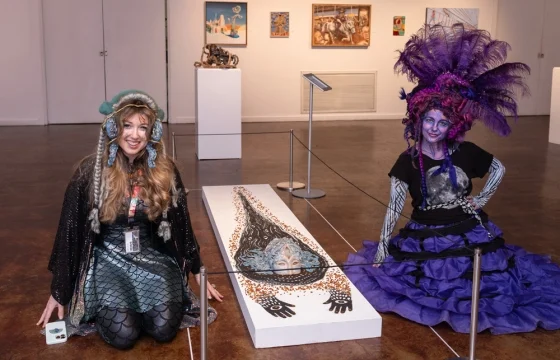
At the heart of Reishi’s winning entry is a sculpture that defies easy categorization. Surface Tension depicts a female figure caught in a state of suspended animation, emerging from dark, turbulent waters. Her hands reach forward, poised to break the barrier between the fluid depths and the terrestrial world.
The piece is a study in threshold—the liminal space where the known world ends and the mysterious, often perilous, world beneath the surface begins. To achieve this, Reishi utilized a haunting interplay of light and texture. The sculpture glows with an internal luminescence, a subtle, ghostly light that remains hidden until the viewer draws near, rewarding the curious with a "quiet surprise."
Surrounding the central figure is a sprawling, ephemeral field of hand-drawn black sand and amber. This base is not fixed; it is a living, breathing component of the work. Every vibration, every draft of air, and every footstep near the platform subtly alters the intricate patterns of the sand. For Reishi, this is the point. The work is not meant to be a static relic, but a fleeting moment captured in time—a meditation on the impermanence of existence and the tension inherent in the Gulf region’s complex relationship with water.
A Chronology of Artistic Evolution
River Reishi’s path to the Surreal Salon 18 stage was paved with a decade of rigorous experimentation and practical constraints. Her practice, she explains, did not begin in a sprawling, climate-controlled studio, but in limited spaces that forced her to innovate.
Early Foundations and Constraints
In her early years as a maker, Reishi lacked the luxury of a large studio. This necessity became the mother of invention. She began experimenting with modular sculptural elements and materials like sand—substances that could be brought into a space, transformed into a narrative, and then easily dismantled or repurposed. These limitations eventually defined her artistic language: a preference for the transitory, the delicate, and the transformative.
The Influence of Swoon
The selection process for Surreal Salon 18 carried significant weight, as the jury was helmed by Swoon. For Reishi, the validation was deeply personal. She cites Swoon’s 2009 Swimming Cities of Serenissima project—a fleet of sculptural rafts navigated into the Venice Biennale—as a foundational inspiration. To Reishi, Swoon’s ability to bypass institutional gates and command space through pure, creative audacity provided a blueprint for her own career.
The Salon Experience
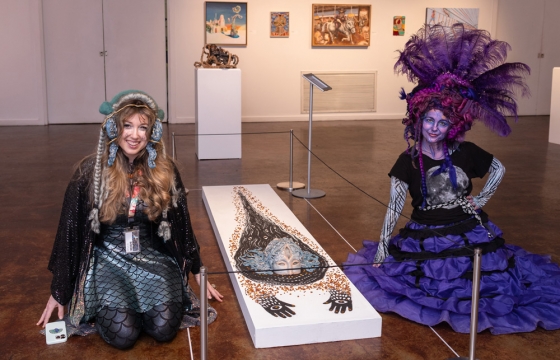
The event itself served as a catalyst for Reishi’s work. Described as the "unofficial kickoff to Mardi Gras season," the Surreal Salon creates an atmosphere where the audience becomes part of the exhibition. Reishi recalls the surreal experience of meeting an attendee who had designed his costume specifically to mirror the aesthetic of Surface Tension. In that moment, the barrier between the art and the viewer dissolved, echoing the very theme of her installation.
Supporting Data: The Power of Symbolic Language
Reishi’s work is deeply rooted in the concept of "inventing symbolic languages." By drawing on ancient mythologies and feminine archetypes, she seeks to create environments that invite the viewer to step inside a story rather than merely observe an object.
Her research is wide-ranging, spanning from the technical manipulation of amber and light to the spiritual resonance of figurative ceramics. During a recent visit to the Museo Nacional de Antropología in Mexico City, Reishi found herself profoundly moved by Mayan ceramics. She describes a specific encounter with a ceramic face that has since dictated her return to sculptural form, underscoring the importance of historical dialogue in her contemporary practice.
This intellectual rigor is balanced by her physical process. Whether working in an empty storefront, a city hall, or a pristine gallery, she maintains an uncompromising commitment to materials that hold history—such as volcanic sand, which she draws upon for its connection to the earth’s raw, primordial power.
Official Responses and Juror Recognition
The announcement of Reishi as the "Best in Show" winner was met with widespread acclaim from both the organizers and the community. The Surreal Salon has long served as a bellwether for the pop-surrealist movement, and the selection of an ephemeral, installation-based work signals a maturation of the genre.
For Reishi, the win was a moment of profound validation. "It was already an honor to be included in a show curated by Caledonia Curry," she remarked during our interview. "So hearing the piece announced as Best in Show later that night felt surreal in the truest sense."

The incident involving an accidental shift in her installation—where a visitor bumped the platform and displaced the sand—became a defining moment of the exhibition. Rather than a disaster, Reishi saw it as an opportunity. As she sat on the gallery floor, carefully re-drawing the sand patterns while patrons watched, the work transformed into a performance. This act of public labor, of creating and recreating beauty in real-time, cemented the narrative that Surface Tension was a living, breathing entity.
Implications for the Future
The success of Surreal Salon 18 has set the stage for a whirlwind year for Reishi. Her trajectory is currently pointed toward Reykjavik, Iceland, where she is scheduled to work with Raf Gallery this August.
The Iceland Project: Darkness and Light
The timing of her residency is auspicious, coinciding with a total solar eclipse on August 12 and the city’s Menningarnótt (Culture Night) festival. Reishi plans to install a piece that synthesizes the myth of the birth of Baltic amber with the astronomical phenomenon of the eclipse. In a gesture that encapsulates her philosophy of art, she intends to invite the local community to participate in the dismantling of the work at the exhibition’s end, returning the sand to the ocean with shared wishes and intentions.
The Philosophy of "No Permission"
When asked about the future of her practice, Reishi remains steadfast in her belief that the "emergence of voice" is an act of defiance, particularly for women in the arts. She views her career as a rejection of the need for "institutional permission." By prioritizing alternative spaces and ephemeral materials, she ensures that her work remains untethered by the market’s demand for permanence.
As she moves forward, Reishi continues to explore the tension between the fragility of her chosen mediums and the power of the stories they tell. Her work asks the viewer to acknowledge the "threshold"—that thin, transparent, and often dangerous line between the world we know and the worlds we carry within us.
River Reishi’s win at Surreal Salon 18 is more than a trophy; it is a declaration of intent. By choosing to build art that vanishes, she has ensured that her impact remains indelible. Whether in the heart of Louisiana or the volcanic shores of Iceland, Reishi’s work reminds us that the most memorable moments are those that we know we cannot hold onto forever.