Muslim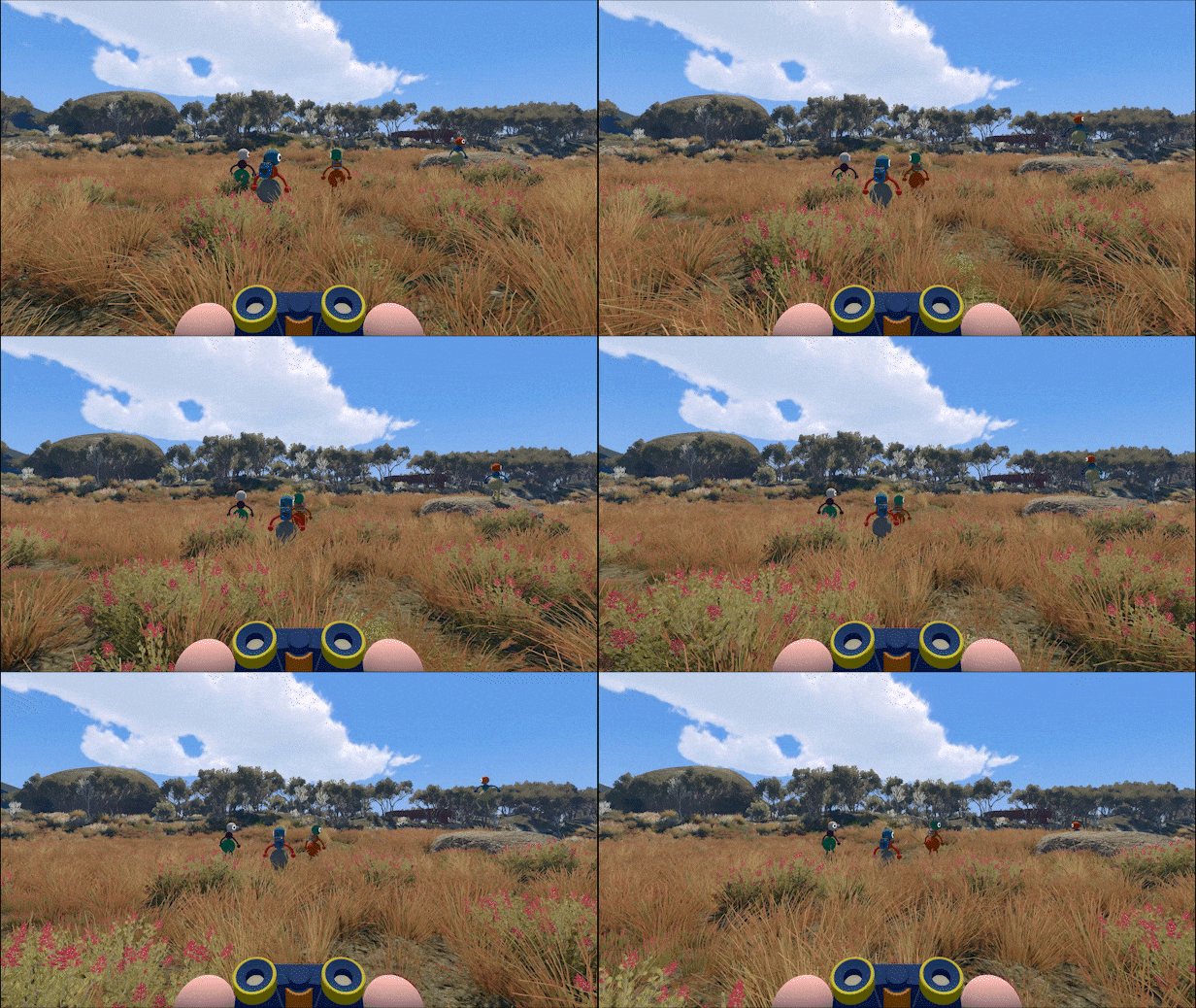
In an industry currently dominated by the high-octane spectacle of battle royales and the relentless intensity of survival-crafting simulators, the gaming landscape has become increasingly polarized. Players are often funneled into experiences defined by kill-death ratios, complex inventory management, and the constant threat of digital annihilation. However, a quiet revolution is brewing in Melbourne, where developer House House—the studio behind the cultural phenomenon Untitled Goose Game—is preparing to release a title that treats these conventions not as goals, but as obstacles to be bypassed.
Their upcoming title, Big Walk, is a masterclass in minimalism and connection. By stripping away the pressure to dominate and replacing it with the simple, human act of walking and talking, the studio has created a "cooperative online walker-talker" that challenges what a multiplayer game can be. It is, in many ways, the antithesis of the modern blockbuster, favoring shared exploration over competitive combat.
The Core Concept: Redefining Social Gaming
At its heart, Big Walk is a radical departure from the "anarchy-first" design philosophy. While other open-world games encourage players to exploit their environment or one another, Big Walk asks players to inhabit a space together. The game centers on the act of traversal through sprawling, surreal, and evocative landscapes.

The developers describe the experience as a blend of discovery, light puzzle-solving, and the intentional absence of traditional gameplay loops. In Big Walk, the environment is not a theater for war, but a canvas for social interaction. Players find themselves navigating vibrant, abstract environments where communication is not just a feature—it is the primary mechanic. In some areas, the game’s design renders players momentarily speechless, forcing them to find creative, non-verbal ways to guide their friends, coordinate movements, or solve environmental enigmas that require collective input.
Chronology of Development: From Goose to Giant Strides
The trajectory of House House has been defined by a commitment to unconventional mechanics. To understand the significance of Big Walk, one must look at the studio’s evolution.
- 2019: The Goose Effect. House House achieved international acclaim with Untitled Goose Game. The game turned the player into a mischievous avian, focusing on environmental manipulation and stealth-lite humor. It proved that players were hungry for "low-stakes" games that prioritized joy and curiosity over power fantasies.
- 2021: The Initial Reveal. The studio first teased Big Walk, signaling a move toward multiplayer environments. The early concept art and snippets of gameplay suggested a shift from the isolated comedy of the goose to a broader, more collaborative landscape.
- 2024: Refining the "Walker-Talker." Throughout the intervening years, House House spent considerable time testing the physics and the social dynamics of the game. They focused on how players move in tandem and how the environment reacts to multiple people traversing it simultaneously.
- August 4, 2026: The Launch. Following years of anticipation, the game is scheduled to land on PC (Steam), PlayStation 5, and the highly anticipated Switch 2, marking a significant milestone for the independent studio.
Supporting Data: Why Low-Stakes Games Matter
The rise of the "cooperative walker-talker" genre is not merely a creative choice; it is a response to a shifting market demographic. Recent industry data from gaming analytics firms indicates a growing fatigue with "always-on" competitive gaming.

- Retention vs. Intensity: Players are increasingly seeking games that function as "third spaces"—virtual environments where they can hang out with friends without the stress of competitive performance metrics.
- Collaborative Play: Titles that emphasize collaborative puzzle-solving have seen a 40% increase in active player base over the last three years, suggesting a hunger for experiences that reward patience and communication over twitch reflexes.
- Accessibility: By removing the "combat" barrier to entry, Big Walk lowers the skill floor, allowing non-traditional gamers to join their more experienced friends, significantly expanding the potential player base.
Official Responses and Developer Philosophy
In their promotional material and recent developer interviews, the team at House House has remained characteristically humble about their goals. They are not looking to disrupt the industry with a new monetization model or a technical breakthrough; they are looking to change how people interact within a digital room.
"As much as Big Walk is a game about walking and talking, it’s also about exploring, and getting lost, and doing challenges, and sometimes, not really doing anything at all," the studio shared in their official release announcement. This philosophy highlights a crucial design choice: the inclusion of "downtime." In most games, idle time is considered "dead air" that needs to be filled with content. For House House, the ability to simply stand on a virtual beach, watch a sunset with a friend, or engage in a silly, inconsequential activity is the game’s primary feature.
This perspective is echoed in the game’s aesthetic, which favors clean lines, bold colors, and a whimsical, almost dreamlike geometry that encourages players to move at their own pace.

The Implications: A New Era for Multiplayer
The release of Big Walk carries significant implications for the future of game design. If it succeeds, it could validate the "slow-burn" multiplayer model, encouraging other developers to move away from the "GaaS" (Games as a Service) model—which relies on daily logins, battle passes, and high-intensity grind—and toward games that prioritize organic social interaction.
The Death of the "Grind"
Many modern titles operate on a treadmill of rewards. Big Walk offers no such thing. Its implications for the industry are clear: games do not need to be a job. By stripping away the need for leveling up, gear scores, and competitive rankings, House House is essentially asking, "What is left when you remove the ego from gaming?"
Technology as a Social Bridge
The integration of voice chat and environmental cues in Big Walk suggests a future where game engines are optimized for empathy rather than just fidelity. If a game can make you feel the weight of a silence or the joy of a shared discovery, it creates a much stronger emotional tether than a simple high score ever could.

Platform Versatility
The decision to launch on the Switch 2 alongside PC and PS5 is a strategic masterstroke. The hybrid nature of the Switch—and its successor—aligns perfectly with the casual, "pick-up-and-play" nature of Big Walk. It acknowledges that players want to be able to jump into a beautiful world, spend twenty minutes with a friend, and step back out without the commitment required by a standard RPG or shooter.
Conclusion: The Quiet Power of the Walk
As we approach the August 4th release, the anticipation surrounding Big Walk is a testament to the audience’s evolving tastes. We are living in an era where the noise of the digital world is deafening; games like Big Walk provide a necessary respite. They do not demand our perfection; they invite our presence.
Whether you are navigating a rocky ledge, jumping across a checkered floor, or simply playing a game of "chicken" on a virtual beach, Big Walk reminds us that the most memorable moments in gaming aren’t always the ones where we win. Often, they are the ones where we walk, talk, and get lost in the company of friends. In a world of digital anarchy, choosing to take a walk might just be the most revolutionary act of all.

 Laily UPN
 Basiran