

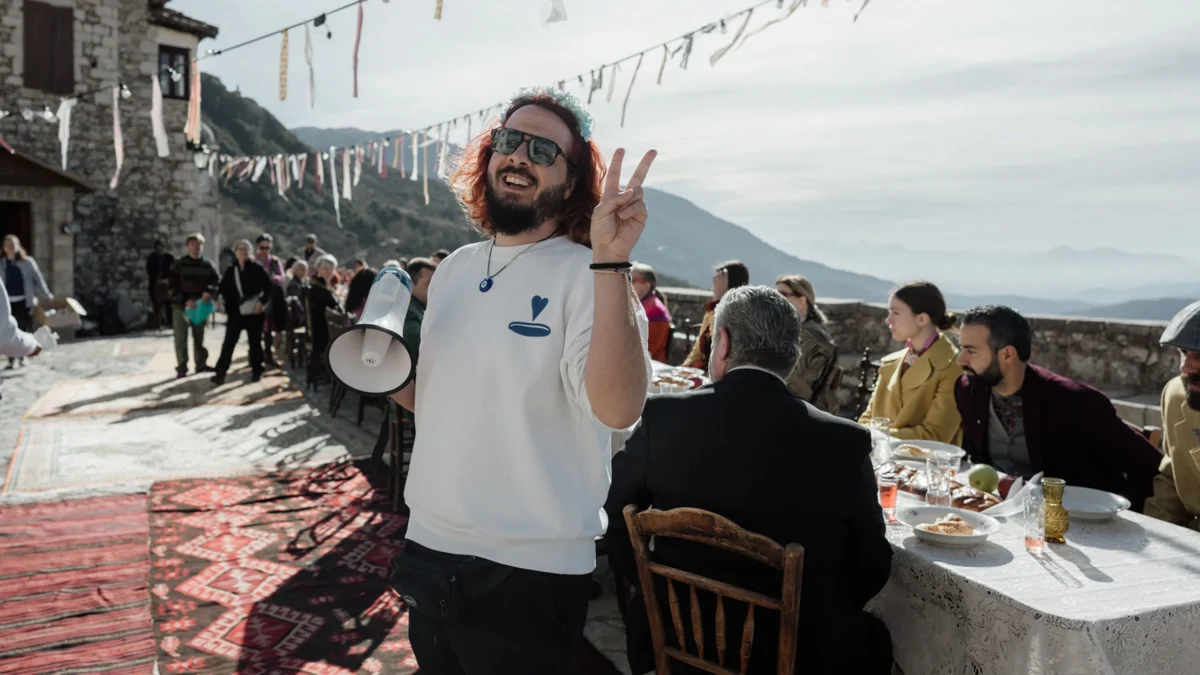
In the remote, mist-shrouded mountains of Epirus, a village chant echoes through the narrow, stone-paved alleys: “Nay Evil, yay Good!” It is a ritual of protection, a desperate incantation designed to keep the unfamiliar at bay. This atmospheric isolation serves as the crucible for The Boy With the Light-Blue Eyes, the striking feature debut from Greek director Thanasis Neofotistos. Premiering at the SXSW London 2026 Screen Festival on June 4, the film is a masterclass in folk horror that transcends its genre tropes to offer a visceral, poignant examination of queer identity, the trauma of otherness, and the suffocating nature of superstition.
The Genesis of a Mythic Vision
The journey to the screen for The Boy With the Light-Blue Eyes has been a long-gestating odyssey, spanning over 12 years. Neofotistos, who grew up in the rugged borderlands of Epirus—a region historically distinct from the popular sun-drenched imagery of the Greek islands—began conceptualizing the narrative in 2015.
The director’s upbringing in a tight-knit community of fewer than a dozen families provided the bedrock for the film’s authenticity. He recounts his grandmother, a woman deeply tethered to the old ways, as the primary inspiration for the film’s antagonist: the crushing weight of irrational belief. “She believed very much in the kako mati—the evil eye,” Neofotistos explains. “It wasn’t just a cultural curiosity; it was a way of life, a lens through which they viewed the world and anyone who didn’t fit into it.”
Chronology of a Coming-of-Age Nightmare
The film follows Petros, played with haunting vulnerability by newcomer Giorgos Karydis. In the world of the film, Petros is an outcast not by choice, but by biology. Born with striking light-blue eyes, he is deemed a vessel for bad energy—a walking jinx in a community that prizes uniformity. To survive the village’s scrutiny, he is forced by his matriarchal grandmother and the local authorities to live behind a mask, literally and metaphorically obscuring his true self.

The production timeline saw Neofotistos collaborate closely with screenwriter Grigoris Skarakis, with whom he shares a personal connection that mirrors the film’s themes of liberation. The film was lensed by cinematographer Djordje Arambasic, whose use of shadows and light transforms the Epirus landscape into a character in its own right. Editing duties were helmed by Panagiotis Angelopoulos, who helped shape the film’s impressionistic, POV-driven narrative style. Following a rigorous development phase, the project secured backing from Argonauts, with Gersh handling the international sales, positioning the film as a standout title at this year’s festival.
The Symbolic Weight of the Evil Eye
While the “evil eye” has become a globalized, mass-produced souvenir, Neofotistos argues that its roots in ancient Greek and Eastern societies were far more sinister. “Before globalization blended our cultures, these societies were homogeneous—dark-eyed and dark-skinned,” he says. “A stranger with blue eyes was inherently a threat. It was believed that this beauty carried a curse, capable of causing misfortune or even death.”
This historical context provides the film with its sharpest allegorical edge. By centering the story on a boy who is feared for his appearance, Neofotistos draws a direct line to the contemporary experiences of the LGBTQ+ community. He admits that the film is, in many ways, an autobiography of his own struggle to be accepted by his conservative family. “My grandmother once told me, ‘Please don’t bring me a blue-eyed wife.’ But I’m a gay man,” he recalls. “Petros is my alter ego. Being gay in my family was as random and as ‘cursed’ as being born with blue eyes.”
Supporting Data: The Anatomy of a Queer Allegory
The film is not a literal historical drama; rather, it is a psychological landscape. Neofotistos intentionally left the temporal setting ambiguous, though the production design by Dafni Kalogianni and costumes by Christina Lardikou evoke the aesthetic of the 1990s. The inclusion of dated technology—a flickering television, an old-fashioned camera—in Petros’s bedroom creates a sense of domestic entrapment.

The Power of Perspective
The director employs a strictly limited point-of-view (POV) structure. Everything the audience experiences is filtered through Petros’s subjective reality. This stylistic choice is central to the film’s horror elements.
- Impressionistic Storytelling: The film avoids objective reality in favor of psychological truth.
- The Nature of Violence: When violence erupts, it is not for shock value; it represents the trauma and internal collapse of a teenager being bullied into submission.
- Magical Realism: Elements of fantasy are used to manifest the character’s internal emotional state, blurring the line between the external world and his internal suffering.
“I am a traumatized person, as are many who grow up in spaces where their identity is viewed as a defect,” Neofotistos explains. “If you tell the story of your teenage years through the lens of trauma, the world feels like a place where people are literally trying to take your eyes, take your voice, and bind you. That is why the violence feels organic—it is how the world felt to me.”
Official Responses and Creative Evolution
The casting of Giorgos Karydis was a turning point for the production. Much like his character, Karydis began the shoot as an introverted, shy performer. Over the course of the month-long production, the actor underwent a metamorphosis that mirrored Petros’s own arc. “You can see it in his eyes,” says Neofotistos. “He literally grows up on screen. His voice changes, his posture changes. It was an incredibly moving process to witness.”
The film’s writing process also served as a catalyst for the director’s personal life. Neofotistos co-wrote the script with his partner, and the couple married last year. “My family was at the wedding,” he says, noting the irony that his acceptance by his parents was facilitated through his work. “They watched my films, they understood my stories, and then they finally spoke to me about my sexuality. It is a slow, painful process, but it is one that leads to freedom.”

Implications for Global Cinema
The Boy With the Light-Blue Eyes arrives at a moment when global cinema is increasingly grappling with the intersection of regional folklore and universal human rights. By choosing to frame the queer experience through the lens of folk horror, Neofotistos avoids the didacticism often found in coming-of-age dramas.
The film challenges the audience to consider the “randomness” of identity. By making Petros’s “difference” a physical trait (blue eyes) that society deems dangerous, the director successfully bypasses the barriers of prejudice that some viewers might bring to a story about sexuality alone. It demands that the viewer empathize with the victim of the “evil eye” before they even realize they are witnessing a story about a young gay man.
As the film makes its world premiere, it stands as a testament to the power of subjective storytelling. It is a work that argues that while society may try to mask our true selves, the light in our eyes—the essence of who we are—is impossible to fully extinguish. For Neofotistos, the 12-year journey to finish this film was the final step in his own process of coming out, a cinematic exorcism of the ghosts of his past. With this debut, he has not only established himself as a distinct voice in European cinema but has also provided a mirror for those who have ever felt like an unwanted stranger in their own home.











No comments yet. Be the first to join the conversation!