

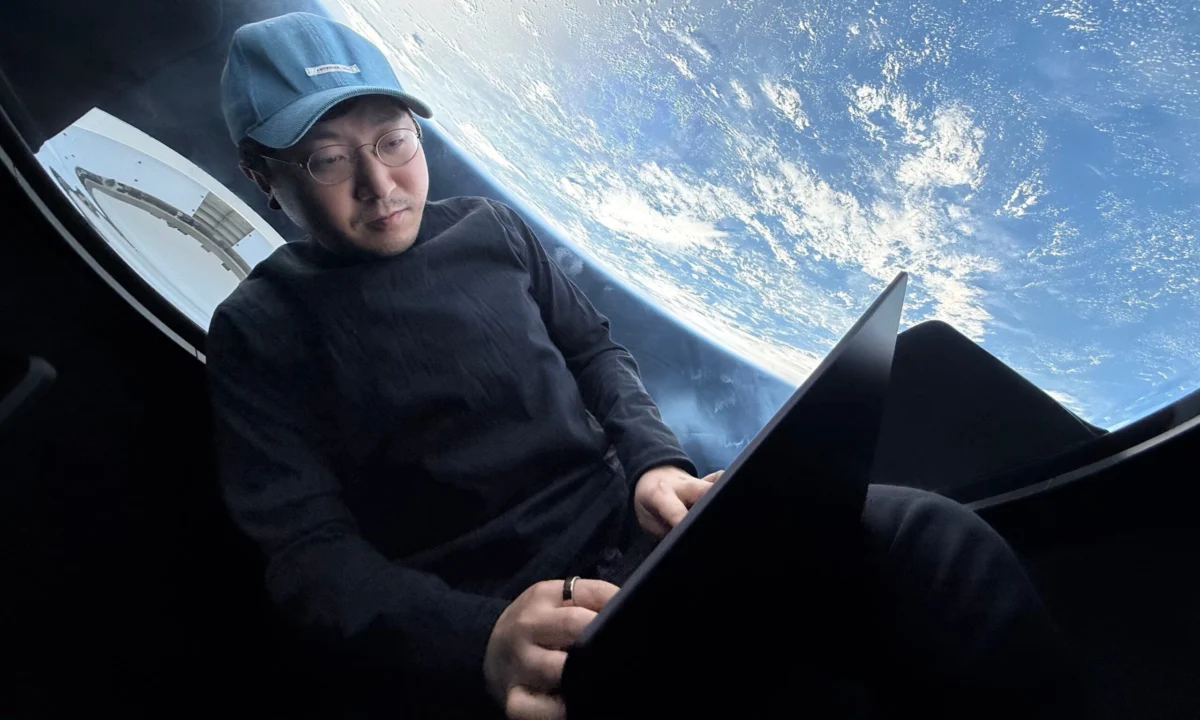
The history of space exploration was once defined by the rigid hierarchies of government-funded agencies and the stoic, military-trained personas of pilots like Neil Armstrong and Buzz Aldrin. Today, the frontier of human endeavor is being rewritten by a different breed of explorer: the billionaire entrepreneur. At the center of this paradigm shift is Chun Wang, a cryptocurrency magnate whose ascent from the world of Bitcoin mining to the captain’s seat of a SpaceX Starship signals a transformative era in how humanity approaches the cosmos.
As Elon Musk’s SpaceX continues to refine the Starship launch vehicle, reports indicate that Wang is slated to lead a daring mission that will carry humans beyond the confines of Earth’s orbit, tracing a trajectory toward the Red Planet. While the mission profile is currently a flyby—a journey to Mars and back without a surface landing—the implications of such a voyage are monumental, representing the most significant leap in private spaceflight since the inception of the industry.
The Changing Face of Exploration
For decades, the public face of space travel was synonymous with the Apollo program. The astronauts of that era were symbols of national will, engineering precision, and governmental oversight. In the mid-2020s, however, the narrative has pivoted. The commercialization of low-Earth orbit (LEO) has paved the way for a “celebrity phase” of spaceflight, epitomized by Blue Origin’s successful suborbital missions, which have carried high-profile figures, journalists, and private citizens to the Kármán line.

Yet, Chun Wang’s planned expedition is a departure from the quick, suborbital hops that have dominated headlines in recent years. A flight around Mars is not a tourist excursion; it is a profound endurance test. Estimates suggest the mission could span up to two years, placing immense physical and psychological strain on the crew and testing the limits of life-support systems on a scale never before attempted by a non-governmental entity.
Wang is no stranger to the rigors of space. In 2025, he commanded the Fram2 mission, a SpaceX Crew Dragon flight that saw four civilian astronauts orbit over Earth’s polar regions. That mission, which lasted several days, provided Wang with vital experience in the harsh environment of space. By leveraging his background in the high-stakes world of crypto-finance, Wang has effectively positioned himself as the bridge between the digital-first economy and the new space race.
A Chronology of the Starship Development
The path to Mars is paved with engineering hurdles that SpaceX has been systematically tackling through a series of high-profile test flights. The development of Starship, the most powerful rocket ever built, is the linchpin of Musk’s vision for a multi-planetary future.

The Testing Phase (2023–2026)
SpaceX’s development cycle has been characterized by its “fail fast” mentality. The company has moved rapidly from static fire tests to full-stack orbital attempts.
- Early Trials: Initial tests focused on stage separation and the development of the Raptor engines.
- The May 2026 Milestone: On May 22, 2026, SpaceX launched the upgraded Starship V3. Despite a slight delay due to launch tower mechanical issues, the vehicle achieved critical benchmarks, including successful stage separation and the deployment of mock Starlink satellites.
- Controlled Destruction: The mission concluded with a splashdown in the Indian Ocean, followed by a spectacular fireball. While critics often highlight the destruction of the craft, SpaceX has maintained that the loss was intentional, as the goal was to validate the vehicle’s flight characteristics rather than recover the prototype.
The Engineering Challenge: Reaching the Red Planet
The technical requirements for a Mars flyby are orders of magnitude more complex than those for a standard LEO mission. Unlike a trip to the International Space Station, a Mars mission necessitates deep-space navigation, long-term radiation shielding, and the ability to operate autonomously for months at a time.
Life Support and Radiation
The primary concern for any crewed mission to Mars is the deep-space environment. Without the protective blanket of Earth’s magnetosphere, crew members are exposed to significant solar and cosmic radiation. Engineers at SpaceX are currently developing advanced shielding solutions and closed-loop life support systems designed to recycle water and air with near-total efficiency.

Navigation and Propellant Management
Starship’s design relies on a refueling architecture in orbit. To make the journey to Mars, a “tanker” variant of the Starship must launch, rendezvous with the crewed ship, and transfer cryogenic methane and liquid oxygen. This orbital refueling maneuver is perhaps the most difficult technical hurdle remaining, as it requires precision docking and fluid transfer in zero-gravity—a process that has never been attempted on this scale.
Official Perspectives and Industry Implications
SpaceX has remained characteristically guarded regarding specific launch dates for the Wang mission. The company’s policy is to wait until the vehicle has proven its reliability through multiple successful landings and recoveries. However, the influence of private funding is undeniable. By aligning his personal wealth with the goals of SpaceX, Wang is effectively accelerating the pace of development, providing the capital necessary to sustain such a high-burn-rate endeavor.
Industry experts note that this arrangement reflects a broader trend in the aerospace sector: the privatization of high-risk exploration. As government agencies like NASA increasingly shift toward a “customer” role—purchasing services from private companies rather than owning the infrastructure—individuals like Wang are stepping into the vacuum left by traditional national space programs.

The Economic and Ethical Implications
The involvement of a cryptocurrency billionaire in the first human journey to Mars has sparked a debate about the motivations and ethics of space exploration. Critics argue that such missions, while technologically impressive, serve the interests of an elite class rather than the collective good of humanity.
Conversely, proponents argue that this is exactly the kind of risk-taking required to break the stagnation of the post-Apollo era. If a private mission can successfully traverse deep space, it proves that the commercial sector is capable of handling the logistical complexities of long-duration flight. This could lower the barrier to entry for subsequent exploration, including scientific research, resource mining, and eventually, the colonization goals so often championed by Musk.
The "One Million Humans" Goal
Musk’s long-term vision—a colony of one million people on Mars—is intrinsically linked to the financial incentives built into his compensation packages. According to recent reports, his potential payouts are tied to specific, ambitious milestones, including the establishment of a self-sustaining human presence on the Martian surface. This creates a feedback loop: every successful milestone reached by private explorers like Wang increases the likelihood of reaching that distant goal, which in turn secures the capital required for the next phase of development.

Conclusion: A New Era of Exploration
The journey of Chun Wang toward the Red Planet is more than just a headline-grabbing stunt. It is a fundamental shift in the composition of the astronaut corps and the funding models that drive modern discovery. As Starship continues to evolve from an experimental prototype into a reliable transport vessel, the transition from government-led missions to privately funded expeditions becomes increasingly inevitable.
While the dangers of deep-space travel remain profound, the momentum behind this project suggests that we are witnessing the birth of a new era. Whether or not this mission becomes the catalyst for a permanent human presence on Mars, one thing is clear: the face of space exploration is changing, and it is increasingly being written by those with the vision and the capital to push beyond the sky. As the world watches, the question is no longer whether we can go, but who will lead the way, and what their journey will mean for the future of our species.












No comments yet. Be the first to join the conversation!