

The original version of this story appeared in Quanta Magazine.
For the better part of three decades, the scientific community has operated under a looming shadow: the realization that the rapid advancement of quantum computing will eventually render the bedrock of modern digital security obsolete. The cryptographic protocols that protect everything from personal banking credentials to classified state secrets—currently secured by the mathematical complexity of prime factorization—are expected to fall to the superior processing power of quantum algorithms.
In response, cryptographers have spent years architecting "quantum-resistant" algorithms. These post-quantum schemes are designed to withstand attacks from computers that leverage qubits instead of traditional bits. Simultaneously, researchers have pioneered Quantum Key Distribution (QKD), an ingenious method of communication that relies on the immutable laws of physics—specifically the principles of quantum entanglement—rather than mathematical complexity to ensure secrecy.
Yet, a profound, almost philosophical question now nags at the leading edge of theoretical physics: What if quantum mechanics is not the final word? Just as Newtonian physics was subsumed by the deeper, more complex framework of quantum mechanics a century ago, is it possible that our current quantum protocols are built upon a foundation that may one day be superseded? If a more fundamental theory of nature exists, will the current "quantum-secure" techniques hold, or will they collapse under the scrutiny of a new, post-quantum physics?
The Paranoid Architect: Challenging Fundamental Assumptions
"In terms of these cryptographic protocols, it’s good to be paranoid," says Ravishankar Ramanathan, a quantum information theorist at the University of Hong Kong. "Let’s try to minimize the assumptions behind the protocol. Let’s suppose that at some future date, people realize that quantum mechanics is not the ultimate theory of nature."
Ramanathan’s skepticism is not born of a dismissal of quantum theory, but of a rigorous scientific desire for bulletproof security. The ongoing struggle to reconcile quantum mechanics with general relativity suggests that our current understanding of the universe is, at best, an approximation. If we are to build long-term digital infrastructure that lasts for centuries, we cannot simply bank on the current state of quantum theory. We must dig deeper, toward the root of causality itself.
The Mechanics of Trust: Quantum Key Distribution (QKD)
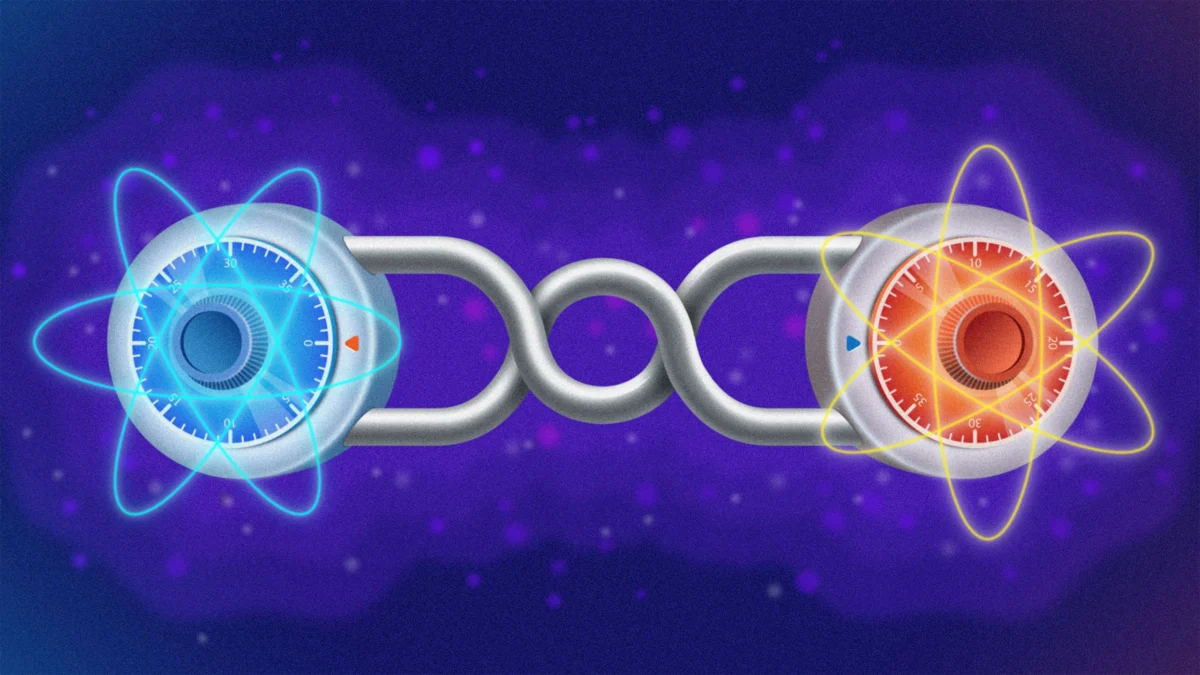
To understand why this "paranoia" is necessary, one must look at how QKD currently functions. At its heart, QKD uses entanglement to create a "locked" connection between two parties, traditionally referred to as Alice and Bob.
In a quantum system, two particles can become entangled, meaning their states are intrinsically linked. If Alice measures a property of her particle—such as spin—the state of Bob’s particle is instantaneously determined, regardless of the distance separating them. This linkage provides a built-in security feature: the "monogamy of entanglement." Because an entangled pair is exclusive, any attempt by a third party (often named Eve) to intercept or measure the particles will inevitably disrupt the entanglement. This disruption acts as a tripwire, alerting Alice and Bob that their connection has been compromised.
However, this security is predicated entirely on the validity of quantum mechanical laws. If those laws are incomplete, or if there exists a "loophole" in the fabric of reality that allows for information to be tapped without disrupting the entanglement, the security of QKD evaporates.
The Specter of "Quantum Jamming"
The theoretical threat that keeps researchers like Ramanathan awake is "quantum jamming." In this scenario, an adversary does not merely attempt to eavesdrop; they manipulate the underlying principles of the particles themselves.
If the principle of the monogamy of entanglement were not absolute—perhaps due to a deeper, undiscovered physical mechanism—a sophisticated adversary could theoretically manipulate entangled particles without leaving a "trace." In such a world, an outsider could subtly alter the state of the particles during transmission, disrupting communication or injecting malicious data while the system reports that everything is perfectly secure.
The Parable of Jim the Jammer
Michał Eckstein, a theoretical physicist at Jagiellonian University in Krakow, Poland, utilizes a thought experiment to illustrate the existential nature of this threat. He introduces a new character to the standard Alice and Bob narrative: Jim the Jammer.
"Suppose you have Alice and Bob, and they meet a magician, Jim the Jammer," Eckstein explains. "The magician says, ‘I have two balls; one is white, and one is black.’"
In this analogy, the balls represent entangled particles. In standard quantum mechanics, the correlation between these balls is guaranteed. But Jim the Jammer claims he can intervene in a way that remains invisible to Alice and Bob. If Jim can manipulate the correlations of these balls without triggering a detection mechanism, he has effectively "jammed" the quantum channel. The question for physicists is whether such a "magician" is possible under the laws of a more fundamental physics, or if the structure of causality itself prevents such a feat.
Chronology of the Quantum Security Evolution
- 1984: Bennett and Brassard introduce the BB84 protocol, the first practical application of quantum key distribution, setting the stage for physics-based security.
- 1994: Peter Shor develops "Shor’s Algorithm," proving that a quantum computer could theoretically factor large integers efficiently, effectively signaling the eventual death of RSA encryption.
- 2010s: Development of post-quantum cryptography (PQC) intensifies, focusing on lattice-based and code-based encryption to withstand quantum-level attacks.
- 2020–2025: The "Device-Independent" (DI-QKD) movement gains momentum, aiming to create cryptographic protocols that do not rely on trusting the hardware itself, but only on the observed correlations of the data.
- 2026: Leading theorists begin formally addressing the implications of "post-quantum" physics on current cryptographic standards, marking a shift toward exploring the fundamental limits of causality in information theory.
Supporting Data: The Limits of Correlation
Current research into quantum jamming often focuses on the "non-signaling principle." This principle states that while entanglement creates correlations between distant particles, it cannot be used to send information faster than the speed of light.
Most modern cryptographic protocols are built upon the assumption that this non-signaling principle is inviolable. However, if a future theory of gravity or a "theory of everything" allowed for subtle signaling or deviations from these correlations, the very foundation of quantum security would be undermined.
Researchers are currently calculating the "Bell inequality" limits—a mathematical framework that defines the maximum amount of correlation possible in a quantum system. If an experiment were to reveal correlations exceeding these limits, it would suggest that the system is either malfunctioning or that our understanding of quantum physics is fundamentally flawed.
Implications for Global Security
The shift toward exploring these "paranoid" protocols has massive implications for national security and digital infrastructure:
- Long-Term Data Persistence: Data encrypted today that must remain secure for 50 to 100 years (such as genetic records or state secrets) is at risk. If current encryption is based on assumptions that are later proven false, this data could be retrospectively decrypted.
- Hardware Independence: The push toward "device-independent" cryptography is accelerating. By removing the need to trust the internal workings of a quantum device, researchers hope to create a "future-proof" layer of security that relies on mathematical verification of the physics, rather than the physics itself.
- Fundamental Research Funding: Governments are increasingly funding research into the foundations of quantum mechanics. There is a growing consensus that we cannot effectively secure our digital future without a more granular understanding of the nature of causality.
Conclusion: The Path Forward
The quest to protect the digital world from both quantum computers and potential post-quantum physical discoveries is driving the most rigorous fundamental research in modern physics. By challenging the assumptions behind our current cryptographic protocols, scientists are not just trying to build better locks; they are attempting to map the very limits of what is possible in our universe.
As Ravishankar Ramanathan and his peers continue to probe the edges of causality, the message to the cybersecurity world is clear: True security is not found in believing our current theories are perfect, but in designing systems that remain robust even if those theories are eventually proven to be mere shadows of a deeper, more fundamental reality. In the race to secure the future, the most dangerous assumption we can make is that we have already discovered the rules of the game.










No comments yet. Be the first to join the conversation!