

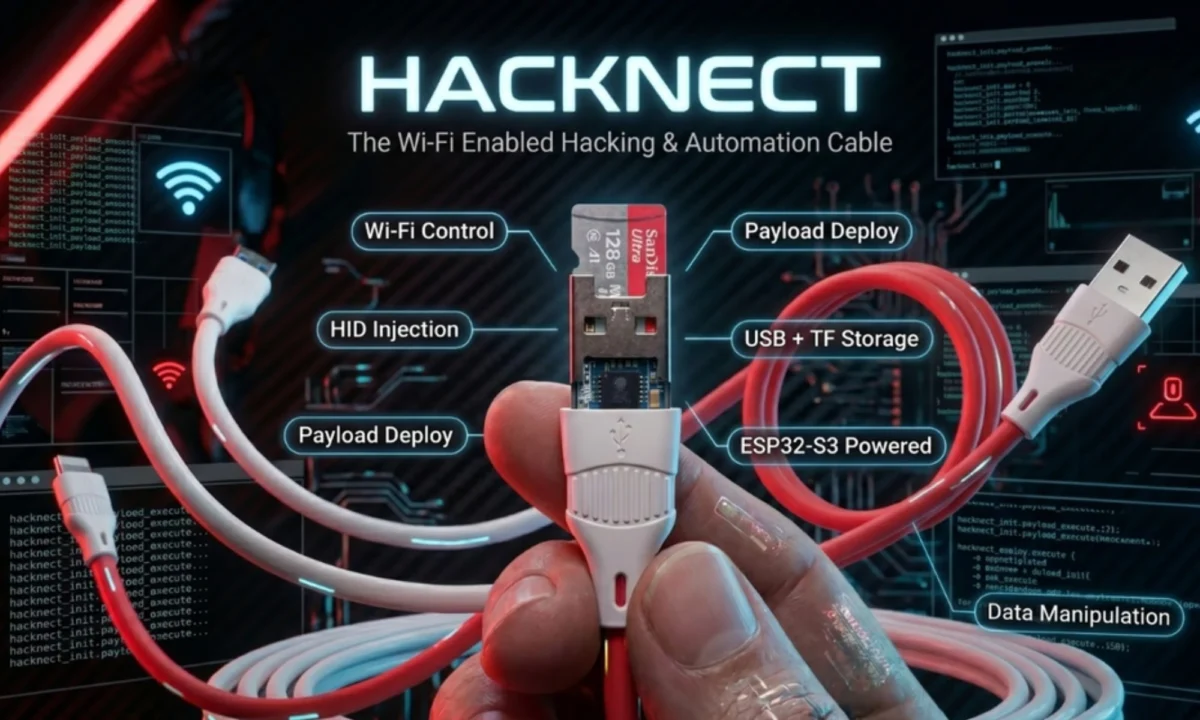
At first glance, it is the ultimate exercise in deception: a standard-issue charging cable, indistinguishable from the dozens of white, braided, or rubberized cords cluttering office desks, coffee shop tables, and bedside drawers across the globe. But beneath the innocuous exterior of the "Hacknect," a new project currently making waves on Kickstarter, lies a sophisticated, Wi-Fi-enabled computing platform. By embedding an ESP32-S3 chip directly into the housing of a USB connector, developers have transformed a mundane utility into a potent tool for automation, penetration testing, and—critics fear—unauthorized digital intrusion.
As the lines between software-based cybersecurity and physical hardware exploits continue to blur, Hacknect represents a significant shift in how we perceive everyday tech. Designed for ethical hackers, security researchers, and hardware enthusiasts, the device is capable of far more than simply passing power or data; it is a Trojan horse for the modern age, capable of executing scripts, emulating keyboard inputs, and storing exfiltrated data on a concealed microSD card.
The Anatomy of a Digital Trojan
The technical architecture of Hacknect is surprisingly lean yet formidable. At its core, the ESP32-S3 microcontroller is a powerful dual-core processor that supports both Wi-Fi and Bluetooth connectivity. By integrating this into a cable, the creators have bypassed the need for a bulky external dongle.
When plugged into a target machine, the Hacknect utilizes a technique known as Human Interface Device (HID) emulation. Essentially, the computer’s operating system identifies the cable not as a storage device, but as a trusted peripheral—specifically, a keyboard. Once the "keyboard" is initialized, the device can execute pre-programmed keystrokes at superhuman speeds. A complex, multi-step malicious script that might take a human ten minutes to type can be executed by the Hacknect in a matter of seconds.
The device is managed wirelessly via a browser-based dashboard or a dedicated smartphone interface. This remote control capability is what elevates it from a mere novelty to a serious cybersecurity concern. An attacker could potentially leave the cable plugged into an unattended machine and, from a nearby location, trigger scripts, pull files to the internal microSD storage, or establish a reverse shell to gain persistent access to a network.
A Brief Chronology: From Underground Forums to Crowdfunding
The concept of the "malicious cable" is not new, but its transition from shadowy, high-cost espionage tools to mass-produced, accessible hardware is a recent phenomenon.
- The Early Days (2010s): Initial proof-of-concepts for HID-based attacks were largely limited to academic research papers or bespoke, hand-soldered hardware built by elite penetration testers.
- The Rise of the "Rubber Ducky" (2015-2018): Hak5’s USB Rubber Ducky popularized the concept of HID keystroke injection. These devices were small but usually required physical proximity and a visible USB form factor.
- The O.MG Era (2019-2022): The release of the O.MG Cable brought the "spy movie" aesthetic to life. These were high-end, expensive tools used primarily by intelligence agencies and top-tier security firms to simulate real-world attacks where a physical cable is swapped out during a coffee break.
- The Hacknect Pivot (2026): With the current Kickstarter campaign, we are seeing the "democratization" of this hardware. By utilizing cheaper, widely available chips like the ESP32-S3, the project aims to lower the barrier to entry, moving these tools out of the exclusive domain of state-sponsored actors and into the hands of hobbyists and developers.
The Dual-Use Dilemma: Legitimate Utility vs. Malicious Intent
The creators of Hacknect lean heavily on the "ethical hacking" narrative, a standard industry practice for marketing security hardware. From a professional standpoint, the utility of such a device is clear. Security teams utilize these cables to conduct "physical social engineering" tests. By leaving a handful of these cables in a corporate breakroom, security professionals can audit whether employees are prone to plugging unknown hardware into company-issued laptops. These exercises help identify gaps in endpoint security and the need for stricter USB port policies.

Furthermore, automation enthusiasts have championed the device for its potential in streamlining repetitive workflows. In a developer’s environment, a cable that can automatically authenticate a machine, mount a drive, or open a series of development tools with a single button press on a smartphone is an undeniable productivity booster.
However, the "dual-use" nature of the hardware is what fuels the current controversy. A device that can be used to audit a network is, by definition, a device that can be used to breach one. Unlike software, which can be patched, hardware vulnerabilities are physical. Once a malicious script is executed via an HID device, it often bypasses traditional software firewalls because the computer believes it is receiving commands from a human user typing on a physical keyboard.
Implications for Physical Cybersecurity
The emergence of Hacknect forces a conversation about the "Trust Gap." For decades, the IT industry has focused on the "perimeter"—firewalls, antivirus software, and multi-factor authentication. Physical security has often been treated as an afterthought.
1. The Death of "Plug and Play" Trust
The most immediate implication is that "Plug and Play" is no longer a safe philosophy. Users are conditioned to trust any cable that provides a charge. Hacknect exploits this psychological vulnerability. If a cable works, users assume it is safe, ignoring the fact that the copper wiring inside can be diverted to host a tiny computer.
2. The Rise of Port Hardening
Organizations are now forced to consider "port hardening." This involves disabling USB ports at the hardware level, using physical port blockers, or employing software policies that require explicit authorization for any new HID device plugged into a workstation.
3. The Supply Chain Concern
Beyond the threat of a malicious actor planting a cable, there is the broader, more chilling concern of supply chain integrity. If a device as complex as the Hacknect can be produced via a Kickstarter campaign, it stands to reason that low-cost, malicious hardware could be integrated into the manufacturing process of generic charging cables sold at gas stations or through third-party marketplaces.
Expert Opinions and Official Responses
The cybersecurity community is divided. Some argue that the transparency of a public Kickstarter project is actually a net positive. "By bringing this into the light, we are forcing companies to take physical security seriously," says Dr. Aris Thorne, a cybersecurity analyst. "If people didn’t know these things existed, they wouldn’t build defenses against them."

Conversely, privacy advocates are calling for tighter regulations on the sale of HID-emulation hardware. While the Kickstarter project states that it intends to ship only to verified security professionals, the platform’s nature is inherently open. There is no foolproof way to ensure that a buyer is using the device for ethical training rather than illicit data theft.
The project creators have addressed these concerns in their FAQ, stating: "Hacknect is designed as a tool for the security community. It is the responsibility of the end-user to operate within the bounds of the law and ethical guidelines. We provide the hardware; the intent resides with the user."
Looking Ahead: A Hardened Future
As we move further into 2026 and beyond, the Hacknect serves as a stark reminder that the tools of the trade are becoming increasingly invisible. The days of attackers needing to install bulky servers in a basement are over. Today, the attack can fit inside a pocket, look like a piece of plastic, and be deployed in a matter of seconds.
The lesson for the average consumer is simple: treat your USB cables with the same level of scrutiny you would apply to an unknown email attachment. If you did not purchase the cable yourself from a trusted manufacturer, do not plug it into a device that holds sensitive data.
The Hacknect project will likely succeed in its funding, not just because of its technical prowess, but because it taps into a fundamental anxiety in our digital lives: the fear that the objects we trust most may be the very things betraying us. Whether it becomes a standard tool in the ethical hacker’s arsenal or a cautionary tale of consumer tech gone wrong, the Hacknect has successfully moved the goalposts for physical security, proving that in the modern era, the most dangerous wires are the ones that look the most ordinary.











No comments yet. Be the first to join the conversation!