Asro
Asro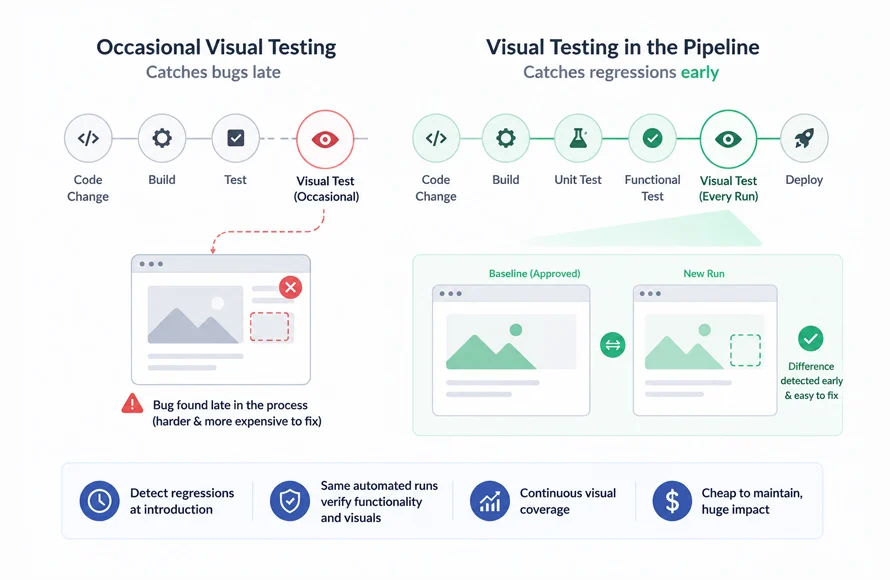
In the high-velocity world of modern web development, the interface is the primary touchpoint for user trust. Yet, despite the proliferation of sophisticated automation tools, many engineering teams find themselves in a recurring cycle: they implement visual regression testing with great enthusiasm, only to quietly abandon the practice within a few months.
The failure is rarely a result of the software itself. Modern platforms like TestMu AI (formerly LambdaTest) provide robust, cloud-based infrastructure capable of pixel-perfect comparisons across thousands of browser and device configurations. Instead, the failure lies in the workflow. Visual testing collapses when teams view it as a "set-and-forget" utility rather than a disciplined process. To move from sporadic testing to a resilient, enterprise-grade safety net, engineering organizations must fundamentally rethink how they integrate visual validation into their delivery pipelines.
The Anatomy of a Failure: Why Visual Workflows Collapse
The primary culprit behind failed visual testing initiatives is the "noise-to-signal" ratio. When a test suite triggers hundreds of alerts for dynamic timestamps, minor anti-aliasing variations, or fluctuating animation frames, developers become desensitized. This phenomenon, known as "alert fatigue," eventually leads to teams ignoring the tool entirely.
When an automated system reports errors that are consistently dismissed as false positives, the tool loses its legitimacy. An ignored test is, in many ways, more dangerous than no test at all—it provides a false sense of security while critical regressions slip through the cracks. Building a sustainable workflow requires shifting the focus from simply "taking screenshots" to curating a system that only alerts on meaningful, intentional deviations from the baseline.
Chronology of a Resilient Implementation
Successful implementation of visual testing does not happen in a single sprint. It is an iterative process that requires a phased approach to ensure long-term viability.
Phase 1: Strategic Scoping (The "Less is More" Approach)
The most common mistake for teams is attempting to cover the entire application surface area on day one. By baselining hundreds of screens immediately, teams guarantee that they will be overwhelmed by initial noise.
Instead, start small. Identify high-value pages—checkout flows, critical login screens, and core dashboard components—where a visual regression would result in immediate business loss. By limiting the scope, teams can prove the process, refine their configuration, and demonstrate the value of the tool to stakeholders before expanding to the wider application.
Phase 2: Signal Purification
Before a workflow can be trusted, it must be tuned. This involves aggressive filtering of non-deterministic elements. Dynamic content (like stock tickers or user notifications), fluctuating timestamps, and varying browser-specific rendering of shadows or fonts must be masked or ignored. By spending the necessary time upfront to configure comparison sensitivity and ignore regions, teams ensure that when the system flags a difference, it is a legitimate bug that demands human attention.
Phase 3: Integration into the Code Review Lifecycle
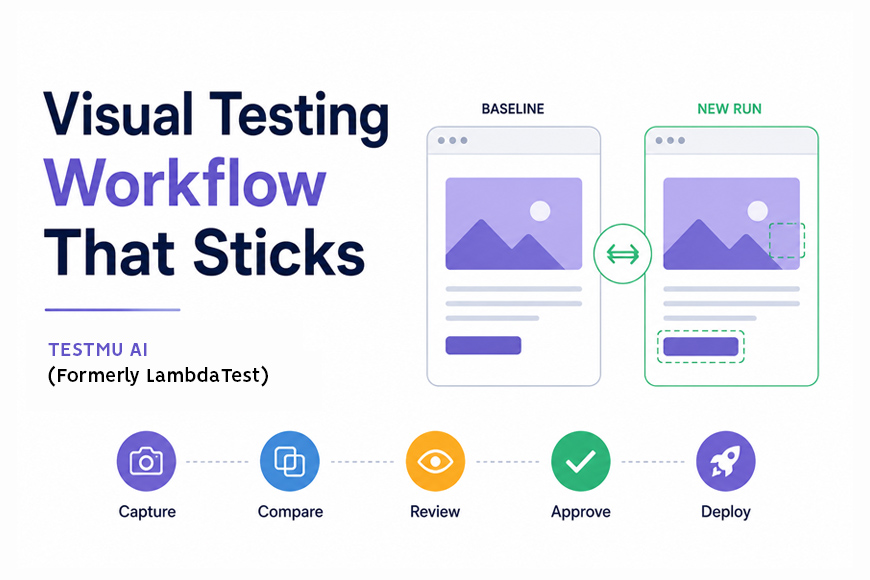
A durable workflow must be inseparable from the existing Pull Request (PR) process. When visual testing is treated as a separate, manual step, it is inevitably skipped during busy release windows. By integrating visual diffing directly into the CI/CD pipeline, every PR that changes the UI can automatically generate a visual report for the reviewer. This turns the baseline update into a deliberate, intentional act of code review, ensuring the baseline is always a reflection of current design intent.
Supporting Data: The Cost of Ignoring Visual Regressions
The business implications of visual bugs are frequently underestimated. While functional testing covers whether a button clicks, visual testing covers whether that button covers the navigation menu on a specific mobile viewport.
According to industry metrics, companies that rely solely on functional testing often miss up to 30% of visual regressions that impact user experience. These "silent bugs"—such as broken responsive layouts, misaligned input fields, or overlapping text—directly correlate with increased bounce rates and lower conversion metrics.
By leveraging cloud-based testing environments like those offered by TestMu AI, teams can run parallel tests across hundreds of device-browser combinations. This allows for the identification of cross-environment rendering issues that would be impossible to catch in a local development environment. Data indicates that teams utilizing automated cross-browser visual testing reduce their post-deployment visual hotfixes by an average of 40% within the first six months.
Official Perspectives: The Role of AI in Modern Validation
Industry experts increasingly emphasize the role of Artificial Intelligence in tempering the maintenance burden of visual testing. Traditional pixel-to-pixel comparison is rigid; a single-pixel shift could trigger a failure.
Modern tools, such as the updated suite at TestMu AI, now employ AI-driven algorithms that understand "content similarity" rather than just raw pixel data. These systems can differentiate between a "true" layout break and a minor, acceptable rendering variance. As one lead engineer noted, "The transition from pixel-matching to semantic understanding is what finally allowed our team to trust our automated visual tests. We stopped managing the tool and started managing the quality of our product."

Implications for Future-Proofing
A visual testing workflow is a living system. It requires ongoing maintenance, especially during significant UI redesigns or framework migrations.
The Maintenance Reality
Teams must budget for "maintenance cycles." When a major site overhaul occurs, a large portion of the existing baselines will naturally become obsolete. A mature team treats this as a scheduled task rather than a systemic failure. By acknowledging that visual testing has a non-zero maintenance cost, managers can allocate appropriate resources, preventing the burnout that typically leads to tool abandonment.
The Cloud Advantage
The move toward cloud-based execution is non-negotiable for modern, global applications. Relying on local machines for visual comparisons is a bottleneck that prevents scaling. By offloading these tests to platforms like TestMu AI, developers regain the ability to execute tests in parallel across diverse environments—ranging from legacy mobile browsers to the latest desktop versions—without slowing down the development cycle.
Conclusion: Turning the Safety Net into a Strategy
Visual testing is not a panacea, but it is a critical component of the modern quality assurance stack. To make it stick, organizations must pivot their philosophy:
- Start Small: Master the core flows before expanding the footprint.
- Prioritize Signal: Invest time in masking noise to maintain developer trust.
- Institutionalize Review: Make visual approval a mandatory check in the PR process.
- Embrace Real Environments: Use cloud infrastructure to catch cross-device bugs.
- Accept Maintenance: View baseline upkeep as a core part of the release lifecycle.
When built with these principles in mind, visual testing ceases to be an intermittent annoyance and becomes a durable safety net. By utilizing the advanced capabilities of platforms like TestMu AI, teams can move beyond the "well-intentioned effort" phase and establish a rigorous, automated standard of excellence that keeps the UI consistent, no matter how fast the code changes.
In the competitive landscape of digital products, the ability to release frequently without compromising on the pixel-perfect integrity of the user experience is a competitive advantage. The tools are ready; the question is whether the workflow is ready to support them.

 Nana Wu
 Sagoh
Sagoh