

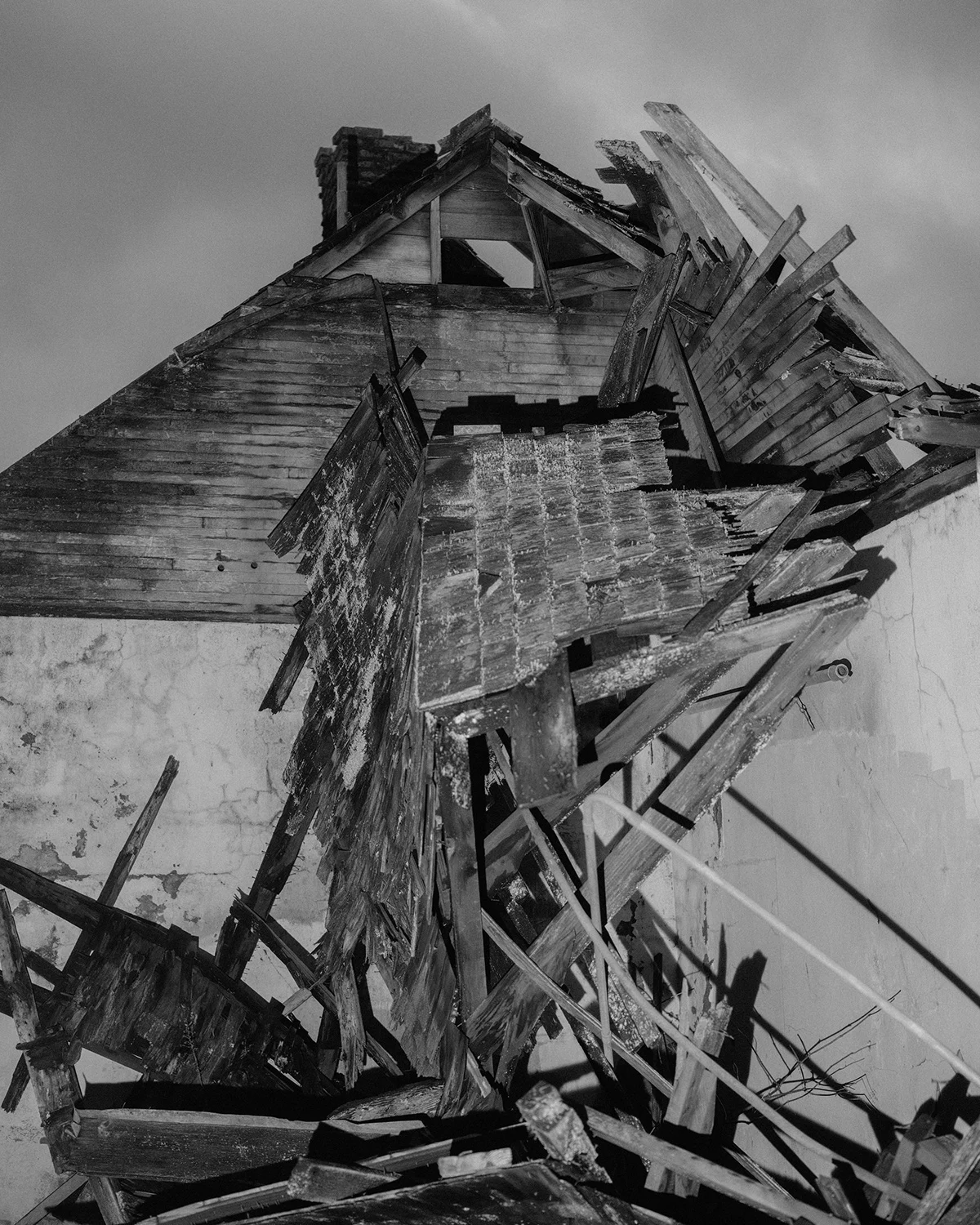
In the landscape of contemporary documentary photography, few works confront the visceral intersection of personal grief and historical excavation as unflinchingly as Brian Van Lau’s debut monograph, We’re Just Here for the Bad Guys. Published by the esteemed nonprofit organization Light Work, the book is more than a collection of images; it is a profound, meditative study on the nature of abandonment, the fragility of memory, and the restorative power of the camera lens.
At its core, the project chronicles Lau’s complex, often fractured relationship with his estranged father. Shaped by the shadow of incarceration and the long-term emotional fallout of absence, the narrative follows Lau’s journey from Hawai‘i to Vietnam, and eventually back to the shores of his youth, as he attempts to reconcile with a man who was simultaneously his primary source of trauma and a profound mystery.
The Architecture of Absence: Main Facts and Premise
We’re Just Here for the Bad Guys operates as a visual memoir. It captures the tension between the "bad guy"—the figure of the incarcerated, absent parent—and the human being who eventually succumbed to terminal illness.
The monograph is structured around a central paradox: the effort to build a relationship in the eleventh hour. When Lau received word that his father, who had moved to Vietnam following his release from prison, was suffering from terminal cancer, the photographer chose not to retreat. Instead, he traveled to Vietnam to witness the final chapter of his father’s life.
The resulting images are not merely clinical observations of decline. They are a collaborative effort—a dialogue held in the language of light and shadow. By handing his father a camera, or allowing his father to influence the composition of their shared reality, Lau transformed the documentation of death into a collaborative act of living. The book poses a fundamental question: When someone has been absent for a decade, how do you reintroduce yourself to them before they vanish entirely?
A Chronology of Reconnection and Discovery
To understand the weight of this monograph, one must trace the timeline of the project, which spans from childhood trauma to the post-mortem reconstruction of a family tree.
The Years of Silence
Lau’s childhood was defined by his father’s absence due to incarceration. During these formative years, the elder Lau existed more as a concept—a shadow in the family narrative—than a present figure. Following his eventual release, the father’s decision to relocate to Vietnam led to a near-decade-long period of total estrangement. For Lau, the "bad guy" moniker, while likely rooted in his father’s criminal past, became a shorthand for the pain of being left behind.
The Final Week
The catalyst for the project was a sudden medical crisis. Upon learning of his father’s terminal cancer diagnosis, Lau made the journey to Vietnam. The final week of his father’s life became the crucible of their relationship. During this time, they engaged in a photographic project—a desperate, beautiful attempt to document the unsuccessful recovery. This period serves as the emotional heart of the book, where the roles of "son" and "estranged father" were momentarily suspended in favor of "artist" and "subject."
The Return to Hawai‘i
Following his father’s passing, Lau returned to his hometown in Hawai‘i. The burden of the journey shifted from caretaking to commemoration. Entrusted with the task of dispersing his father’s ashes across the island of O‘ahu, Lau found himself confronted with a new set of questions. Who was this man, really? What parts of his life remained hidden in the diaspora of his past?
The Genealogical Excavation
Back in Hawai‘i, the final phase of the project began. Working closely with his grandparents, Lau began to piece together the fragmented history of his family. By sifting through old photographs, archives, and oral histories, he began to reconcile the "bad guy" of his childhood memories with the nuanced, flawed, and ultimately human reality of his father’s life.
Supporting Data: The Craft of the Monograph
The significance of We’re Just Here for the Bad Guys lies in its technical and thematic execution. Light Work, the publisher, has long been a champion of artists who push the boundaries of narrative photography. Their decision to publish this work speaks to its caliber.
- Visual Language: The book utilizes a mix of candid portraits, still-life imagery, and archival documents. The transition between the high-contrast, often claustrophobic images of the Vietnam hospital room and the sweeping, oceanic landscapes of O‘ahu creates a rhythm of entrapment and release.
- Archival Integration: By weaving in his grandparents’ personal artifacts, Lau moves the project from a private diary to a socio-historical document. It reflects the broader experience of many immigrant families, where history is often kept in shoeboxes and whispered in fragments.
- The Collaborative Lens: The most striking data point of the project is the collaboration itself. The fact that the subject participated in his own documentation suggests a reclamation of agency. In the face of death, the father was granted the opportunity to be seen, rather than just judged.
Official Responses and Critical Reception
Since its release, the monograph has garnered significant attention from the arts community. Critics have praised the work for its "brutal honesty" and "narrative bravery."
"Brian Van Lau has managed to do something incredibly difficult," wrote one reviewer in an early arts journal feature. "He has taken the most difficult relationship in his life and held it up to the light, not to burn it, but to see it clearly."
Light Work’s curation of the project highlights their commitment to "the long-form narrative." By supporting Lau, they have provided a platform for a conversation that is rarely held in the public sphere: the conversation between the child of an incarcerated parent and the parent themselves. The organization emphasizes that the book is not merely a memorial; it is an interrogation of the American carceral system’s impact on the family unit, viewed through the lens of a personal, intimate journey.
Implications: Why This Story Matters
The implications of We’re Just Here for the Bad Guys extend far beyond the personal experience of the Lau family.
On the Nature of Forgiveness
The project serves as a profound meditation on forgiveness. It posits that forgiveness is not an act of erasing the past or excusing the "bad guy" behavior. Instead, it is an act of understanding the context of that behavior. By uncovering his father’s history, Lau does not necessarily exonerate him, but he contextualizes him. This is a vital distinction for anyone dealing with the long-term effects of parental absence.
On the Role of Photography in Grief
In the digital age, we take thousands of photos, yet we rarely use the medium to process complex emotional states. Lau’s work challenges the viewer to use the camera as a tool for introspection. The act of photographing the dying process, as morbid as it may seem to some, is framed here as an act of profound love. It is a way of saying, "I am here, and I am watching you, and you are not alone."
The Socio-Political Context
We cannot overlook the role of the prison system in this narrative. The "bad guy" label is often a byproduct of a system that focuses on punishment rather than rehabilitation. The book subtly highlights how the carceral system creates a vacuum in the home—a vacuum that, even after the physical body returns, is rarely filled. By documenting this, Lau contributes to the growing body of literature and art that demands we look at the human cost of incarceration.
Conclusion: A Legacy of Light
We’re Just Here for the Bad Guys is a haunting, necessary contribution to the genre of the photographic monograph. It reminds us that our parents are not merely the roles they play in our lives, but individuals with their own histories, struggles, and limitations.
Brian Van Lau has succeeded in creating a work that is both intensely local—rooted in the specific geography of O‘ahu and the specific circumstances of his family—and universally resonant. For those who have ever grappled with the mystery of an absent parent, or who have sought to find peace in the wake of a difficult death, this book offers a roadmap. It does not provide easy answers, but it provides something far more valuable: a mirror in which we can see the complexity of our own histories.
We’re Just Here for the Bad Guys is currently available through Light Work. It is a essential addition to any collection that values photography as a medium for healing and historical truth. Through his lens, Lau has done more than just remember his father; he has ensured that his father’s story—with all its flaws and all its shadows—is finally, clearly, seen.











No comments yet. Be the first to join the conversation!