


In the pantheon of speculative fiction, two pillars stand taller than all others: J.R.R. Tolkien’s The Lord of the Rings and Frank Herbert’s Dune. Both works are monumental, characterized by unparalleled world-building, intricate histories, and linguistic depth that have captivated generations of readers. For decades, literary critics and fans alike have drawn parallels between the two, positioning them as the dual summits of fantasy and science fiction.
However, the authors behind these behemoths did not share this mutual admiration. In a revelation that has surfaced via rediscovered correspondence, it is clear that J.R.R. Tolkien—the architect of Middle-earth—viewed Frank Herbert’s seminal sci-fi masterpiece with a profound and, at times, visceral distaste.
The Foundations of World-Building
To understand the friction between these two giants, one must first appreciate the scope of their respective projects. Tolkien, a philologist by trade, began his journey with The Hobbit (1937) before expanding his reach into the dense, mythological tapestry of The Lord of the Rings (1954). His work was deeply rooted in Northern European folklore, Anglo-Saxon linguistics, and a desire to create a "mythology for England." The result was an impossibly detailed world, complete with functional languages, complex genealogies, and a moral framework influenced by his devout Catholic faith.
Roughly a decade later, Frank Herbert unleashed Dune (1965) upon the literary world. Where Tolkien looked to the past, Herbert looked to the distant, technologically advanced future. Dune was an ecological and political treatise disguised as a space opera. It focused on the desert planet Arrakis, the sole source of the spice melange—the most valuable substance in the universe—and the machinations of Great Houses, the Spacing Guild, and the Bene Gesserit sisterhood. Like Tolkien, Herbert invented a sprawling glossary of terms, religions, and social structures.
For the reading public, the comparison was inevitable. Both series demanded total intellectual surrender; both were "impenetrable" to the casual reader. Yet, while fans saw them as two sides of the same epic coin, Tolkien saw something entirely different.

The 1966 Letter: A Candid Admission of Hatred
The historical evidence of Tolkien’s disdain is preserved in a letter dated 1966, addressed to his friend and correspondent, John Bush. The letter was later included in the reference volume Tolkien’s Library: An Annotated Checklist. The document surfaced in the public consciousness after being highlighted by the archival account @SecretsOfDune, sparking a wave of discourse among literary historians.
In the letter, Tolkien addresses the receipt of a copy of Dune, which had been sent to him by a friend named Sterling Lanier. It appears that Tolkien’s inner circle—perhaps sensing the burgeoning popularity of Herbert’s work—repeatedly pressured the Oxford professor to engage with the sci-fi epic. Tolkien’s response was a masterclass in polite but firm intellectual rejection:
"Thank you for sending me a copy of ‘Dune.’ I received one last year from [Sterling] Lanier and so already know something about the book. It’s impossible for an author still writing to be fair to another author working along the same lines. At least I find so. In fact, I dislike ‘Dune’ with some intensity, and in that unfortunate case, it is much the best and fairest to another author to keep silent and refuse to comment."
Tolkien’s choice of words—"dislike ‘Dune’ with some intensity"—is striking. He was a man who famously avoided criticizing his peers, preferring silence to negativity. That he explicitly mentioned his "intensity" of feeling suggests that Dune did not merely bore him; it likely offended his sensibilities on a fundamental level.
Philosophical Divides: Faith vs. Cynicism
While Tolkien never provided a detailed critique of Dune—a choice he likely made to avoid the public spectacle of a "writer’s war"—scholars have long speculated on the root causes of his animosity.

The primary divergence lies in their treatment of power and religion. Tolkien’s Middle-earth is a place where, despite the presence of corruption and the looming threat of Sauron, there is an objective moral reality. His work champions the "eucatastrophe"—the sudden, joyous turn of events that saves the protagonists, often fueled by acts of pity, mercy, and sacrifice. For Tolkien, faith was a light that fought against the encroaching darkness.
In contrast, Dune is fundamentally cynical. Herbert’s universe is one of "power politics," where religion is a weaponized tool used to control the masses. The messianic figure of Paul Atreides is not a beacon of hope, but a cautionary tale about the dangers of charismatic leaders and the fanaticism they inspire. Where Tolkien sees the potential for divine grace, Herbert sees the inevitable degradation of human institutions. It is highly probable that Tolkien, a man of faith, found the cold, clinical, and Machiavellian nature of Herbert’s universe to be morally repulsive.
The Legacy of the Conflict
The debate between the merits of Dune and The Lord of the Rings has evolved from a literary squabble into a full-scale pop-culture rivalry, mirrored by the current state of blockbuster filmmaking.
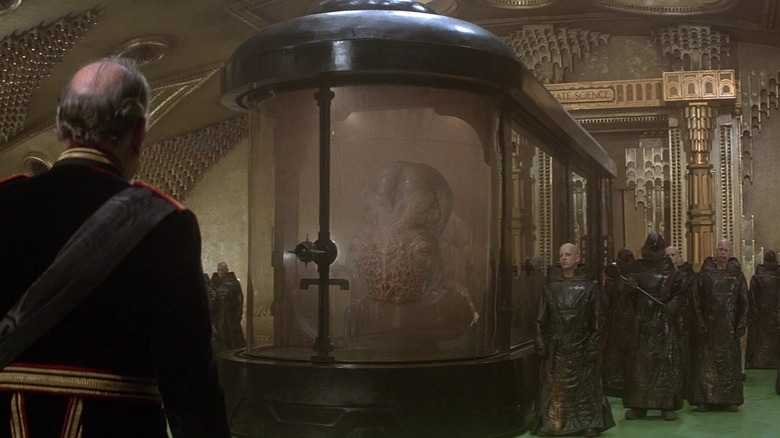
The early 2000s saw Peter Jackson cement the legacy of Middle-earth with his Academy Award-winning film trilogy, a feat that brought Tolkien’s world to the masses with unprecedented fidelity. Simultaneously, the 2020s have been dominated by Denis Villeneuve’s Dune adaptations, which have been praised for capturing the "hard" sci-fi, political, and philosophical weight of Herbert’s writing.
With the expansion of both universes into television—Amazon’s The Rings of Power and HBO’s Dune: Prophecy—the two franchises are once again occupying the same cultural space. The "war" between the two is no longer just on the bookshelf; it is on our streaming platforms and in the box office, with each property representing a different philosophy of storytelling.
Implications for Modern Storytelling
What does Tolkien’s dislike of Dune tell us about the nature of creativity? It underscores the inherent difficulty in one creator objectively analyzing the work of another, especially when they occupy the same sub-genre.
Tolkien’s hesitation to comment was, in his own words, a "fair" act. He understood that when you are building a world of your own, you are building it on the foundation of your own beliefs and values. To step into someone else’s world—especially one that mimics the complexity of your own while subverting your moral core—is to invite an intellectual conflict that can be difficult to reconcile.
Ultimately, whether one prefers the lush, romantic, and hope-filled landscapes of Middle-earth or the harsh, unforgiving, and politically charged dunes of Arrakis is a matter of personal temperament. Tolkien preferred the song and the legend; Herbert preferred the strategy and the sociology.
As we continue to navigate the expansive universes these two men left behind, we can appreciate the friction between them. It serves as a reminder that the greatest stories are not those that everyone agrees upon, but those that force us to confront our own values. J.R.R. Tolkien may have hated Dune, but his reaction serves as a testament to the power of both works: they were, and remain, impossible to ignore.











No comments yet. Be the first to join the conversation!