Laily UPN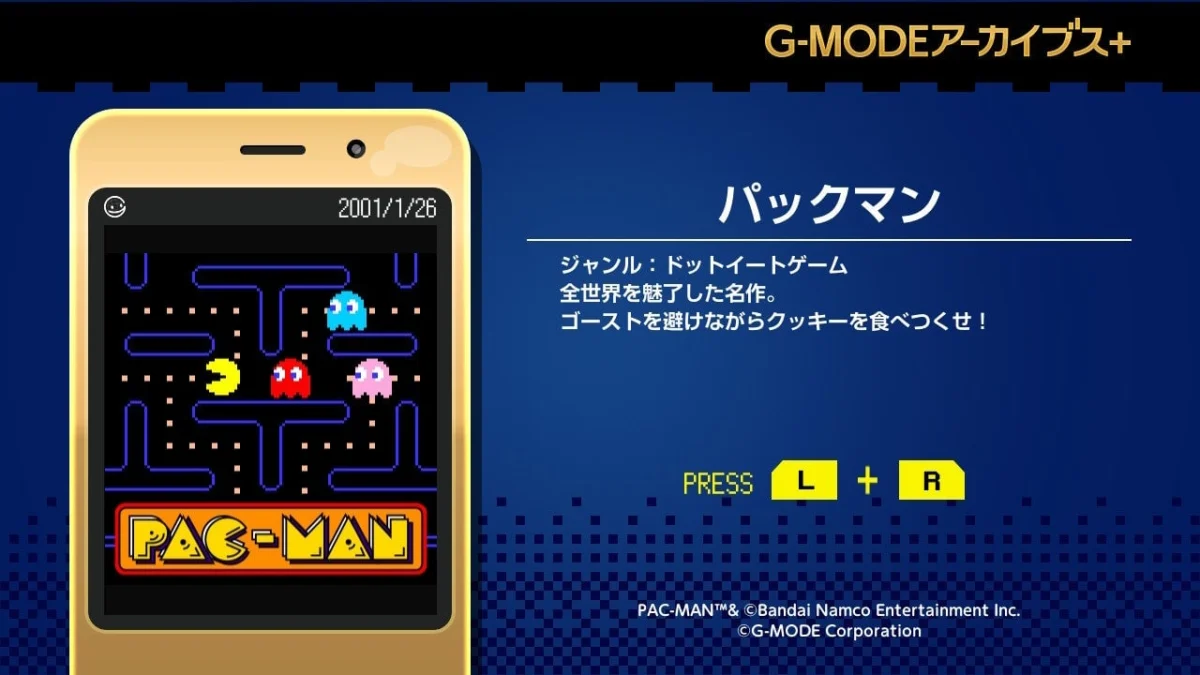
TOKYO, Japan – G-MODE Corporation, a prominent entity in the realm of digital game preservation, has officially announced the impending release of the feature phone rendition of the iconic arcade game, PAC-MAN, as part of its esteemed G-MODE Archives+ series. This meticulously preserved version of the classic maze-chase game is set to launch digitally on June 18 in Japan, making its debut on the Nintendo Switch via the Nintendo eShop and for PC through Steam. Priced at 800 yen (approximately $5.10 USD), this release marks a significant moment for both retro gaming enthusiasts and advocates of digital cultural preservation, offering a window into a unique chapter of PAC-MAN‘s storied history.
The announcement, made by G-MODE Corporation, confirms that this particular iteration of PAC-MAN is a direct port of the version originally developed for Japanese flip phones – devices that predated the global smartphone revolution and held a significant cultural and technological footprint in Japan. The company has emphasized its commitment to authenticity, stating that the release will not introduce modern enhancements such as additional languages or achievement systems, thereby preserving the original feature phone experience in its entirety. This philosophy aligns with the core mission of the G-MODE Archives+ initiative: to make historically significant, yet increasingly inaccessible, mobile games available to contemporary audiences on modern platforms.
Main Facts: A Digital Resurrection
The core of this announcement revolves around the digital re-release of a specific, somewhat obscure, version of PAC-MAN. While the original arcade game from Bandai Namco Entertainment (then Namco) is universally recognized, its journey through various hardware iterations often leaves certain versions relegated to the annals of history. The feature phone version represents one such chapter, tailored for the unique constraints and user interfaces of early 21st-century mobile phones.
This upcoming release through the G-MODE Archives+ platform is not merely a nostalgic trip; it’s an act of digital preservation. G-MODE Corporation, known for its extensive catalog of games developed for feature phones, has taken on the mantle of archiving these titles before they are lost to technological obsolescence. The choice of PAC-MAN as a candidate for this preservation effort underscores its enduring cultural significance and broad appeal, even in its most simplified forms.
Scheduled for a June 18 release, the game will be available for purchase at 800 yen. The dual-platform launch on Nintendo Switch and PC (via Steam) ensures wide accessibility for players who might prefer either a portable console experience or a desktop gaming setup. This multi-platform strategy is characteristic of the G-MODE Archives+ series, aiming to reach as broad an audience as possible for these digitally unearthed treasures. The game overview, as detailed on its Steam page, highlights its nature as a direct port, emphasizing the "timeless masterpiece" status of PAC-MAN and its simple, yet deeply engaging, mechanics of "eating all Pac-Dots while dodging the ghosts!" The specific naming of the four iconic ghosts – Oikake (red), Machibuse (pink), Kimagure (light-blue), and Otoboke (orange) – further grounds this release in the authentic PAC-MAN lore.
Chronology: From Arcades to Pockets and Beyond
To fully appreciate the significance of this G-MODE Archives+ release, it’s crucial to trace the evolutionary path of PAC-MAN and the rise of mobile gaming.
The Genesis of a Gaming Icon: 1980 and Beyond
PAC-MAN first burst onto the scene in 1980, an arcade game developed by Toru Iwatani for Namco (now Bandai Namco Entertainment). Its colorful characters, unique maze-chase gameplay, and non-violent premise immediately set it apart from the space shooters and sports games prevalent at the time. It became a cultural phenomenon, spawning merchandise, a cartoon series, and even a hit song. PAC-MAN‘s success was pivotal in establishing video games as a mainstream form of entertainment, transcending gender and age barriers. Its simple rules – eat all the Pac-Dots, avoid the ghosts, use Power Cookies to turn the tables – masked a surprising depth of strategy and skill, ensuring its longevity.
Mobile Gaming’s Early Frontier: The Feature Phone Era in Japan
Before the advent of the iPhone in 2007 and the subsequent global smartphone boom, mobile gaming had a vibrant, albeit often overlooked, history, particularly in Japan. The late 1990s and early 2000s saw the widespread adoption of "feature phones" – mobile phones with more advanced capabilities than basic talk-and-text devices, but lacking the sophisticated operating systems and app ecosystems of modern smartphones.
In Japan, carriers like NTT DoCoMo, au, and SoftBank (then J-PHONE/Vodafone K.K.) developed robust platforms for delivering content to these devices. Services like i-mode (NTT DoCoMo) allowed users to download small applications, including games, directly to their phones. These games were often developed with significant memory and processing power constraints, leading to creative solutions in game design and optimization. For many Japanese consumers, their feature phone was their primary, and often only, gaming device outside of dedicated consoles. Major publishers, including Bandai Namco, adapted their most popular franchises, including PAC-MAN, for this burgeoning mobile market, ensuring their iconic characters were accessible on the go. These feature phone versions often featured simplified graphics, touch-tone or directional pad controls, and gameplay mechanics tweaked to suit short play sessions.
G-MODE Archives+: A Mission of Digital Preservation
G-MODE Corporation itself played a significant role in this era, developing numerous games for feature phones. Recognizing the inherent ephemerality of digital content, especially for platforms that become obsolete, G-MODE launched the G-MODE Archives (later G-MODE Archives+) initiative. This project aims to meticulously port and release a curated selection of these vintage mobile games to modern platforms like the Nintendo Switch and PC. Their efforts are crucial for digital cultural heritage, ensuring that a significant chapter of gaming history, largely confined to Japan, does not fade into obscurity. The G-MODE Archives+ series is a testament to the company’s dedication to preserving these unique gaming experiences, offering them to a new generation of players and allowing veterans to revisit cherished memories.
The Feature Phone PAC-MAN’s Journey to Modern Platforms
The specific feature phone version of PAC-MAN now being released is a product of this rich history. It represents a particular adaptation of a global phenomenon to a specific technological context. Its re-release is not just about making a game available; it’s about showcasing the ingenuity of developers working under constraints and providing a historical artifact for study and enjoyment. By bringing this version to Switch and PC, G-MODE Corporation closes a loop, bringing a game from a technologically limited, niche platform to widely accessible, powerful modern systems, bridging decades of gaming evolution.
Supporting Data: Deep Dive into Preservation and Gameplay
The decision to port the feature phone version of PAC-MAN with an emphasis on authenticity reveals much about G-MODE’s approach and the unique characteristics of this specific title.
A Deep Dive into the G-MODE Archives+ Initiative
The G-MODE Archives+ series is more than just a collection of retro games; it’s a digital museum. Each title brought under its banner undergoes a careful process of porting to ensure fidelity to the original experience. This often involves intricate emulation or re-coding to adapt the game’s engine and assets to modern hardware while maintaining the original pixel art, sound, and control schemes. For PAC-MAN, this means preserving the specific graphical style, the distinct sound effects, and the precise timing of the ghosts that defined its feature phone incarnation. The series has already brought dozens of titles to modern platforms, ranging from unique puzzle games to adventure titles and action games, collectively painting a vivid picture of the diverse mobile gaming landscape of early 2000s Japan.
Authenticity Over Augmentation: The Porting Philosophy
G-MODE Corporation’s explicit statement that "This release does not add elements such as languages and achievements that were not part of the original version" is central to its preservation philosophy. In an era where many retro re-releases offer quality-of-life improvements, graphical enhancements, or expanded content, G-MODE chooses a purist path. This approach ensures that players experience PAC-MAN exactly as feature phone users did, complete with its original Japanese text (where applicable in menus, though PAC-MAN is largely language-agnostic) and without the modern conveniences of achievement systems. While some players might desire such additions, this fidelity is invaluable for historical accuracy and provides a genuine glimpse into the constraints and design choices of the original developers. It’s a commitment to presenting the artifact as it was, rather than reimagining it for contemporary tastes. This also implies that the game will likely run in its original aspect ratio, possibly with borders or filters to mimic older displays, further enhancing the retro feel.
Gameplay Mechanics: Timeless Simplicity Preserved
The core gameplay of PAC-MAN is deceptively simple: navigate a maze, eat all the Pac-Dots, and avoid the four colorful ghosts. This simplicity is precisely why it transcended technological eras and remained compelling even on limited feature phone hardware.
- Pac-Dots: The primary objective is to consume every single Pac-Dot scattered throughout the maze. This provides a clear, tangible goal for each round.
- Power Cookies (Power Pellets): Strategically placed in each corner of the maze, these larger dots temporarily turn the ghosts blue, making them vulnerable. During this brief window, PAC-MAN can eat the ghosts for bonus points, sending them back to their central "home" to regenerate. Mastering the timing and placement of Power Cookie consumption is key to high scores and survival.
- The Four Ghosts: The intelligence and distinct personalities of the ghosts are a cornerstone of PAC-MAN‘s design. As per the Steam page description:
- Oikake (Red, Blinky): Known as "Shadow" in the English arcade version, Oikake (meaning "chaser" or "pursuer") is the most aggressive ghost, constantly chasing PAC-MAN‘s current position.
- Machibuse (Pink, Pinky): Known as "Speedy" or "Ambusher," Machibuse (meaning "ambush") attempts to cut PAC-MAN off, often predicting his movements to get ahead.
- Kimagure (Light-Blue, Inky): Known as "Bashful" or "Fickle," Kimagure (meaning "fickle" or "whimsical") has a more complex and unpredictable AI, often behaving somewhat randomly but also influenced by both PAC-MAN‘s position and Blinky’s.
- Otoboke (Orange, Clyde): Known as "Pokey" or "Feigned Ignorance," Otoboke (meaning "feigning ignorance" or "feigning deafness") is the most elusive. It chases PAC-MAN when close but retreats to its corner of the maze when PAC-MAN gets too near, creating a unique challenge.
The feature phone version, while constrained by resolution and input methods (often a directional pad or numpad keys), would have aimed to replicate these core mechanics as faithfully as possible. The simplicity of PAC-MAN‘s controls – simply moving up, down, left, and right – made it particularly well-suited for such devices, requiring minimal adaptation.
The Enduring Appeal of PAC-MAN
PAC-MAN‘s universal appeal stems from several factors: its simple, yet challenging gameplay; its charming, non-threatening characters; and its intuitive controls. It’s a game that can be picked up and understood in seconds but takes a lifetime to master. This timeless design means that even a feature phone port, stripped of modern graphical bells and whistles, retains its fundamental enjoyment. For many, it’s not just a game, but a piece of cultural history that continues to resonate across generations.
Market Dynamics and Nostalgia
The decision to release this specific version of PAC-MAN is also a savvy move within the retro gaming market. There’s a strong and growing demand for classic games, driven by both nostalgia among older players and curiosity among younger audiences interested in gaming’s roots. The G-MODE Archives+ taps into this by offering unique historical artifacts rather than just re-releasing readily available console versions. The relatively low price point of 800 yen makes it an accessible impulse purchase, further capitalizing on the retro wave.
Technical Considerations for a Feature Phone Port
Porting a feature phone game to modern platforms presents its own set of technical challenges. Feature phones had small, low-resolution screens (e.g., 240×320 pixels) and limited color palettes. The game would have been optimized for these displays. On a large monitor or TV screen, the pixel art will be significantly magnified. G-MODE likely employs scaling algorithms or optional display filters to ensure the visuals are appealing without distorting the original art style. Similarly, input from a physical directional pad or numerical keypad must be accurately mapped to modern controllers (Switch Joy-Cons/Pro Controller) and PC input devices (keyboard/gamepad), ensuring a responsive and authentic feel. The absence of new languages means the game’s internal text and UI remain as they were, a crucial detail for preservationists.
Official Responses: G-MODE’s Vision and Bandai Namco’s Legacy
The announcement of this specific PAC-MAN release comes directly from G-MODE Corporation, highlighting their proactive role in digital preservation.
G-MODE Corporation’s Vision
G-MODE’s public statement and the very existence of the G-MODE Archives+ initiative serve as their official response. Their motivation is clear: to rescue and reintroduce a vast library of feature phone games that represent a unique and often overlooked era of mobile gaming. By specifically choosing PAC-MAN, they are leveraging a universally recognized IP to draw attention to their broader preservation efforts. Their commitment to a "no added elements" policy is a strong statement of their dedication to historical accuracy and providing an unadulterated experience of these vintage titles. They are not merely selling games; they are curating and presenting digital history. The company likely sees this as an opportunity to both generate revenue from an existing asset base and solidify its reputation as a champion of retro game preservation.
Bandai Namco’s Legacy
While G-MODE is the publisher for this specific port, Bandai Namco Entertainment remains the original creator and rights holder of the PAC-MAN franchise. Their implicit approval for G-MODE to port and release this specific feature phone version speaks to their willingness to allow partners to explore different facets of their vast IP catalog. It also underscores Bandai Namco’s own ongoing efforts to keep PAC-MAN relevant across various platforms and generations, from modern remakes to archival releases. This collaboration allows a specific, older version of PAC-MAN to see the light of day again, extending the reach of the classic character to a new context.
Implications: The Future of Digital Preservation and Retro Gaming
The release of the feature phone version of PAC-MAN has several broader implications for the retro gaming market, digital preservation, and the future trajectory of G-MODE Archives+.
The Future Trajectory of G-MODE Archives+
This high-profile PAC-MAN release could significantly elevate the visibility of the G-MODE Archives+ series. While G-MODE has released many interesting titles, PAC-MAN holds a unique place in gaming history. Its inclusion could attract a wider audience to the Archives+, potentially leading to increased sales for other titles in the collection and encouraging G-MODE to pursue similar collaborations with other major publishers holding rights to feature phone classics. This could open doors for more iconic Japanese mobile games from the pre-smartphone era to be preserved and rereleased.
Broadening the Scope of Digital Game Preservation
The PAC-MAN release reinforces the critical importance of digital game preservation. As technology rapidly evolves, older digital content, especially from platforms like feature phones, becomes incredibly vulnerable to being lost forever. Initiatives like G-MODE Archives+ are essential in combating this digital decay, ensuring that future generations can experience and study the history of interactive entertainment. This specific release highlights that preservation efforts must extend beyond just arcade and console titles to encompass all forms of gaming, including early mobile iterations. It also serves as a reminder that the history of mobile gaming is far richer and deeper than just the smartphone era.
Player Expectations and Engagement
The "no added elements" policy will likely divide player opinion. Purists and preservationists will applaud the commitment to authenticity, valuing the opportunity to experience the game exactly as it was. However, some modern players, accustomed to conveniences like save states, rewind features, or graphical filters common in other retro collections, might find the lack of such features limiting. Nevertheless, the charm and inherent fun of PAC-MAN are expected to transcend these debates, attracting both nostalgic fans and curious newcomers. The relatively low price point also mitigates potential disappointment for those expecting a more modernized experience.
The Enduring Power of Simplicity
Ultimately, the re-release of this feature phone PAC-MAN underscores the enduring power of simple, well-designed game mechanics. Despite its technological limitations and the passage of decades, PAC-MAN‘s core loop remains as compelling as ever. It’s a testament to Toru Iwatani’s original vision and the universal appeal of his creation. This particular version, stripped down to its essentials for early mobile devices, perhaps best exemplifies the core brilliance of PAC-MAN: pure, unadulterated maze-chase fun. As players navigate the familiar mazes on their modern devices, they will not only be enjoying a classic game but also participating in a unique act of digital archaeology, connecting with a forgotten piece of gaming’s rich and diverse past.


 Lina Irawan
 Sagoh
Sagoh