

In the world of high-stakes blockbuster filmmaking, the difference between an homage and an allegation of plagiarism is often a matter of mere degrees. As production gears up for the highly anticipated 2026 release of Travis Knight’s Masters of the Universe, the creative team has found themselves navigating a peculiar hurdle: the shadow cast by the insectoid aircraft of Arrakis.
Denis Villeneuve’s Dune (2021) redefined the cinematic aesthetic of the science-fiction epic, and at the heart of its visual language were the ornithopters—agile, dragonfly-like vessels that utilized flapping wings rather than traditional rotors. However, for Guy Hendrix Dyas, the production designer tasked with bringing the world of Eternia to life, these iconic ships created a "huge problem." With the public consciousness now firmly linked to the ornithopter’s design, the Masters of the Universe team has had to engage in a rigorous creative pivot to ensure their own classic vehicle, the Fright Fighter, doesn’t appear to be a derivative copy.
The Convergence of Science Fiction Aesthetics
To understand the tension, one must look at the lineage of both designs. While Frank Herbert’s source material for Dune explicitly described ornithopters as bird-like—a nod to the etymology of the word "orni"—Villeneuve’s adaptation opted for a dragonfly-inspired silhouette. This choice was both aesthetically striking and grounded in a terrifying, predatory reality.
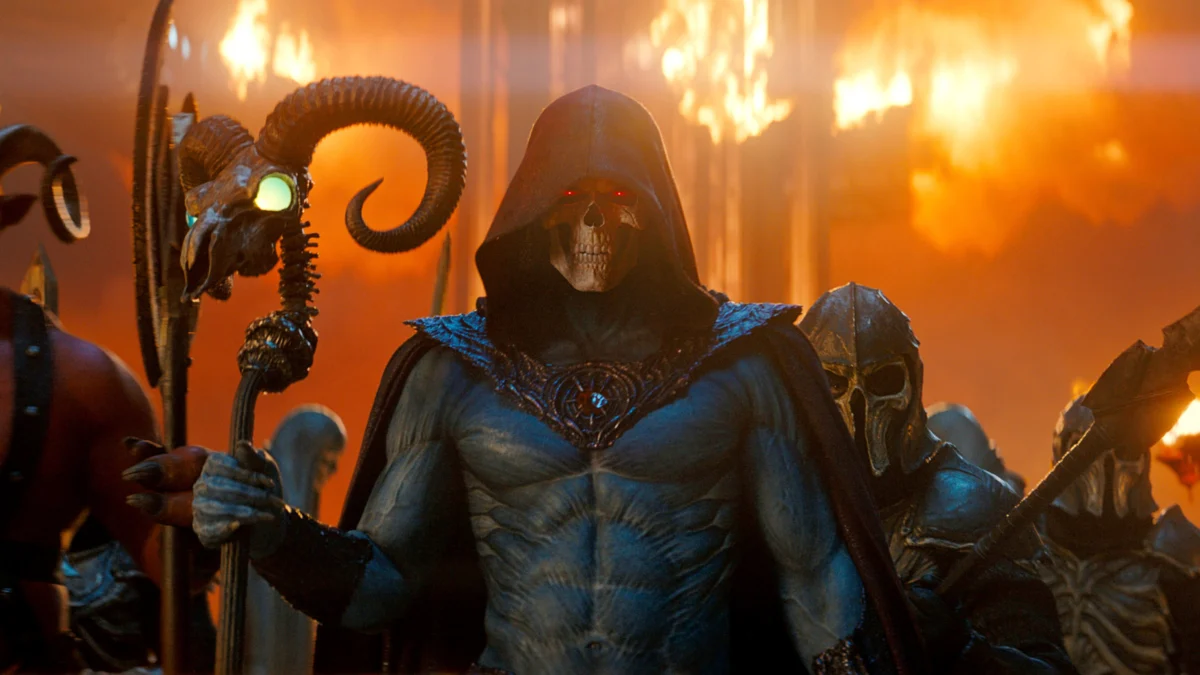
Conversely, the Fright Fighter has been a staple of the Masters of the Universe toy line and animation legacy for decades. Originally conceived during the height of the 1980s aesthetic, the craft was a staple of Skeletor’s arsenal. When Travis Knight, known for his work on Bumblebee and Kubo and the Two Strings, stepped into the director’s chair, he sought to honor the vibrancy of the source material while modernizing it for a contemporary audience.
The conflict is one of chronology versus perception. The Fright Fighter predates the modern Dune films by decades, yet in the age of social media, the first iteration to reach mass cultural saturation often claims the "originality" crown in the eyes of the public. "I secretly believe, and I’ve yet to find this out, that whoever designed [the Dune ornithopter] maybe was a fan of Masters of the Universe," Dyas speculated during a set visit. Regardless of the artistic intent behind the Dune design, the visual overlap became an undeniable roadblock for the production team on Masters of the Universe.
A Chronological Breakdown: Who Flew First?
The history of the Fright Fighter is rooted in the "Masters of the Universe" toy line produced by Mattel in the mid-1980s. It was a utilitarian, terrifying-looking craft designed to mirror the dark, magical aesthetic of the Snake Mountain dwellers. Throughout the Filmation animated series, the vehicle was depicted with rigid, insect-like wings and a color palette that screamed "villainy."
In stark contrast, the ornithopters of Arrakis were a deliberate departure from literary description. Villeneuve’s vision moved away from the more traditional aircraft of previous adaptations, favoring the vibrating wing mechanics that felt organic and alien. By the time Dune: Part One hit theaters in 2021, the ornithopter had become a symbol of prestige sci-fi design.
The challenge for the Masters of the Universe team is that the Fright Fighter, in its original toy form, looks deceptively similar to the Dune craft when placed in a modern, high-fidelity film environment. If the team had simply translated the toy into a live-action asset, audiences would have inevitably accused the production of "ripping off" the aesthetic that made Dune so successful. The truth—that the Fright Fighter design predates the modern ornithopter by nearly forty years—would likely be ignored in the "court of public opinion."
The Creative Pivot: Distinguishing Eternia from Arrakis
Facing the risk of being branded a copycat, Travis Knight and Guy Hendrix Dyas initiated a series of design adjustments that go beyond simple surface-level changes. The goal was to maintain the integrity of the original toy while introducing mechanical movements and features that felt distinctly "Eternian."
1. The Dynamic Tail
One of the most significant changes proposed by Knight involves the structural flexibility of the craft. "He said, ‘What would happen if, like a dragonfly, the tail could actually flex and bend?’" Dyas explained. By introducing a tail that mimics the fluid, rhythmic movement of an actual insect, the Fright Fighter gains a sense of predatory grace that sets it apart from the more rigid, mechanical nature of the Dune ornithopters.
2. Integrated Landing Gear
In many science fiction designs, landing gear is an afterthought—a secondary piece of hardware that drops down upon approach. The Masters team decided to integrate the landing mechanism directly into the propulsion system. In their version, the rotors themselves serve a dual purpose, transitioning into legs when the craft touches down. This creates a functional uniqueness that serves as a mechanical "fingerprint," distinguishing it from the traditional landing struts used in the Dune vehicles.
3. Embracing the "Camp" Color Palette
Perhaps the most bold decision involves the color scheme. In an era where "gritty realism" dominates blockbuster sci-fi—often resulting in a sea of metallic grays, rusted browns, and muted beiges—the Masters of the Universe production is doubling down on the neon-infused, high-saturation aesthetic of the 1980s.
"What I’ve tried to do in every case is make sure that all the vehicles adhere to the original color schemes of the toys and the animation," Dyas noted. By utilizing bold purples and vibrant blues, the Fright Fighter avoids the desert-camouflage aesthetic of Arrakis entirely. It serves as a visual reminder that Eternia is a world of magic and fantasy, not a bleak, grounded reality.
Implications for Future Franchise Filmmaking
The struggle to differentiate the Fright Fighter highlights a broader issue in modern blockbuster production: the "aesthetic homogenization" of science fiction. As films increasingly share visual language, designers find themselves in a race to claim unique silhouettes.
When a film like Dune establishes a dominant visual trope, it forces every subsequent production to either adopt that trope or perform a "creative pivot" to avoid comparisons. For the Masters of the Universe production team, the "huge problem" was not just a design hurdle—it was a strategic marketing necessity. If the film were released with a design that appeared even vaguely similar to a recent, massive hit, the discourse would be dominated by comparisons rather than the film’s own merits.
By leaning into the original toy’s "campy" colors and innovating the mechanical movement of the craft, Knight and Dyas are attempting to reclaim the design’s identity. It is an act of preservation—reminding audiences that the tropes we associate with "modern" sci-fi often have deep roots in the pop culture of the past.
Looking Ahead: The June 2026 Release
As the release date of June 5, 2026, approaches, the success of these design choices will be put to the test. Fans of the original Masters of the Universe are notoriously protective of the source material, while general audiences are accustomed to the polished, grounded look of contemporary sci-fi epics.
The Fright Fighter serves as a microcosm for the entire project. The film must balance the nostalgia of a generation that grew up with the toys and the expectations of a modern audience accustomed to the scale of films like Dune or Guardians of the Galaxy. If the Fright Fighter can successfully marry the iconic purple-and-blue aesthetic of the 80s with the fluid, insect-like movement of the new design, it may well prove that you don’t have to abandon the past to create something that feels entirely new.
In the end, the "Dune problem" may turn out to be the best thing that happened to the Masters of the Universe production. It forced the creative team to push beyond the obvious, ensuring that their vehicles aren’t just copies of what came before, but a unique evolution of a classic legacy. When the Fright Fighter finally takes flight in 2026, it will be carrying more than just Skeletor’s minions; it will be carrying the burden of proving that Eternia has a place in a modern sci-fi landscape, entirely on its own terms.











No comments yet. Be the first to join the conversation!