


For many social media agency owners, the "Tuesday Afternoon Crisis" is a familiar ritual. You are on a call with a long-standing client—perhaps one paying $1,800 a month for two years—and the conversation shifts from strategy to skepticism. The client poses the dreaded question: "I just feel like we’re not getting enough value."
For the agency owner, the frustration is palpable. You posted 20 times last month, replied to every comment, and delivered a polished report on time. Yet, you find yourself on the defensive, justifying your invoice rather than discussing growth. This friction is the inherent flaw of the traditional fixed-retainer model. As platforms evolve, algorithms shift, and ROI becomes increasingly elusive to track, agencies are finding that "time-for-money" is no longer a sustainable currency.
The solution gaining traction in the industry is the performance-based retainer. By blending a guaranteed base fee with a bonus tied to specific, agreed-upon KPIs, agencies are transforming their relationships from service providers to performance partners.
The Anatomy of the Performance-Based Retainer
A performance-based retainer is not a commission-only gamble. It is a hybrid pricing structure designed to protect the agency’s margin while incentivizing excellence.
What Sets It Apart
Unlike commission-only models, which expose the agency to risks beyond their control, or fixed retainers, which cap the agency’s financial upside, the performance model provides a "safety floor."
- The Base Fee: Covers the core operational costs, including content creation, community management, and account maintenance.
- The Variable Bonus: Triggers only when results exceed a pre-established baseline.
This structure creates a "shared skin in the game" dynamic. When the agency succeeds, the client grows, and both parties win.
The Mathematical Foundation
The model operates on a straightforward formula:
Total Fee = Base Fee + [(KPI Result – Baseline) × Agreed Rate]

For example, if a client’s social-attributed revenue baseline is $15,000, and you generate $20,000, the $5,000 surplus becomes the basis for your bonus. If you have negotiated a 20% bonus rate, you earn an additional $1,000 on top of your $2,500 base. This requires robust tracking, such as 30-day attribution windows using UTM parameters, to ensure the data is indisputable.
The Chronology of Implementation: A Strategic Roadmap
Transitioning to a performance-based model is not an overnight shift; it requires a disciplined, step-by-step approach to ensure both parties remain aligned.
Phase 1: The Audit (Months 1–2)
Before you can pitch a performance bonus, you must establish "normal." Spend the first 60 to 90 days gathering data. Identify the client’s baseline for engagement, lead volume, or link clicks. This period is non-negotiable; without a documented starting point, you cannot prove the "uplift" you provide.
Phase 2: The Pitch (Month 3)
When introducing this model, avoid the "I’ll only get paid if I succeed" narrative. Instead, frame it as a commitment to shared growth. Use the line: "I want to tie part of my fee to what we actually move, so you’re only paying more when the numbers go up." Ensure the client understands that the base fee remains the bedrock for all core deliverables.
Phase 3: The Contractual Framework
Draft a formal agreement that includes a clear Exclusion Clause. This protects the agency from external factors—such as platform algorithm changes, inventory shortages, or the client’s own failure to approve content—that could artificially deflate performance.
Supporting Data: Why the Old Model is Breaking
The shift toward performance pricing is a response to structural changes in the digital landscape. Over the last two years, organic reach across major platforms has seen a steady,, industry-wide decline.
When agencies operate on fixed retainers during these shifts, they take on 100% of the risk. If engagement drops due to a platform update, the agency’s invoice remains the same, but the client’s perception of value plummets. According to recent agency benchmarking data from Promethean Research, the average agency net margin is a razor-thin 13%. When you factor in the time spent "defending the invoice," that margin often evaporates.
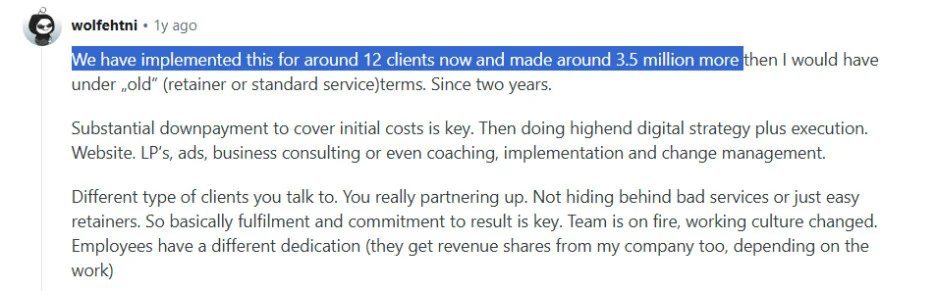
Furthermore, industry discussions on platforms like Reddit highlight that the most successful agencies are those moving away from "vanity metrics" and toward "outcome-based" billing. By tying fees to KPIs, agencies effectively stop the "what are we paying for?" conversation by replacing it with a "look at what we achieved" conversation.
Managing Expectations: Official Responses to Objections
When you present this model, clients will inevitably raise concerns. Being prepared to handle these objections with professional, data-backed responses is critical to closing the deal.
Objection 1: "What if social media doesn’t drive sales?"
- Response: "That is exactly why we established a baseline. If we don’t beat the performance of the last 90 days, your fee remains fixed. You only pay for verified, incremental results."
Objection 2: "Will you just inflate vanity metrics to get a bonus?"
- Response: "The KPIs are selected based on your business goals—not just likes or follows. We define these in the contract before work begins, and we use verified tracking tools to ensure the data is transparent and neutral."
Objection 3: "Why not just do commission-only?"
- Response: "A base fee provides the operational floor required to staff your account properly. It ensures my team has the resources to execute high-quality work. Performance bonuses are the ‘cherry on top’ for over-delivering, not the entire budget."
Implications: The Shift in Agency-Client Dynamics
Adopting a performance-based retainer changes the agency-client relationship in two profound ways:
1. The Death of Scope Creep
Because the bonus is tied to specific, agreed-upon KPIs, the scope of work becomes explicitly defined. If a client requests an extra, unplanned project, it is no longer a matter of "just squeeze it in." It is an opportunity to discuss if that task contributes to the KPI or if it should be treated as an add-on. This brings professional boundaries back into the relationship.
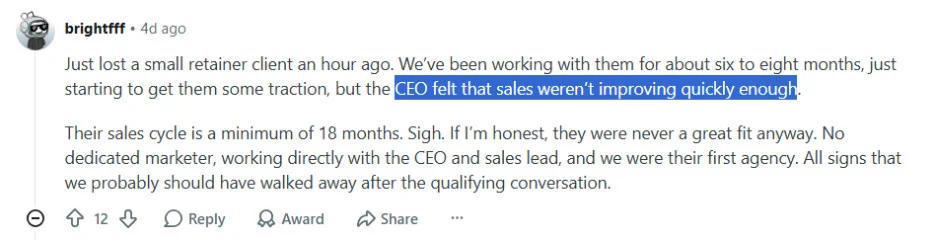
2. Heightened Operational Accountability
The model requires a high level of operational trust. For the agency to succeed, the client must provide timely approvals and access to necessary tracking tools. When the client has a financial incentive to see you succeed, the "waiting for approval" bottleneck often disappears. They become a partner in the process rather than a spectator.
The Role of Technology
This model is only viable if the reporting is seamless. Trying to manage performance scorecards for 10+ clients using manual spreadsheets is a recipe for burnout. Agency owners are increasingly turning to tools like SocialPilot to centralize their analytics. By pulling engagement, reach, and performance data from Instagram, LinkedIn, TikTok, and Facebook into a single, white-labeled dashboard, agencies can provide the "proof" required to trigger bonuses without wasting hours on administrative tasks.
Conclusion
The transition from a fixed-retainer agency to a performance-driven partner is a maturation process. It requires you to know your data, believe in your strategy, and have the courage to demand a bonus for your results. By structuring your contracts with clear baselines, rigorous KPI definitions, and automated reporting, you can stop defending your invoices and start building a high-growth, high-margin agency.
Start by auditing your current client roster. Identify the ones with clear conversion paths and consistent data, and propose a transition. The results will not only speak for themselves—they will speak for your bottom line.












No comments yet. Be the first to join the conversation!