

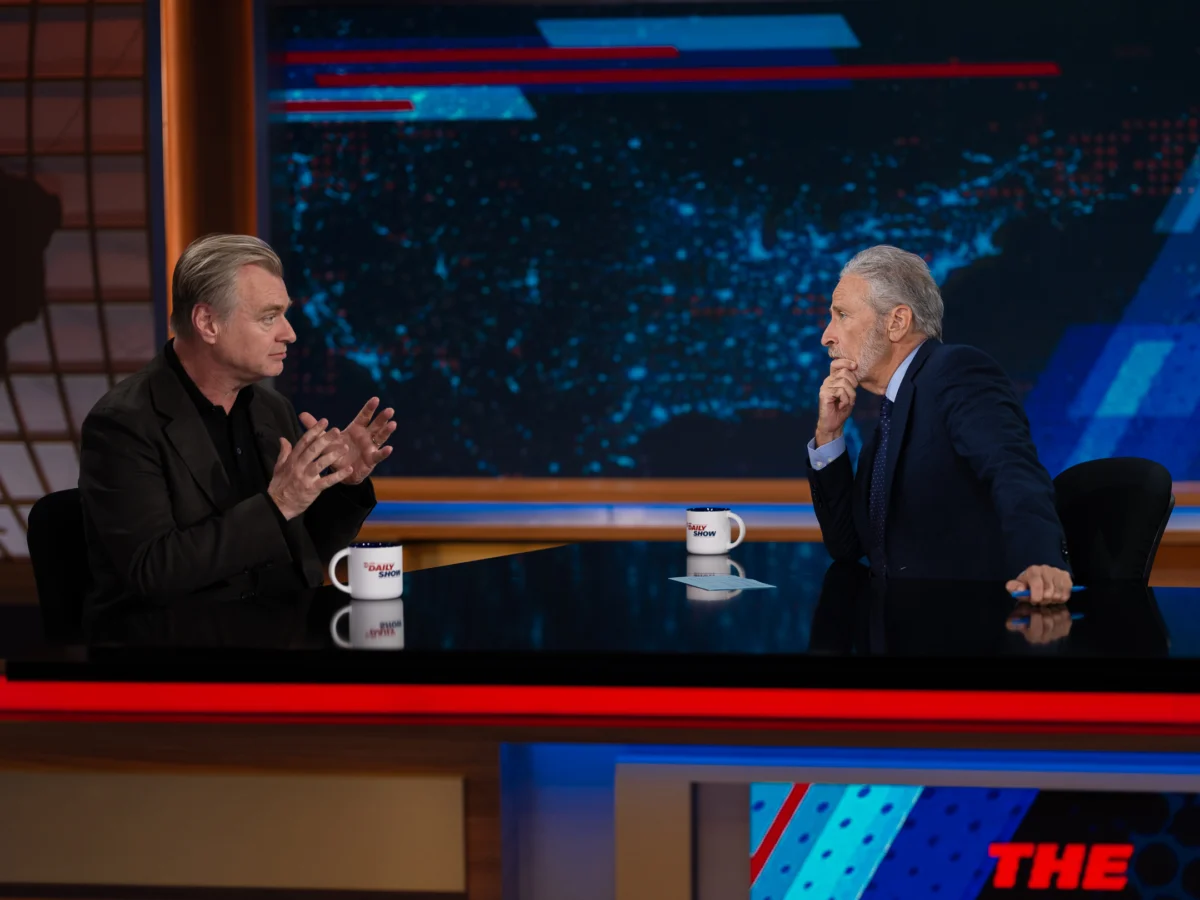
In a characteristically whimsical exchange on The Daily Show, Jon Stewart managed to pin down one of modern cinema’s most enigmatic auteurs, Christopher Nolan. The conversation, which veered from lighthearted inquiries about ancient Greek mythology to the hard-nosed economics of Hollywood studio financing, provided a rare glimpse into the mind of a filmmaker currently standing at the pinnacle of his craft. As Nolan pivots from the atomic intensity of Oppenheimer to the foundational weight of Homer’s The Odyssey, the interview served as a reminder that even the most celebrated directors must navigate the complex machinery of the studio system to bring their grandest visions to life.
The Mythical Premise: Why The Odyssey?
The interview began with Stewart’s signature brand of irreverent curiosity. “I will never get a chance to get high with you in a dorm room,” Stewart quipped, setting the stage for a series of questions that were as existential as they were absurd. Stewart probed the narrative choices of The Odyssey, asking why the Cyclops lacked a sense of humor, questioning the engineering logistics behind the Trojan Horse, and positing the psychological theory that the entire epic might merely be a manifestation of Odysseus’s fractured psyche.
While Nolan handled the playful interrogation with characteristic poise, the broader conversation shifted to the "why" behind the project. Tackling a text written in the 8th century BCE—a cornerstone of Western literature—is a daunting task for any director. For Nolan, the decision was pragmatic, rooted in the hard-won leverage earned by his recent monumental success.
The Currency of Success: Leveraging Oppenheimer
The heart of the discussion centered on a surprising revelation: even for a director of Nolan’s stature, the ability to greenlight a massive, epic-scale production is tethered to the commercial performance of previous outings.
“Coming out of my last film, Oppenheimer had way more success than I think we had any right to expect,” Nolan explained. He noted that in the high-stakes environment of major film studios, commercial triumph is the primary currency. “That gives you an opportunity to get something made that you might not otherwise be able to get made.”
Stewart, visibly incredulous, pointed out the paradox of a filmmaker who has defined the modern blockbuster era—having helmed the Dark Knight trilogy, Inception, Interstellar, and Memento—still feeling the need to prove his commercial viability.
“You would have had trouble, Christopher Nolan, after everything—after Interstellar, after Inception, after Memento, after Batman?” Stewart asked.
Nolan’s response was a masterclass in the realities of the business. “I think it helped that it was very successful,” he replied. When Stewart nudged him, asking if the recent Academy Awards sweep for Oppenheimer played a role, Nolan was unequivocal: “I think the Oscar thing helped. I think it all helped to go to the studio and say—because being The Odyssey, it needs a massive budget. It needs a massive cast. It needs a lot.”
The Anatomy of a Production: Hard Work and Harder Reasons
Nolan described the process of filming The Odyssey not as a comfortable creative exercise, but as a grueling, necessary labor. “I like to say it was a very hard movie, but hard for all the right reasons,” he remarked. “It’s The Odyssey. It should be hard. It shows up on screen.”
This commitment to the difficulty of the material speaks to Nolan’s reputation as a director who demands peak physical and mental endurance from his cast and crew. It is a philosophy that prioritizes the visceral reality of the production over the ease of digital intervention. By grounding the production in the physical challenges inherent to the story’s epic scope, Nolan aims to capture a tangible sense of struggle that is increasingly rare in the era of CGI-dominated filmmaking.
Chronology of Production: Efficiency Amidst Intensity
Perhaps the most surprising detail shared during the interview was the production’s timeline. Despite the massive scale and the inherent difficulty of the project, Nolan confirmed that the team completed filming ahead of schedule.
“Someone was telling me that you actually completed it ahead of schedule, as you had with all of your movies, and under budget,” Stewart noted.
Nolan’s confirmation was humble yet illustrative of his rigorous approach to management. “Yes. Never happens,” he laughed. “The reality is, we went in at a hundred days. And by day 91, we couldn’t have taken another step. So we finished—we finished at the right time… Everybody was done. I mean, people were just exhausted. They’d been through it. So it took the right time to make the film. We had enough time to make it.”
This efficiency is a hallmark of Nolan’s career. By fostering a highly disciplined set environment, he ensures that the energy of the cast and crew is focused, preventing the "bloat" that often plagues major studio epics. The fact that he achieved this with The Odyssey—a film of significant narrative and technical complexity—reinforces his standing as one of the most organized and effective directors in Hollywood.
Implications for the Future of Epic Cinema
The implications of this conversation extend beyond the specific film in question. Nolan’s candid admission regarding the necessity of a "win" to secure funding for his next project highlights a systemic issue within the film industry: the risk-aversion of major studios. Even directors who have generated billions of dollars in revenue are subject to the volatility of the box office and the prestige of awards season.
However, Nolan’s success also serves as a beacon for high-concept, auteur-driven cinema. By choosing to adapt a foundational epic, he is signaling a continued interest in bridging the gap between high-art intellectual property and large-scale, mass-market entertainment.
Furthermore, the interview underscores a changing tide in how audiences perceive "prestige" films. When a director can use the momentum of an R-rated biopic about theoretical physics to pivot into a sprawling adaptation of an ancient Greek poem, it suggests that there is a viable, perhaps even hungry, audience for stories that are "hard" and "demanding."
A Closer Look at the "Nolan Method"
Throughout his career, Nolan has maintained a distinct methodology that relies on a synthesis of practical effects, tight narrative construction, and high-stakes themes. His work on The Odyssey appears to be a continuation of this path. By insisting that the film be "hard," he is essentially communicating that the audience should expect a sensory and emotional experience that is difficult to process, mirroring the journey of Odysseus himself.
The technical discipline—finishing in 91 days rather than the allocated 100—is not merely about saving money. It is about the preservation of creative intent. In Hollywood, production delays often lead to studio interference or compromised visions. By staying ahead of schedule, Nolan maintains control over his creative destiny, ensuring that the final product is a reflection of his own standards rather than a compromise dictated by the clock.
Conclusion: The Persistence of the Auteur
As Christopher Nolan continues his work on The Odyssey, the industry watches with bated breath. The project represents a confluence of historical importance and modern cinematic ambition. As Jon Stewart’s interview highlighted, while the questions surrounding the project may be playful, the underlying process is serious business.
Nolan remains a rare breed: a filmmaker who can navigate the precarious demands of studio executives while maintaining a singular, uncompromising vision. Whether or not The Odyssey will achieve the same cultural saturation as The Dark Knight or the critical acclaim of Oppenheimer remains to be seen. However, one thing is certain: if anyone has the discipline, the vision, and the hard-earned leverage to bring the ancient world to life in a way that feels vital and new, it is Christopher Nolan.
In a world where cinema is increasingly fragmented and digital, Nolan’s commitment to the "hard" way—to real sets, real time, and real endurance—remains one of the most compelling stories in modern entertainment. As he noted to Stewart, the exhaustion of his crew is not a failure; it is the evidence that they have truly lived through the journey, and that, in turn, is what will show up on the screen for audiences around the world.










