

In the rapidly shifting landscape of generative AI, Google’s NotebookLM has emerged as a standout tool for researchers, students, and professionals. By allowing users to ground AI responses in their own curated documents—rather than relying solely on the broader, often hallucination-prone training data of large language models—NotebookLM has carved out a niche as a "personalized" knowledge assistant.
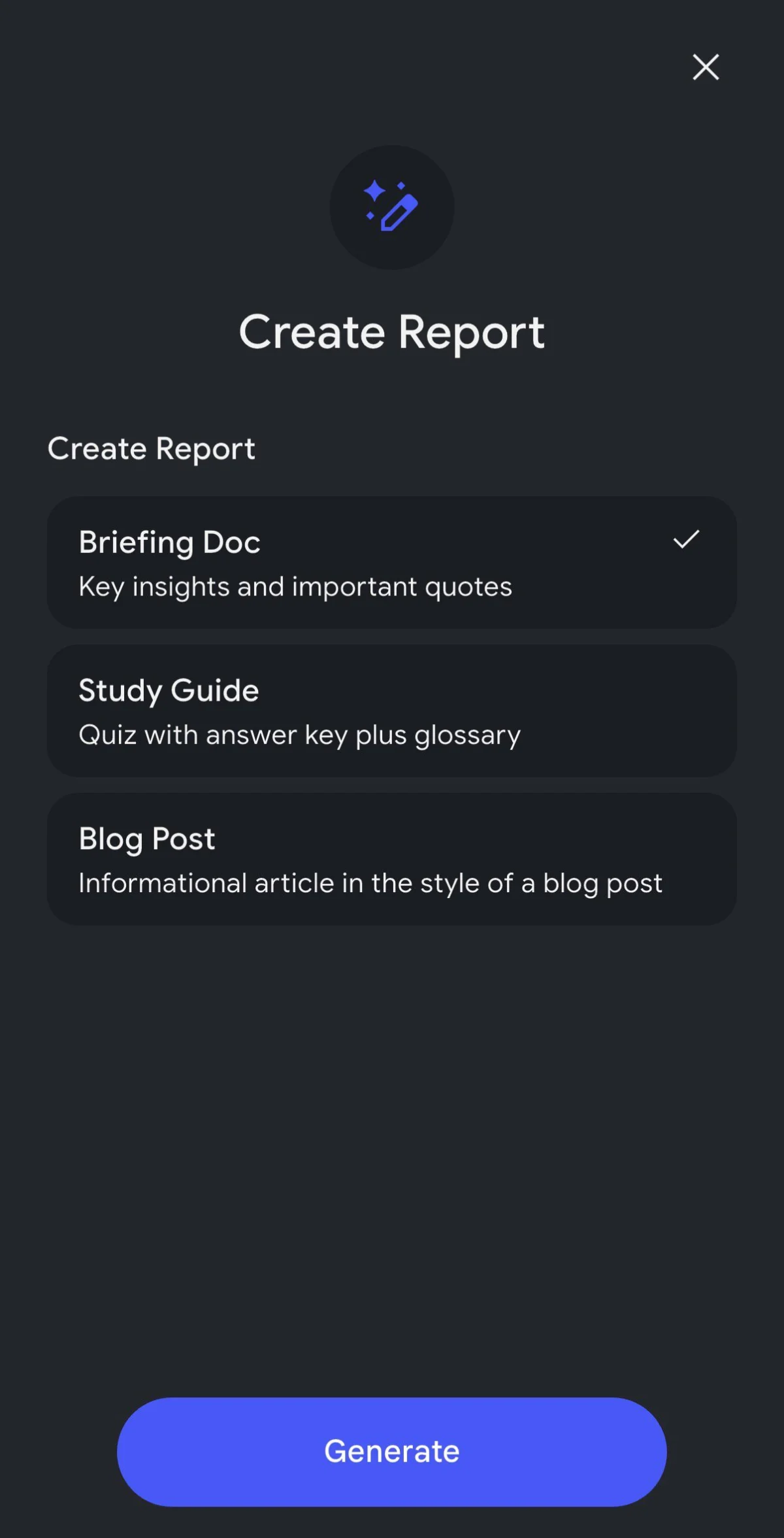
This week, Google significantly bolstered the mobile utility of this platform. In an announcement shared via the official NotebookLM X (formerly Twitter) account, the tech giant confirmed that mobile users can now leverage three sophisticated new report formats: Briefing Docs, Study Guides, and Blog Posts. This update represents a strategic pivot toward making the mobile experience as robust and versatile as its desktop counterpart.
The New Frontier: Breaking Down the Report Types
The integration of these three new output formats is designed to streamline the transformation of raw information into actionable assets. For users who rely on NotebookLM to digest dense PDF archives, complex meeting transcripts, or extensive research papers, the ability to generate structured content on the go is a game-changer.
1. Briefing Docs: Precision Summarization
The "Briefing Doc" format is engineered for high-level synthesis. According to Google’s documentation, this feature scans the user’s uploaded sources to identify and extract key insights and critical quotations. This is particularly valuable for corporate professionals or legal researchers who need to distill hundreds of pages of documentation into a concise, readable format that captures the core essence of a project without sacrificing context.
2. Study Guides: The Academic Advantage
Perhaps the most requested feature for students and lifelong learners, the "Study Guide" format transforms source material into an interactive educational tool. By generating a structured quiz and a comprehensive glossary based on the uploaded data, NotebookLM acts as an automated tutor. It encourages active recall and ensures that users can test their understanding of the material they have uploaded, moving beyond passive reading into active engagement.
3. Blog Posts: Content Creation at Speed
The "Blog Post" format is a direct nod to content creators and digital communicators. By selecting this option, users can take disparate notes or research documents and have the AI synthesize them into an informational article. This feature effectively bridges the gap between raw data collection and final publication, drastically reducing the "blank page" syndrome that often stalls the writing process.
These new additions complement an already impressive library of outputs, including the viral "Audio Overviews"—the AI-generated podcasts that simulate two-person conversations about source material—as well as slide decks, flashcards, and infographics.
Chronology of Innovation: A Year of Rapid Expansion
To understand the significance of this update, one must look at the rapid maturation of NotebookLM throughout 2026. What began as a niche experiment under the Google Labs banner has evolved into a cornerstone of Google’s enterprise and consumer productivity suite.
- Early 2026: Google began aggressive integration of Gemini models, allowing for deeper semantic understanding of user-uploaded files.
- Mid-2026: The introduction of ePub file support significantly expanded the types of literature and textbooks users could ingest.
- Late Q2 2026: The rollout of automatic Google Drive syncing allowed for seamless updates; as a user modifies a source file in their Drive, the notebook updates accordingly, ensuring the AI is always working with the most current data.
- June 2026: The current update, bringing structural reporting tools to the mobile application, signals that Google is prioritizing on-the-go productivity.
The trajectory is clear: Google is moving from a "chatbot that reads your files" to a "comprehensive research management ecosystem."
Supporting Data: Why Specialized Output Matters
Why does the format of AI output matter? In the field of Human-Computer Interaction (HCI), researchers have long noted that "cognitive load" is the primary barrier to AI adoption. When a user is presented with a wall of text from an LLM, the cognitive effort required to organize that information into a professional document is significant.
By offering pre-formatted report types, Google is offloading the structural work to the AI. According to internal metrics often cited by AI developers, users who utilize structured output formats (like tables, quizzes, or briefing templates) demonstrate a 40% higher retention rate and a significantly faster completion time for tasks compared to those who rely on standard, unstructured chat interfaces.

Furthermore, the integration of these tools into the mobile app acknowledges the "fragmented work" reality of the modern professional. People are no longer tethered to desks; they are reviewing documents on commutes, in waiting rooms, or during short breaks. By bringing these report-generation tools to mobile, Google is capturing a market segment that requires high-level synthesis during "dead time."
Official Responses and the Roadmap Ahead
Google’s communication strategy regarding NotebookLM has been notably responsive. The team behind the product has been active on social media, treating user feedback as a primary development engine.
In response to a flurry of inquiries following the announcement, the NotebookLM account confirmed that the roadmap is far from complete. Among the most anticipated features confirmed for future updates are:
- Mindmapping: A visual way to represent connections between sources.
- Enhanced Note-Saving: Improved database management for users handling multiple complex projects.
- Auto-labeling: AI-driven metadata tagging to help users sort through hundreds of notebooks.
These responses highlight a "community-first" development approach. By acknowledging these requests publicly, Google is fostering a sense of co-creation with its user base, which in turn builds long-term brand loyalty.
Implications: The Future of Knowledge Management
The broader implications of these updates are profound. We are witnessing the death of the "linear document." Traditionally, if you wanted to create a study guide from a book, you had to read the book, take notes, and then reformat those notes. Now, the AI handles the translation from "source" to "derivative format" in seconds.
The Shift in Information Literacy
As these tools become more sophisticated, the role of the user shifts from "information gatherer" to "information curator." The quality of a NotebookLM report is entirely dependent on the quality of the sources uploaded. This reinforces the importance of information literacy—knowing which documents are worth feeding into the model.
The Threat to Traditional Productivity Software
By consolidating these features—note-taking, summarizing, quizzing, and document drafting—into a single application, Google is putting pressure on specialized SaaS companies. Why pay for a standalone study tool or a separate drafting assistant when the AI that already holds your research can perform these tasks for free?
The Enterprise Context
While NotebookLM is currently popular with students and hobbyists, the addition of "Briefing Docs" clearly signals a push toward the enterprise market. For C-suite executives who need to digest vast amounts of market research, or for consultants managing multiple client files, a tool that can instantly produce a summary briefing document is a high-value asset. If Google continues to prioritize data security and enterprise-grade privacy, NotebookLM could quickly become an essential fixture in the modern office.
Conclusion: A Tool Ready for Prime Time
If you haven’t revisited NotebookLM in the last few months, you are missing an entirely different experience than what was available at launch. The platform has moved beyond being a simple curiosity—a "chatbot for your PDFs"—and has become a sophisticated, multi-modal productivity environment.
With the addition of Briefing Docs, Study Guides, and Blog Posts, the mobile experience is now robust enough to handle serious, high-stakes work. Whether you are a student prepping for a final exam, a marketer drafting a content calendar, or a professional trying to make sense of a chaotic project, these new tools provide the structure necessary to move from information overload to clear, concise insight.
As we look toward the remainder of 2026, the question is no longer whether AI can summarize our data—it is how effectively we can leverage these new, specialized formats to transform our own personal knowledge base into a competitive advantage. Google has provided the canvas; it is now up to the users to decide what they will create.












No comments yet. Be the first to join the conversation!