

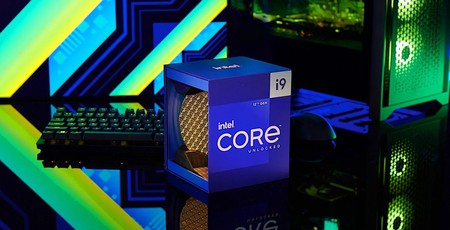
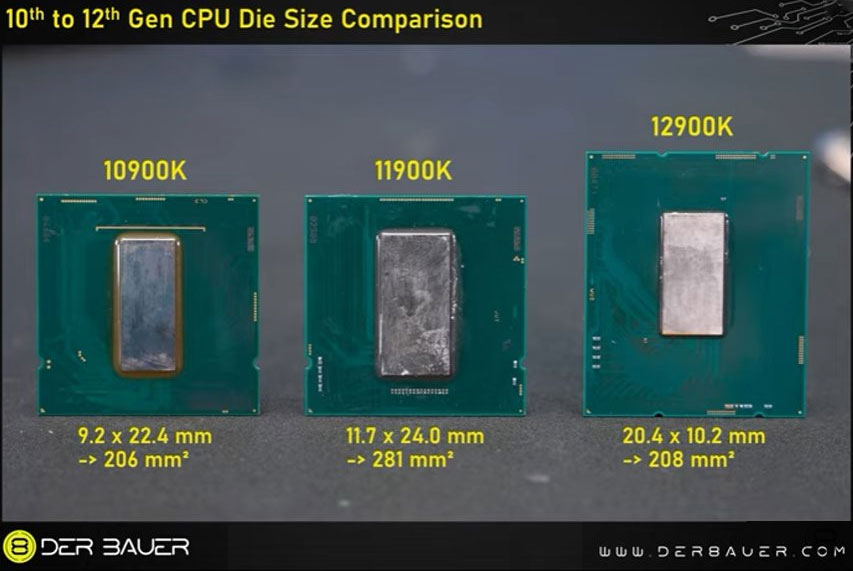
In a move that marks the most significant architectural shift for Intel in over a decade, the semiconductor giant officially pulled the curtain back on its 12th Generation "Alder Lake-S" desktop processors this past Wednesday. This launch represents more than just a routine frequency bump; it signifies Intel’s transition to the "Intel 7" process node and the introduction of a hybrid performance architecture that seeks to redefine the capabilities of the desktop PC.
The initial rollout consists of six "K-series" enthusiast-grade processors, spanning the Core i9, i7, and i5 segments. These chips are designed to bridge the gap between high-performance gaming and intensive multi-threaded productivity, setting the stage for a heated battle against AMD’s long-standing Ryzen dominance.
Main Facts: The Alder Lake Lineup
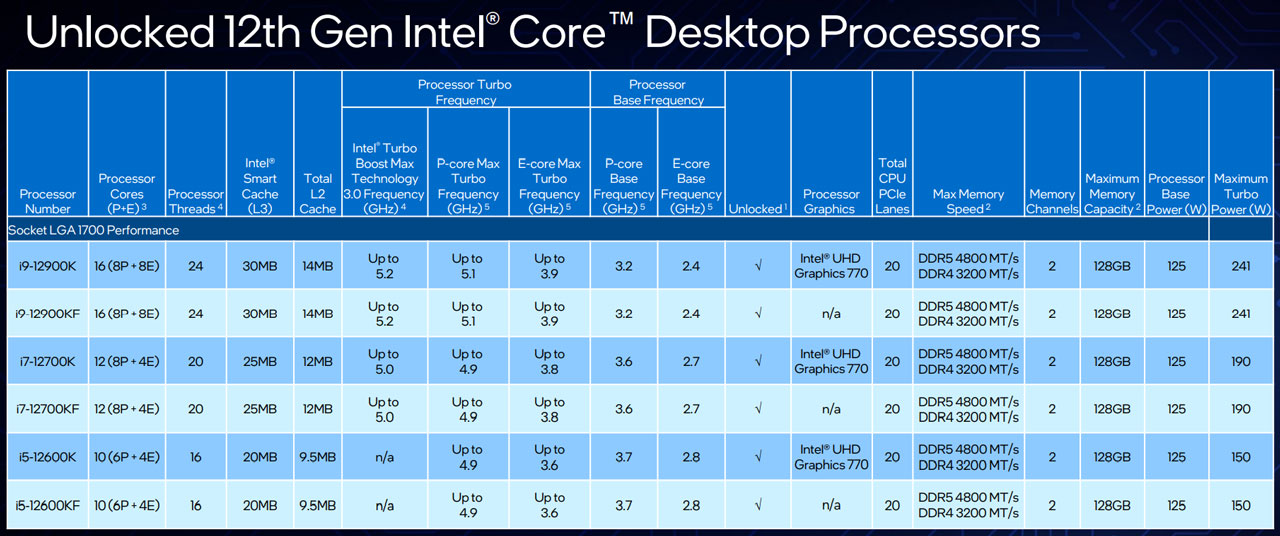
The 12th Gen launch is headlined by three distinct tiers, each offered in a standard ‘K’ variant and a ‘KF’ variant—the latter omitting the integrated graphics unit for a slight cost reduction.
| Processor | Cores (P+E) | Threads | Max Turbo Frequency | Base Power | Max Turbo Power |
|---|---|---|---|---|---|
| Core i9-12900K/KF | 16 (8+8) | 24 | 5.2 GHz | 125W | 241W |
| Core i7-12700K/KF | 12 (8+4) | 20 | 5.0 GHz | 125W | 190W |
| Core i5-12600K/KF | 10 (6+4) | 16 | 4.9 GHz | 125W | 150W |
The Hybrid Architecture Explained
The defining feature of Alder Lake is the integration of two distinct core types: Performance-cores (P-cores) and Efficient-cores (E-cores). The P-cores are built for high-IPC (Instructions Per Clock) tasks, such as gaming and single-threaded professional applications. Meanwhile, the E-cores are optimized for background tasks and multi-threaded throughput. This "big.LITTLE" approach, long used in mobile SoCs, has been adapted for the desktop to allow for a more efficient power-to-performance ratio.
Chronology: From Architecture Day to Retail Availability
The path to this launch has been a carefully orchestrated campaign by Intel to regain market confidence.
- August 2021: Intel held its "Architecture Day," providing the first deep-dive into the Alder Lake silicon. The company teased the hybrid architecture and the move to the Intel 7 process but remained tight-lipped regarding specific pricing, SKU configurations, and final benchmark data.
- Late October 2021: The formal launch event occurred, providing the industry with the missing puzzle pieces: final specs, power limits, and a glimpse at the new Z690 chipset ecosystem.
- The November 4th Embargo: Intel has strictly limited the release of third-party, independent performance reviews until November 4th, the same date that the chips and supporting PCs become commercially available to the public. This approach ensures that the "out-of-the-box" experience is synchronized with the availability of critical platform infrastructure, such as Windows 11 and DDR5 memory.
Supporting Data and Performance Metrics
Intel’s internal testing paints a picture of a company aiming to reclaim the "world’s best gaming processor" title.
Gaming Performance
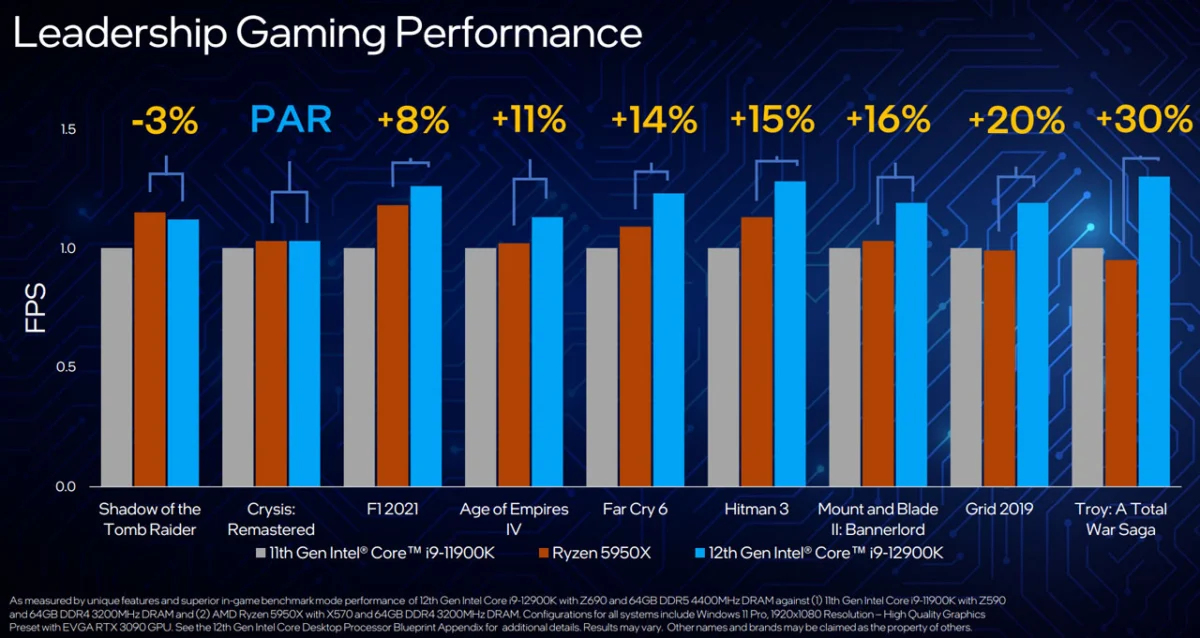
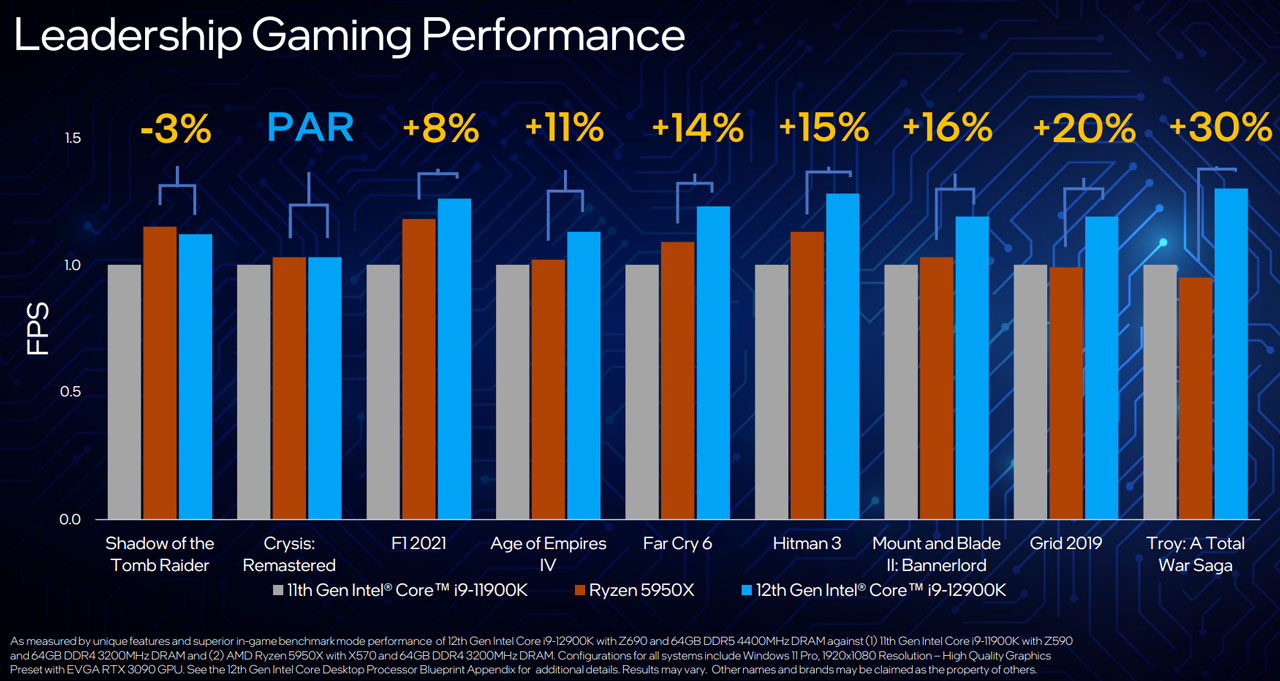
The flagship Core i9-12900K is being marketed as a gaming powerhouse. Intel’s internal benchmarks suggest the chip is approximately 12% faster in modern gaming titles compared to the AMD Ryzen 9 5950X. However, context is vital here. Industry analysts have noted that these tests were conducted on Windows 11 systems that lacked the latest AMD-specific patches. At the time of the announcement, AMD platforms were experiencing issues with L3 cache latency and "preferred core" scheduling, which could artificially deflate their performance by as much as 15%. This nuance suggests the real-world gap between the two titans may be tighter than Intel’s charts initially imply.
Content Creation
In productivity-focused workloads—such as video rendering, 3D modeling, and compilation—Intel claims the 12th Gen lineup is at least 30% faster than its 11th Gen predecessors. This leap is largely attributed to the increased core count and the efficiency of the E-cores handling background processes, which leaves the P-cores free to focus entirely on the primary creative task at hand.
Power Considerations
While the chips are listed with a "Processor Base Power" of 125W, enthusiasts should be aware of the "Maximum Turbo Power." The i9-12900K, for instance, can draw over 240W under heavy, sustained loads. Intel has made it clear that to realize the full potential of these chips, the platform must be paired with robust cooling solutions and high-end Z690 motherboards capable of handling these high power-delivery demands.
The 600 Series Ecosystem: A New Foundation
Accompanying the processors is the new Z690 chipset, which introduces a host of modern I/O standards. This is a platform-wide transition designed to future-proof user systems.
PCIe 5.0 and DDR5
The headline features for the Z690 platform include native support for PCIe 5.0, providing double the bandwidth of PCIe 4.0 for next-generation GPUs and storage devices. Furthermore, the platform introduces DDR5 memory, which offers significantly higher frequencies and bandwidth compared to the outgoing DDR4 standard.
Partner Support
The ecosystem support is robust. Major motherboard manufacturers, including ASUS, Gigabyte, and MSI, have unveiled a vast array of boards. ASUS alone has announced nineteen distinct Z690 models, ranging from compact Mini-ITX builds for home-theater PCs to E-ATX behemoths designed for extreme overclocking. Similarly, memory manufacturers like G.Skill are already pushing the envelope, demonstrating DDR5 modules reaching speeds of 6800MHz, highlighting the overclocking headroom provided by the new architecture.
Implications: A Shifting Competitive Landscape
The launch of Alder Lake is a pivotal moment for the industry, with several long-term implications for consumers and competitors alike.
The Challenge to AMD
For the past two years, AMD’s Ryzen 5000 series has enjoyed a comfortable lead in both power efficiency and raw multi-core performance. By moving to a hybrid architecture, Intel is effectively "changing the rules" of the game. If the P-core and E-core scheduling works as intended, Intel stands to gain a significant advantage in balancing the often-conflicting needs of high-frequency gaming and heavy-duty background processing.
The Role of Windows 11
The effectiveness of Alder Lake is deeply tied to the Windows 11 Thread Director technology. This software-hardware integration is what tells the OS which tasks should be assigned to P-cores and which should be sent to E-cores. Because this scheduling is so critical, the success of the 12th Gen chips is inextricably linked to the maturation of Windows 11. Users moving to this platform are essentially committing to Microsoft’s latest OS.
Price vs. Performance
With the flagship i9-12900K priced at $590, the i7-12700K at $410, and the i5-12600K at $290, Intel is positioning its chips competitively. While these prices are higher than some mid-range alternatives, they represent a aggressive value proposition given the performance leaps promised in the content creation and gaming sectors.
Final Thoughts
As the November 4th release date approaches, the excitement is palpable. Intel has finally moved past the limitations of its previous 14nm and 10nm processes, embracing a design philosophy that reflects the reality of modern computing—where users are simultaneously gaming, streaming, and running multiple background applications.
While the provided benchmarks and marketing materials suggest a clear victory, the true test will occur in the labs of independent reviewers. Only then will we know if the "Intel 7" process and the new hybrid architecture have truly recaptured the performance crown, or if the competition has a counter-strategy ready to blunt Intel’s resurgence. For now, the hardware community has a new, formidable architecture to analyze, and the desktop PC has never looked more promising.










No comments yet. Be the first to join the conversation!