Dwi Wanna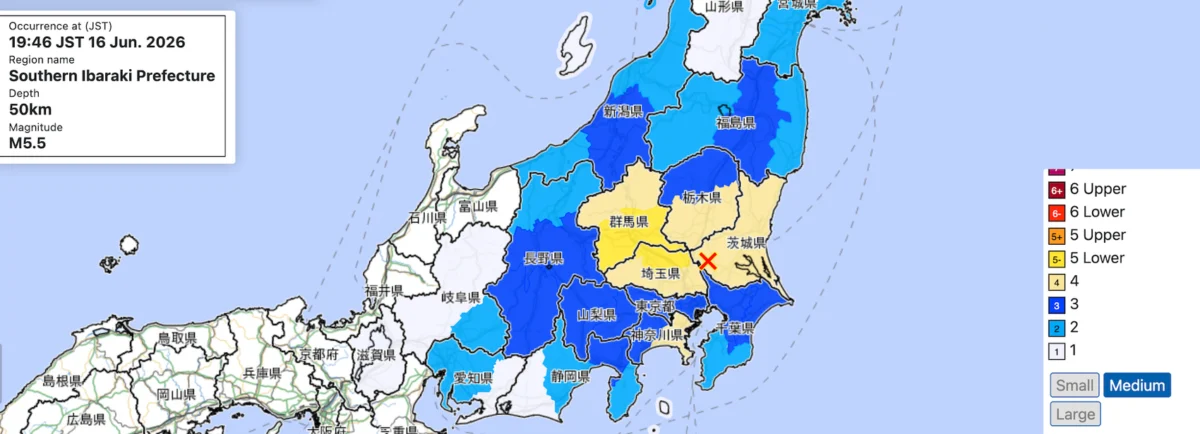
TOKYO — A significant seismic event rattled Japan’s Kanto region on Tuesday evening, as a magnitude 5.5 earthquake struck Ibaraki Prefecture. The tremor, which occurred at 7:46 p.m. local time, served as a stark reminder of the volatile tectonic nature of the Japanese archipelago. While the Japan Meteorological Agency (JMA) confirmed that no tsunami warning was issued, the quake caused immediate, widespread disruption to critical transportation networks and prompted a swift review of safety protocols at industrial facilities across the region.
Main Facts: A Sudden Seismic Disturbance
The earthquake, which originated at a depth of 50 kilometers, sent shockwaves through the densely populated areas of Ibaraki and neighboring prefectures, including the Greater Tokyo Metropolitan Area. According to data released by the Japan Meteorological Agency, the epicenter was located in the inland regions of Ibaraki.
The depth of 50 kilometers—classified as a shallow to intermediate earthquake—resulted in pronounced shaking at the surface. Residents in high-rise buildings in Tokyo and surrounding districts reported significant swaying, lasting for several seconds. In the immediate aftermath, emergency services across the region were placed on high alert, though early reports suggested that structural damage was localized and minimal.
Despite the magnitude, which is capable of causing damage in poorly constructed areas, Japan’s stringent building codes once again played a pivotal role in mitigating potential casualties. As of Wednesday morning, there have been no reports of fatalities or widespread injuries, highlighting the effectiveness of the nation’s focus on seismic-resistant architecture.
Chronology of the Event
The timeline of the evening was marked by the swift, automated response systems that define Japan’s disaster preparedness.

- 7:46 p.m. (JST): The seismic event occurs at a depth of 50 km in Ibaraki Prefecture.
- 7:47 p.m. (JST): The JMA triggers the Earthquake Early Warning (EEW) system. Residents across the Kanto region receive alerts on their mobile devices, providing precious seconds of lead time before the peak shaking hits.
- 7:48 p.m. (JST): Transportation authorities initiate automatic emergency protocols. East Japan Railway Company (JR East) halts operations on the Tohoku and Joetsu Shinkansen lines to inspect tracks and overhead power lines for damage.
- 8:00 p.m. (JST): Initial assessments of the Tokai No. 2 nuclear power station are initiated by Japan Atomic Power Co.
- 8:15 p.m. (JST): The Japan Meteorological Agency officially announces that there is no risk of a tsunami, providing relief to coastal residents.
- 9:00 p.m. (JST): Transportation operators begin the slow process of resuming limited services following safety sweeps.
Supporting Data and Seismic Context
Japan sits at the intersection of four major tectonic plates: the Pacific, North American, Eurasian, and Philippine Sea plates. This geographical reality makes the country one of the most seismically active regions on the planet. Ibaraki Prefecture, in particular, is frequently subject to tremors due to its proximity to the subduction zones where the Pacific plate slides beneath the North American plate.
The magnitude 5.5 reading is considered a moderate event by Japanese standards. However, the impact is often measured not just by the Richter scale, but by the Shindo (seismic intensity) scale used in Japan, which measures the degree of shaking at specific locations. While the JMA has yet to release the full intensity map, the disruption to the Shinkansen network suggests that localized intensities in the immediate epicenter area were high enough to trigger automatic safety shut-offs, which occur even at relatively low-intensity thresholds to prevent derailments.
The reliability of mobile alerts—such as the Nerv and Prep applications mentioned by residents—has become the backbone of public safety. These systems provide a critical psychological buffer, allowing citizens to move away from windows, heavy furniture, or to take cover under sturdy tables before the primary S-waves arrive.
Official Responses and Industrial Safety
One of the primary concerns following any earthquake in Japan is the status of nuclear energy facilities. Following the 2011 Great East Japan Earthquake and the subsequent Fukushima Daiichi disaster, the safety thresholds for nuclear plants have been drastically revised.
Japan Atomic Power Co., the operator of the Tokai No. 2 nuclear power station in Ibaraki, issued a statement shortly after the quake confirmed that the facility had experienced no anomalies. The plant, which is currently undergoing regulatory review and safety upgrades, was subject to automatic monitoring systems that check for cooling circuit integrity, containment vessel breaches, and radiation leakage. The prompt declaration of "no anomalies" was a critical step in maintaining public confidence and preventing unnecessary panic.

Government officials, including those from the Cabinet Office, have urged the public to remain vigilant for aftershocks. In a press briefing, a spokesperson for the government emphasized that while the primary event did not cause catastrophic damage, the geological stress induced by the quake could lead to secondary tremors over the coming 48 to 72 hours. Local municipalities have been instructed to open evacuation centers as a precautionary measure, though demand for these services remained low throughout the night.
Implications: The Resilience of Infrastructure
The immediate halting of the Tohoku and Joetsu Shinkansen lines serves as a case study in Japan’s "zero-risk" approach to high-speed rail. While the stoppage caused significant delays and inconvenience for thousands of commuters and travelers, the policy is intentionally conservative. By stopping trains automatically, Japan prevents the potential for high-speed derailments, which have historically been the most dangerous consequence of earthquakes for travelers.
Urban Planning and Preparedness
The incident also highlights the ongoing challenge of managing urban density during seismic events. With millions of people working in office towers in Tokyo and commuting via rail, the reliance on real-time data is paramount. The fact that the quake occurred at 7:46 p.m. meant that many people were either already home or in the process of commuting. This reduced the potential for "secondary accidents," such as traffic pile-ups or congestion-related injuries in crowded train stations.
However, the event has reignited conversations regarding the aging infrastructure in parts of Ibaraki and the surrounding Kanto area. While new buildings are designed to withstand significant shocks, older residential structures and rural utility networks remain more vulnerable. Policy experts are now calling for increased funding for seismic retrofitting, particularly for municipal buildings and elderly care facilities that may not meet the most current structural standards.
The Human Factor: "Predictably Unpredicted"
As observed by many residents on social media, the unpredictability of these events remains the most unnerving aspect of life in Japan. Even in a society that has perfected the art of disaster preparedness, the arrival of a 5.5 magnitude quake is a jarring experience. The comment sections of news outlets reflect a weary familiarity; citizens are well-drilled in the "Drop, Cover, and Hold On" method, yet there is a constant, underlying tension regarding the "Big One"—the anticipated major seismic event that seismologists have long warned could hit the Tokyo metropolitan region.

Conclusion
The earthquake that struck Ibaraki on Tuesday night was a significant event that tested the readiness of Japan’s infrastructure and emergency systems. Thanks to advanced warning technology, rigorous construction standards, and the calm, practiced response of the public, the event resulted in minimal disruption and no recorded casualties.
As the region returns to normal, the focus shifts to long-term monitoring and the continuous refinement of disaster response strategies. In a nation where earthquakes are a persistent threat, the success of a response is not defined by the absence of an earthquake, but by the ability to endure it with resilience. Authorities continue to advise citizens to keep emergency kits stocked, stay informed through official JMA channels, and maintain a high state of situational awareness in the days ahead.
For now, the Shinkansen lines have resumed, the nuclear facilities remain stable, and the people of Ibaraki are once again proving that while Japan may be the land of the rising sun, it is also, inevitably, the land of the shaking earth.


 Neng Nana
 Asro
Asro