Asro
Asro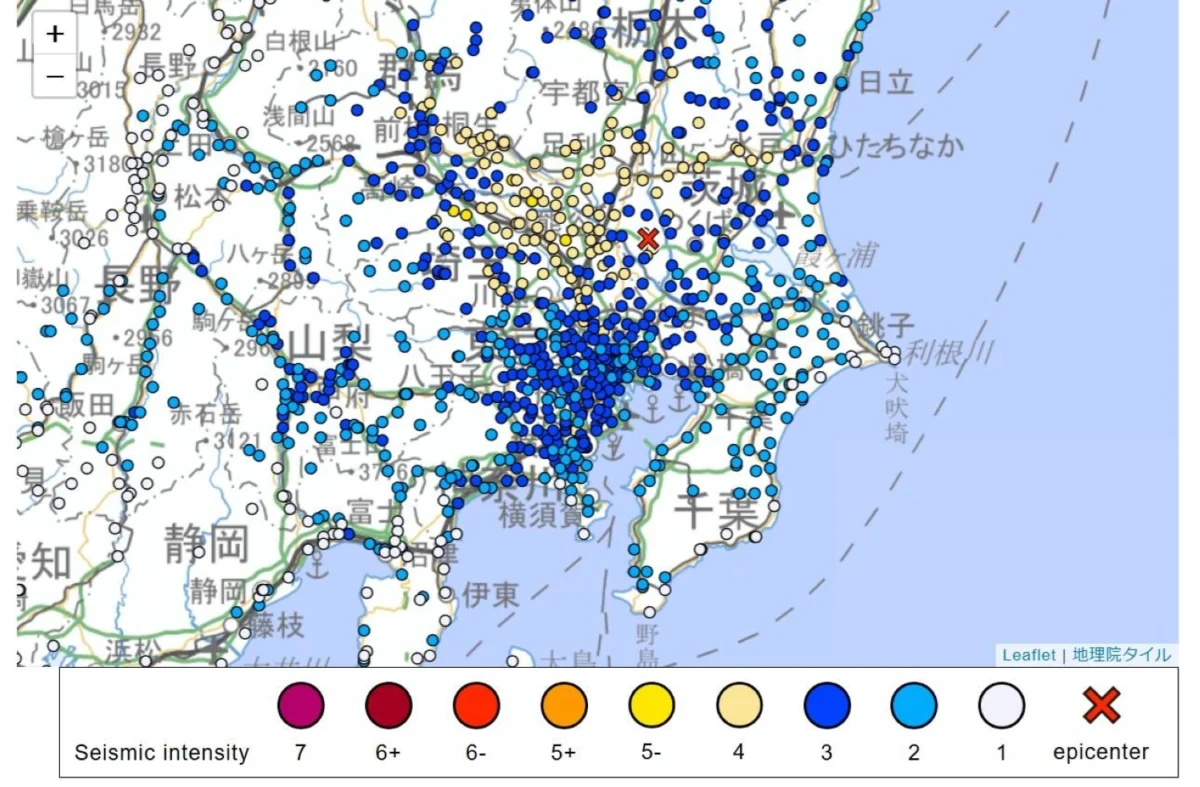
Main Facts: A Night of Seismic Unrest
A significant seismic event rattled the Kanto region and surrounding areas on Tuesday evening, as a magnitude 5.5 earthquake struck southern Ibaraki Prefecture. According to the Japan Meteorological Agency (JMA), the quake occurred at 7:46 p.m. local time, originating at a depth of approximately 50 kilometers.
While the magnitude was registered at 5.5, the impact was measured on Japan’s stringent seismic intensity scale—known as the shindo scale—which prioritizes ground motion over raw magnitude. The quake reached a "lower 5" intensity in multiple municipalities, a level of shaking capable of causing items to fall from shelves and minor structural damage to older buildings. Despite the intensity of the tremors, national authorities were quick to confirm that there was no threat of a tsunami, as the epicenter was located inland and the seismic characteristics did not trigger oceanic displacement.
The earthquake served as a stark reminder of Japan’s precarious geological position. The Kanto Plain, home to the sprawling Greater Tokyo Area, sits at the confluence of several tectonic plates, including the Philippine Sea plate, the Pacific plate, and the Eurasian plate. Tuesday’s event was a localized manifestation of the persistent tectonic pressure inherent to this intersection.
Chronology: The Sequence of Events
The evening began with typical urban bustle, but at 7:46 p.m., the atmosphere shifted abruptly as the earth began to sway.
- 7:46 p.m.: The initial rupture occurred deep beneath southern Ibaraki. Residents across the Kanto region reported a sudden, sharp jolt followed by a period of rolling motion that lasted for several seconds.
- 7:47 p.m. – 7:50 p.m.: As the seismic waves radiated outward, automated alert systems—including the JMA’s Earthquake Early Warning (EEW) system—triggered on millions of mobile devices. Trains across the region, including the Shinkansen lines, initiated automatic emergency braking protocols, leading to immediate service suspensions.
- 7:55 p.m. – 8:15 p.m.: As initial tremors subsided, local municipalities began their damage assessment protocols. NHK and other major news outlets began aggregating reports from local fire departments and police stations.
- 8:30 p.m.: Official government briefings commenced. The JMA confirmed the magnitude and depth, explicitly ruling out the possibility of a tsunami.
- 9:00 p.m. onwards: Public transport operators began safety inspections of tracks and infrastructure, while utility companies scrambled to investigate reports of isolated power outages and gas leaks.
Supporting Data: Seismic Intensity and Geographical Impact
The "lower 5" intensity reading, the threshold at which the JMA classifies an earthquake as potentially damaging, was recorded in key areas across Gunma and Saitama prefectures. Specifically, the city of Ota and the town of Chiyoda in Gunma, alongside the cities of Kazo and Honjo and the town of Misato in Saitama, bore the brunt of the seismic energy.
The reach of the tremor was exceptionally wide. Data recorded by the JMA indicated that shaking of intensity 4 or lower was felt across a vast swathe of Japan, covering eastern, central, and parts of western and north-eastern Japan. In Tokyo, the shaking registered as a level 3 or 4, causing high-rise buildings to sway—a design feature intended to dissipate kinetic energy—which nonetheless caused anxiety among residents.
Seismologists noted that the depth of 50 kilometers was a critical factor. Had the earthquake occurred at a shallower depth, the surface acceleration would have been significantly higher, likely resulting in more widespread structural failure. The depth helped dampen the intensity, preventing a localized catastrophe in the densely populated suburbs of the Saitama-Gunma border.
Official Responses: Government and Infrastructure
The Japanese government’s response was immediate, reflecting the nation’s world-leading disaster preparedness infrastructure. The Prime Minister’s office established a crisis management center within the Kantei immediately following the quake to coordinate information flow between local prefectural governments and national agencies.
Public Transport and Utilities
Transportation hubs were among the most affected sectors. East Japan Railway (JR East) suspended operations on several lines, including the Tohoku and Joetsu Shinkansen, to conduct mandatory safety checks. Passengers were left stranded on platforms or within stalled carriages for hours as engineers inspected tracks for misalignment or damage. By midnight, many lines had resumed limited service, though delays persisted into the following morning.
Utility companies, including Tokyo Electric Power Company (TEPCO), performed rapid assessments of the region’s energy infrastructure. Nuclear facilities in the area, which are subject to some of the strictest safety regulations in the world, were monitored closely. Officials confirmed that there were no abnormalities at the Fukushima Daiichi or Daini plants, nor at other power-generating facilities in the Ibaraki and Saitama vicinities.
Emergency Services
Local fire departments and municipal disaster prevention units mobilized quickly to conduct "welfare checks" on vulnerable populations, including the elderly, who are often at higher risk during seismic events. While there were sporadic reports of minor injuries—mostly related to falls or falling objects—there were no immediate reports of mass casualties or catastrophic building collapses.
Implications: The Ongoing Reality of Seismic Risk
Tuesday’s earthquake has reignited the perennial debate regarding Japan’s readiness for the "Big One"—a potential magnitude 8 or 9 megathrust earthquake centered in the Nankai Trough or directly beneath the Tokyo metropolitan area.
Urban Resilience
Modern Japanese architecture is world-renowned for its earthquake-resistant technology, utilizing base isolation systems, dampening pads, and flexible steel frames. However, the age of housing stock remains a concern. While commercial skyscrapers are engineered to survive massive shocks, older wooden residential buildings in the Kanto region remain susceptible to fire and collapse. Tuesday’s event served as a "stress test" for these older structures, and urban planners are now expected to analyze the data to identify which areas require updated retrofitting.
Psychological Impact and Preparedness
Beyond the physical infrastructure, there is the psychological toll on the citizenry. Japan maintains a culture of "disaster literacy," where citizens are expected to have emergency supplies, know evacuation routes, and understand the warning signals. Yet, as the years pass between major seismic events, public complacency can become an issue. Experts emphasize that the Ibaraki tremor should be viewed as a reminder to refresh emergency kits, ensure furniture is anchored, and verify family evacuation plans.
The Role of Technology
The role of the Earthquake Early Warning system was pivotal on Tuesday. By providing seconds of lead time—which, while brief, allows for the automatic slowing of trains and the cessation of dangerous industrial processes—technology minimized the potential for secondary accidents. The JMA continues to invest in denser seismic sensor networks to improve the accuracy and speed of these alerts, particularly for inland quakes that lack the buffer of distance provided by offshore events.
Conclusion: A Measured Recovery
As of Wednesday morning, life in the Kanto region began to return to a semblance of normalcy. While the trauma of the shaking lingers for many, the resilience of Japan’s infrastructure and the efficiency of its disaster response protocols prevented what could have been a far more devastating event.
The magnitude 5.5 tremor serves as a necessary, if unsettling, contribution to the ongoing conversation regarding Japan’s seismic future. It highlights that in a country where the earth is constantly shifting, preparedness is not a one-time effort but a continuous, evolving mandate. As government agencies finalize their post-event assessments, the data gathered will undoubtedly inform future building codes and disaster mitigation strategies, ensuring that when the next inevitable tremor strikes, the nation is once again ready to meet it with resilience and resolve.


 Neng Nana