Jia Lissa
In the hyper-competitive landscape of digital advertising, the "conversion gap"—the critical window of time between a user expressing interest and taking a definitive action—is where most potential revenue is lost. Recognizing this, Meta has officially unveiled a significant upgrade to its Facebook lead generation suite: embedded appointment booking.
This update, which allows advertisers to integrate third-party scheduling platforms directly into the Facebook ad interface, represents a fundamental shift in how businesses handle high-intent traffic. By removing the need for prospective customers to navigate away from the social platform to complete their booking, Meta is betting on the power of immediate gratification to increase conversion rates for service-based businesses.
Main Facts: Streamlining the Path to Purchase
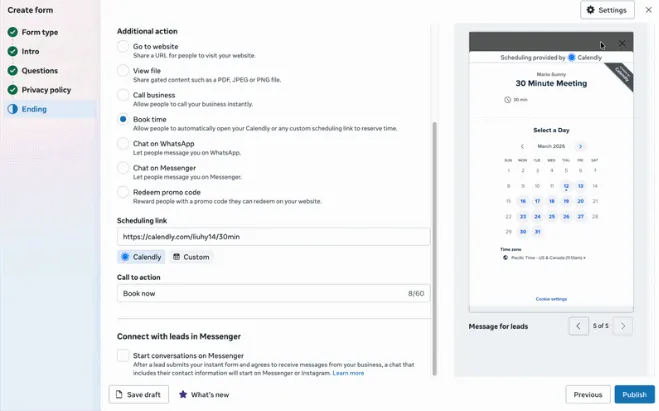
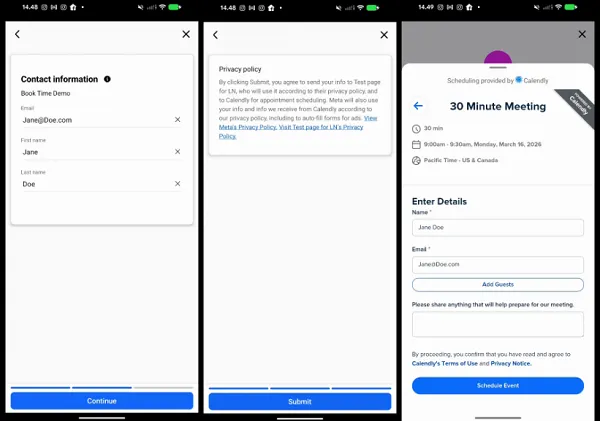
The core functionality of this update is the seamless integration of scheduling tools—such as Calendly and HighLevel—directly into the Facebook Lead Ad experience. Previously, a user clicking on a lead ad would typically be prompted to fill out a contact form, after which they might be redirected to a website or left to wait for a follow-up email.
With the new embedded system, the booking flow begins the moment the user submits their contact information. Meta’s system utilizes pre-filled fields to pull existing profile data, minimizing manual entry and reducing friction.
Key Technical Highlights:
- No-Code Implementation: Advertisers do not need to be developers to deploy this feature. The setup involves selecting "book time" as the primary call-to-action (CTA) and pasting the relevant scheduling link.
- Intelligent Auto-Detection: The system automatically recognizes the calendar provider used in the link, ensuring a smooth integration of the third-party interface.
- Platform Support: At launch, the feature supports Calendly and HighLevel, with native HubSpot integration scheduled for early August. Meta has signaled that further partners will be added to this ecosystem in the coming months.
- Exclusive Rollout: Currently, the feature is exclusive to the Facebook platform, with a full global rollout targeted for completion by October.
Chronology: From Lead Gen to Immediate Action
The evolution of Facebook Lead Ads has always been centered on the removal of friction. Historically, the process looked like this:
- Ad Exposure: User sees the ad.
- Engagement: User clicks, opening an Instant Form.
- Data Submission: User provides email/phone number.
- The "Cooling" Period: The user is redirected to a landing page or waits for an automated follow-up.
This "Cooling Period" is exactly what Meta is attempting to eradicate. By shortening the path between the ad click and the final booking, the company is attempting to align with the decreasing attention spans of modern mobile users.
Development Timeline:
- Q2 2024: Meta begins internal testing of the embedded booking API.
- July 2024: Formal announcement and initial rollout to select business accounts.
- August 2024: Expansion of third-party integrations (HubSpot).
- October 2024: Expected date for full, global availability across all eligible Facebook business accounts.
Supporting Data: Why Timing Matters in Digital Marketing
The business case for this update is rooted in the psychology of "consumer intent." Data from numerous marketing studies suggest that the likelihood of a lead converting drops precipitously within the first 60 minutes of contact.
The Psychology of Intent
When a potential client fills out a lead form, their interest is at its peak. They have made a conscious choice to engage with the brand. However, if that user is then forced to navigate a separate website, wait for a confirmation email, or interact with a disjointed interface, the mental momentum is lost. Meta’s internal research confirms this trend: service-based advertisers frequently see significant "churn" between the initial form submission and the final appointment booking.
By keeping the user within the Facebook environment, Meta is leveraging the platform’s high-performing, native mobile experience. Because the mobile-optimized booking interface loads instantly, the user never feels like they have "left" the app, which significantly reduces bounce rates.

Official Responses and Strategic Rationale
Meta’s positioning of this tool is clear: it is a direct response to the operational headaches faced by service providers—ranging from real estate agents and consultants to healthcare professionals and fitness coaches.
According to official statements from Meta, the logic is simple: "The gap between form submission and appointment booking has always been a challenge for service-based advertisers. A lead might fill out your form with genuine interest, but by the time they receive a follow-up email or navigate to your booking site hours later, that intent has cooled. With embedded appointment booking, you eliminate that gap entirely."
This shift marks a departure from Meta’s older reliance on passive data collection. Instead of simply gathering "leads" to be nurtured later, the platform is now positioning itself as a "conversion engine" where the entire sales cycle—from awareness to appointment—can occur in seconds.
Implications for the Digital Marketing Industry
The release of this feature is not merely a quality-of-life improvement for advertisers; it signals a wider strategic pivot for Meta in the face of increased competition from platforms like TikTok and the ongoing challenges posed by privacy-centric ad tracking.
1. Increased ROAS (Return on Ad Spend)
By increasing the direct conversion rate, the "Cost Per Lead" (CPL) effectively decreases. Advertisers who see a higher percentage of leads convert into booked appointments will inherently view their Facebook ad spend as more efficient, likely leading to increased budget allocation toward the platform.

2. The Rise of "All-in-One" Social Advertising
Meta is effectively turning Facebook into a landing page alternative. For small businesses that struggle to maintain high-converting websites, the ability to bypass the need for a web-development team to set up complex tracking or booking pixels is a game-changer. This democratizes professional-grade lead generation for smaller entities.
3. Heightened Competition for SaaS Providers
The integrations with Calendly, HighLevel, and HubSpot indicate a deepening symbiosis between Meta and the CRM (Customer Relationship Management) software industry. Advertisers will likely prioritize CRM platforms that are natively supported by Meta’s "embedded" ecosystem, forcing other SaaS providers to accelerate their own integration timelines to stay relevant.
4. Data Quality and Privacy
Because the booking occurs within the Meta environment, the data remains cleaner and more consistent. For users, the "pre-filled" nature of the forms means fewer errors in email addresses or phone numbers. This leads to higher-quality leads for the advertiser, as the system ensures that the information being passed to the scheduling tool is accurate and verified by the platform.
Conclusion: The New Standard for Lead Generation
As we move toward the final quarter of 2024, the "embedded appointment" update serves as a powerful reminder that in digital marketing, speed is a feature. Meta’s latest move is an attempt to lock in user behavior and remove the friction that has long plagued the lead-generation funnel.
For the modern marketer, this update provides a clear directive: the days of relying on multi-step, multi-platform journeys are numbered. Success will increasingly belong to those who can capture, qualify, and convert interest in the fewest number of clicks possible. As global availability nears in October, businesses that integrate these scheduling tools early will likely gain a significant competitive advantage in capturing high-intent leads before their competitors even have a chance to send a follow-up email.
This update is not just a tweak to a button; it is an evolution of the digital storefront, and it marks a new era of immediacy in social media advertising.

 Nana Wu
 Neng Nana