

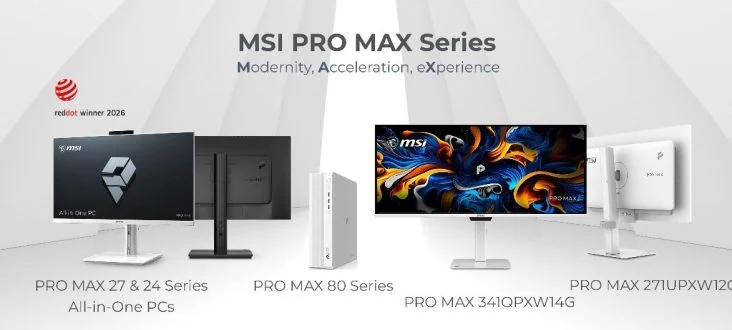
In a strategic maneuver that signals a direct challenge to Apple’s dominance in the professional workstation market, MSI has officially unveiled its "Pro Max" series. This expansive ecosystem encompasses everything from compact desktop towers and sleek all-in-one (AIO) PCs to cutting-edge QD-OLED monitors. By blending enterprise-grade security with high-performance hardware, MSI is positioning its latest hardware not just as office equipment, but as a comprehensive productivity suite designed for content creators, corporate environments, and power users who have historically gravitated toward the macOS ecosystem.
The Core Strategy: Why MSI is Targeting the Prosumer Market
For years, the Apple iMac and Mac Studio have served as the industry benchmark for professional desktop computing, lauded for their minimalist aesthetics and seamless display integration. MSI’s Pro Max initiative is a direct response to this. By offering a modular approach—where users can choose between dedicated workstation towers, integrated AIOs, or ultra-high-definition monitors—MSI is betting that professional users are looking for the flexibility of Windows/PC hardware without sacrificing the build quality and aesthetic polish associated with premium Apple products.
The "Pro Max" moniker suggests a high-performance tier, and MSI has backed this up with a multi-pronged hardware strategy that prioritizes connectivity, display fidelity, and security.
The Desktop Vanguard: Pro Max 80 Series
The centerpiece of the desktop offering is the Pro Max 80 series. Eschewing the bulky towers of traditional PC builds, MSI has opted for a compact, space-saving chassis that belies the performance packed within.
Performance and Security
The Pro Max 80 is built to handle professional workloads, offering support for discrete Nvidia GeForce RTX graphics. This is a critical differentiator from many Apple silicon-based machines, which, while powerful, rely on unified memory architectures that are not always compatible with specific legacy workflows or software that demands CUDA acceleration.
Beyond raw power, MSI has leaned heavily into the corporate sector’s requirements. The system includes:
- Physical Security: A padlock loop and Kensington lock support are standard, providing peace of mind for open-office environments.
- Data Integrity: The inclusion of a chassis intrusion sensor ensures that hardware tampering is logged.
- Administrative Control: BIOS-level USB control allows IT departments to restrict data access, a feature essential for companies dealing with proprietary data.
With nine USB-A ports and a USB-C connection, the Pro Max 80 offers the kind of I/O versatility that power users frequently find lacking in the minimalist design philosophy of current Mac models.
Integrated Elegance: Pro Max 24 and 27 All-in-Ones
For those who prefer a clean, cable-free desk, MSI has introduced the Pro Max 24 and 27 AIO systems. Available in both professional black and minimalist white, these machines are powered by the latest AMD Ryzen 200 Series processors.
Display and Ergonomics
The choice of a 120Hz display as the standard for these AIOs is a bold move, offering a level of fluidity that exceeds the standard 60Hz panels found on many entry-level professional displays. For users requiring tactile interaction, MSI offers a touchscreen upgrade, bridging the gap between a traditional PC and the mobile-first interface expectations of the modern workforce.
The integrated 5MP pop-up webcam reflects the ongoing shift toward hybrid work, offering high-fidelity video conferencing capabilities that remain tucked away when not in use. Perhaps most importantly, the stand design is a departure from the "fixed-position" philosophy of some competitors; it offers full height, tilt, pivot, and swivel adjustments, ensuring that ergonomic health is prioritized in the workplace.
Visual Fidelity: The QD-OLED Revolution
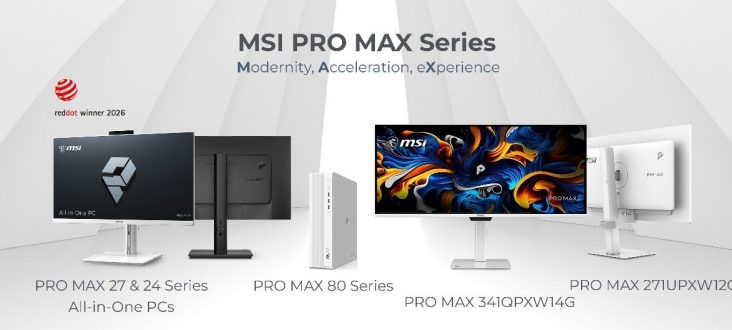
Perhaps the most ambitious segment of the new lineup is the Pro Max QD-OLED monitor series. Available in 27-inch and 34-inch ultrawide configurations, these panels are engineered for color-critical work.
Technical Precision
The monitors are Pantone Validated, ensuring that the colors seen on screen are industry-standard accurate. To solve the common issue of black levels appearing "washed out" in high-ambient-light environments, MSI has implemented its "DarkArmor" film technology. This film deepens black levels and reduces screen glare, a persistent annoyance for creative professionals.
Software Integration
Crucially, MSI has introduced the M-Mate companion application. Historically, Windows monitors have been difficult to control via Mac-like software, but M-Mate is designed specifically for macOS, allowing users to control OSD (On-Screen Display) settings directly from their computer. This suggests that MSI is actively courting Apple users who may want to pair an M-series laptop with a superior external monitor, effectively creating a hybrid ecosystem.
Dual USB-C ports with 98W and 15W power delivery turn the monitor into a docking station, allowing a user to charge their laptop while simultaneously outputting video and maintaining data connectivity through a single cable.
A Specialty Solution: The 271QPHW E14
Rounding out the announcement is the Pro Max 271QPHW E14. Unlike the OLED variants, this model features a circular-polarized panel specifically designed for eye health. With a 144Hz refresh rate and a Delta E ≤ 2 color accuracy, it targets researchers, analysts, and writers—individuals who spend 8 to 10 hours a day reading text and require absolute visual comfort without sacrificing performance.
Implications for the Industry
The arrival of the Pro Max series creates an interesting dynamic in the current PC landscape. By offering a "Pro" ecosystem that mimics the cohesive nature of Apple’s product line, MSI is attempting to reclaim the "Windows Professional" market.
Bridging the OS Divide
The inclusion of macOS-compatible software like M-Mate is perhaps the most significant detail of this entire launch. It indicates that MSI understands the reality of the modern office: many professionals prefer the portability and ecosystem of a MacBook Pro but require the massive, high-performance display or the modular power of a Windows-based tower for specific tasks. MSI is positioning itself as the bridge between these two worlds.
The Corporate Challenge
With the inclusion of enterprise-grade security features like chassis intrusion sensors and BIOS-level USB management, MSI is clearly signaling that these machines are ready for the IT department’s whitelist. The modularity—specifically the ability to swap out components in the desktop line—offers a long-term cost advantage over non-upgradable all-in-one systems, a factor that procurement managers at large corporations are likely to notice.
Future Outlook: Predicting the Shift
As we look at the evolution of hardware over the next half-decade, the lines between "Consumer" and "Professional" hardware are blurring. Just as the gaming industry has seen a massive influx of high-refresh-rate, high-fidelity hardware, the productivity sector is now demanding that same performance.
MSI’s focus on 120Hz/144Hz displays and OLED technology across its professional line suggests that the era of "office-grade" equipment being inferior to "entertainment-grade" hardware is coming to an end. Users now expect their work machines to be as snappy, vibrant, and responsive as the devices they use for gaming and media consumption.
Conclusion: A New Standard?
The MSI Pro Max series is a sophisticated, well-timed, and highly capable challenge to the status quo. By focusing on the "friction points" of the professional experience—security, color accuracy, desk ergonomics, and cross-platform compatibility—MSI has developed a lineup that offers a compelling alternative to the Apple ecosystem.
While the brand loyalty of the Apple user base is notoriously difficult to break, the flexibility, technical specifications, and security-centric design of the Pro Max series offer a strong incentive for companies and independent professionals to reconsider their hardware investments. Whether this will lead to a broader shift in market share remains to be seen, but one thing is clear: MSI is no longer content to simply be a component manufacturer. They are now an ecosystem provider, and the competition is officially on notice.










No comments yet. Be the first to join the conversation!