Nana
Nana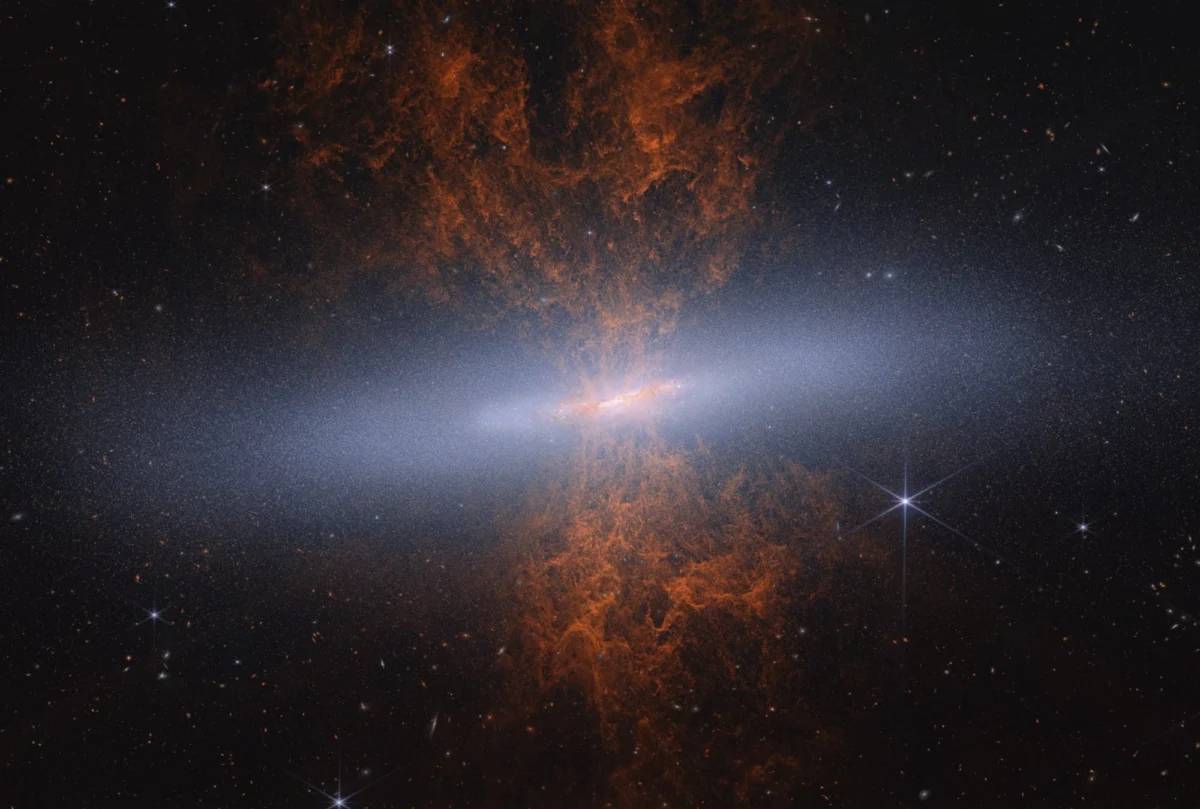
In a breathtaking display of technological prowess, NASA’s James Webb Space Telescope (JWST) has unveiled a spectacular 223-megapixel composite image of Messier 82 (M82), famously known as the "Cigar Galaxy." Located approximately 12 million light-years away in the constellation Ursa Major, this starburst galaxy has long been a subject of intense astronomical fascination. By utilizing the advanced capabilities of its Near-Infrared Camera (NIRCam), the Webb telescope has managed to resolve 16.5 million individual stars within M82, providing an unprecedented look at a celestial environment defined by chaotic, rapid evolution.
This monumental capture, which represents the culmination of 65 hours of continuous observation, serves as a masterclass in modern deep-space imaging. It does not merely photograph a galaxy; it dissects it, peeling back the thick, obscuring layers of interstellar dust that have historically prevented astronomers from witnessing the true density of stellar populations within the galactic core.
The Core Facts: A Star-Forming Powerhouse
At the center of this discovery is the phenomenon of "starburst" activity. Unlike the Milky Way, which maintains a relatively steady, rhythmic pace of star formation, M82 is currently undergoing a violent, high-speed surge of stellar birth. Scientists estimate that stars are being birthed within M82 at a rate roughly ten times higher than in our own galaxy.
The NIRCam imagery highlights this frenzy in exquisite detail. Where previous observations captured the glowing red and orange hues of ionized hydrogen gas and particulate dust, Webb’s infrared eyes pierce through these veils to reveal the underlying architecture of the galaxy. The result is a crisp, dense field of stellar light that offers a glimpse into the mechanics of galaxy-scale evolution. This is not a static portrait, but rather a snapshot of a "beautiful mess"—a phrase coined by NASA fellow Adam Smercina to describe the turbulent, high-energy environment of the Cigar Galaxy.
A Chronological Perspective: From Hubble to Webb
To understand the significance of this new data, one must look at the historical trajectory of space-based observation. For decades, the Hubble Space Telescope stood as the gold standard for optical astronomy. Hubble’s observations of M82 were instrumental in mapping the galaxy’s "galactic wind"—the plumes of ionized gas and dust being ejected from its center. Hubble excelled at showing us the structure of the gas, the anatomy of the interstellar medium, and the grand, glowing outflows that characterize M82’s unique morphology.
However, Hubble was limited by its reliance on visible light. Interstellar dust acts as an opaque screen to optical telescopes, effectively hiding the stars behind the curtain of gas. The arrival of the James Webb Space Telescope changed the equation entirely. By shifting the observational spectrum into the near-infrared, Webb is effectively "color-blind" to the dust that once blocked our view.
The chronology of this mission is a testament to long-term planning. While Hubble provided the context of the galaxy’s gaseous environment, Webb has now provided the resolution needed to identify the constituent parts of the galaxy itself. By comparing the two, astronomers are now able to layer these datasets, creating a multi-dimensional map that tracks both the gas dynamics and the stellar density simultaneously.

Supporting Data: Understanding the "Starburst" Mechanism
The data provided by Webb is not just visually stunning; it is computationally dense. The 16.5 million stars resolved in the composite image provide a massive statistical sample for researchers.
Why is M82 so active?
Current hypotheses center on a violent gravitational encounter. Many astronomers believe that M82’s current state was triggered by a close encounter with its larger neighbor, the spiral galaxy M81. This gravitational tug-of-war likely compressed the vast reservoirs of hydrogen gas within M82, acting as the catalyst for a massive, galaxy-wide ignition of star formation.
This period of rapid growth is, in astronomical terms, a "short-lived event." Scientists estimate that the current burst of activity has been ongoing for a few hundred million years—a mere blink of an eye in the life of a galaxy. The data retrieved by Webb will allow for a more precise timing of this event. By studying the ages and distributions of the stars identified in the NIRCam imagery, researchers can effectively create a "birth certificate" for the current starburst phase, determining exactly when the surge began and how much longer it might sustain itself.
The Role of Infrared Astronomy
The success of this observation underscores why infrared capability is non-negotiable for modern astronomy. As stars are born, they often remain cocooned in the very clouds of dust that birthed them. Visible light is scattered and absorbed by these clouds, rendering the infant stars invisible to traditional cameras. Infrared light, however, has a longer wavelength that can travel through these dense clouds with minimal interference. Consequently, Webb is not just seeing the mature stars of M82; it is potentially uncovering hidden clusters of proto-stars and massive young stars that were previously entirely off the map.
Official Perspectives: The Synergy of Science
The collaboration between missions is a recurring theme in the discourse surrounding the M82 release. Kristen McQuinn, a researcher at the Space Telescope Science Institute, emphasized that the future of astrophysics lies in the integration of multi-wavelength data.
"Galaxies are such intricate ecosystems that if you truly want to understand them, you have to pull datasets from different missions together," McQuinn stated. "One mission cannot fully answer all of the questions we have about M82. Combining the data collected by different telescopes, like Webb and Hubble, is powerful. When you marry the datasets, you expand what you can probe, and the questions that you can pose are even more complex."
This sentiment is echoed by the broader scientific community, which views the Webb data as a bridge between the macroscopic observations of the past and the granular, high-fidelity physics of the future. The "beautiful mess" is being untangled not by abandoning old data, but by synthesizing it with the new.

Implications for the Future of Galactic Evolution
The implications of the M82 study extend far beyond a single galaxy. By understanding the mechanisms that trigger such intense star formation in the Cigar Galaxy, astronomers can refine their models for how galaxies across the universe evolve.
1. Refinement of Star-Formation Models
Current computer simulations of galaxy evolution struggle to accurately predict how starbursts are triggered and maintained. The high-resolution data from Webb provides a benchmark for these simulations. If our current models do not account for the density of stars observed in M82, the models must be adjusted. This iterative process is the backbone of scientific progress.
2. Understanding Galactic Feedback
M82 is a prime laboratory for studying "galactic feedback"—the process by which the energy released by stars and supernovae regulates the galaxy’s own growth. The "plumes" of material observed by Hubble, combined with the stellar density mapped by Webb, allow scientists to calculate the energy budget of the galaxy. This helps us understand how a galaxy can effectively "clean" itself of gas, potentially halting star formation in the future.
3. The Quest for the Invisible
Perhaps most intriguingly, the Webb image confirms that even with our most advanced technology, we are still likely missing a significant portion of the story. While we can see millions of stars as bright blue granules, the sheer density of the galactic core suggests there are many more stellar objects that remain unresolved. This creates a new set of questions: How many stars are lurking in the densest regions? How do these hidden populations influence the stability of the galaxy’s disk?
Conclusion
The James Webb Space Telescope’s latest contribution to our understanding of Messier 82 is more than just a public relations triumph for NASA; it is a vital piece of the cosmic puzzle. By bridging the gap between the known gaseous structures of the past and the resolved stellar populations of the present, the scientific community is moving closer to a comprehensive theory of galaxy formation.
As we continue to analyze the 16.5 million stars captured in this historic composite, we are reminded that our universe is far more active, chaotic, and interconnected than it appears to the naked eye. The "Cigar Galaxy" remains a "beautiful mess," but thanks to the tireless eyes of our space-based observatories, it is a mess that is slowly, but surely, beginning to make sense. Through the synergy of missions like Hubble and Webb, we are not just observing the cosmos—we are beginning to read its history, one star at a time.



 Siti Muinah