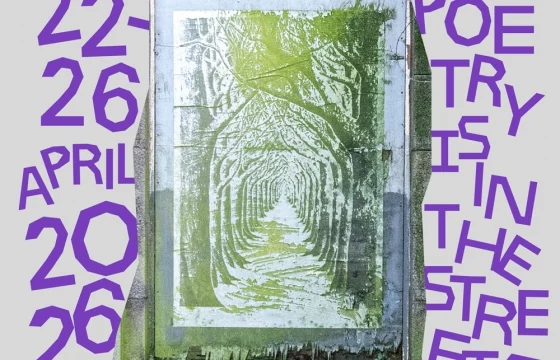
ABERDEEN, SCOTLAND — From April 22 to April 26, 2026, the Granite City will undergo a radical transformation. Nuart Aberdeen, the world-renowned street art festival, is returning for its latest iteration, but with a thematic departure that promises to shift the global conversation surrounding public art. In a bold curatorial move, the 2026 festival will focus primarily on poetry and text-based works, marking what organizers believe to be the first major street art event of its kind to center language over traditional imagery.
A New Philosophy: The Democratization of Art
For over a decade, the "large-scale mural" has defined the international street art aesthetic. While these towering, colorful figurative works have revitalized city centers and become staples of cultural tourism, they have also created a barrier to entry. As Nuart Founder and Curator Martyn Reed notes, the resources required to execute a multi-story mural—heavy machinery, professional logistics, and significant funding—make them arguably the least democratic form of public expression.
"As curators, researchers, and producers, we have a responsibility to not only showcase the most technically competent works of our time but to ensure the culture’s development and survival," Reed explains. "The only way to do this is to inspire those without the privilege of a fine art degree to have a go themselves."
The 2026 festival aims to bridge the gap between the "spectator" and the "creator." By pivoting toward text-based interventions, stencils, and paste-ups, the festival hopes to return to the grassroots origins of the movement: the idea that anyone with a message and a basic toolset can contribute to the urban dialogue.
Chronology of a Vision: From 1968 to the Present
The conceptual foundation of Nuart 2026 rests on two historical pillars that have long influenced the street art community. The first is the 1968 Parisian student uprising, where the slogan "La poésie est dans la rue" ("Poetry is in the Streets") became a rallying cry for creative liberation. This historical echo serves as the intellectual backbone of this year’s festival, challenging the public to view their city as a site of constant, poetic exchange rather than a static environment.
The second influence is the wisdom of pioneering UK graffiti writer Mode2. Reflecting on the explosion of graffiti in the 1980s, Mode2 noted that the movement gained traction precisely because it bypassed the traditional gatekeepers of "fine art." In school, those who could not paint realistically were often sidelined. Graffiti, however, democratized the creative process; if you could write your ABCs, you could participate.
"These were the two innocuous events that formed the genesis of this year’s festival," Reed says. "These are forms of creative expression that we all have access to. I hope it sparks the public’s imagination in the same way those early bubble letters and stencils did."
Supporting Data: Why Text Matters
The shift toward text-based work is not merely an aesthetic choice; it is a calculated effort to foster local engagement. Data collected by the Nuart team over previous years suggests that while massive murals are visually impressive, they are rarely mimicked by the public. Conversely, smaller, human-scale interventions—stencils, wheat-pastes, and simple text-based tags—have a higher "replication rate."
When a resident sees a mural on a tower block, the scale is intimidating and unattainable. When they see a clever, text-based stencil, they recognize the accessible tools involved: a craft knife, a piece of cardboard, and a sharp idea. By shifting the focus to these mediums, Nuart is actively cultivating the next generation of local artists. Many of the producers and artists participating in the 2026 lineup actually began their careers as volunteers and assistants at previous Nuart festivals, proving that the festival functions as a self-sustaining creative ecosystem.
Official Lineup and Artistic Scope
The 2026 festival boasts an eclectic roster of artists, many of whom have deep ties to Scotland or the UK, ensuring that the dialogue remains grounded in the local context while inviting international perspectives. The lineup includes:
- Alisa Oleva (UK): Renowned for performance-based urban interventions.
- Ciarán Glöbel (SCT): A master of traditional sign-writing and typographic design.
- dr.d AKA Subvertiser (UK): A sharp-witted critic of consumer culture through text.
- HICKS (UK), James Klinge (SCT), and KMG (SCT): Diverse voices blending traditional street aesthetics with modern, text-driven narratives.
- Molly Hankinson (UK): Known for her raw, character-based storytelling.
- Remi Rough (UK): An artist who blurs the lines between abstraction and geometric lettering.
- Robert Montgomery (SCT): A pivotal figure in the "text-art" movement, known for his haunting, light-based poetic installations.
- The Rebel Bear (SCT): A satirical voice utilizing stencils to comment on current affairs.
- The Writing Is On The Wall (UK): A collective specializing in text-based public messages.
- Trackie McLeod (SCT): A commentator on British culture through dry, observational text.
- V2k | (LT – SCT): Bridging the gap between Lithuanian roots and the Scottish urban landscape.
Implications for Future Urban Planning
The implications of a city-wide poetry festival are significant for Aberdeen. By encouraging the use of the "whole city as a canvas," Nuart is challenging local authorities and residents to rethink the function of public spaces. In an era where public expression is increasingly digital, Nuart 2026 reinforces the necessity of physical, tangible, and human-scaled communication.
For local partners and sponsors, the festival represents a delicate balance. How does a city council or a tourist board support art that is, by definition, subversive and anti-establishment? The answer lies in the "progressive partnership" model Nuart has championed for years. By framing the city as a living, breathing archive of human thought, sponsors are not just funding a festival; they are contributing to the intellectual infrastructure of the community.
A Call to Action for the Public
As the festival dates approach, the goal is not to fill the city with grand monuments, but to spark a city-wide conversation. Martyn Reed is clear about his aspirations for the coming days: "I imagined a city without art on the streets, with no forms of public expression, where all art is concealed behind the walls of city institutions. It is a sterile, empty vision. We want the opposite."
Nuart 2026 invites the public to look closer, read between the lines, and perhaps pick up a marker or a piece of chalk themselves. By moving away from the "Big Mural" era, the festival is opening the door for a more inclusive, accessible, and intellectually stimulating urban environment.
"Thank you as ever to all of our sponsors, partners, and the city council," Reed concludes. "For allowing us once again to make a contribution to what we believe is a magical and inspiring city."
Whether through the subtle irony of a stencil or the bold declaration of a poetic intervention, Nuart Aberdeen 2026 will ensure that, for at least five days in April, the streets will speak. The question remains: is the public ready to listen, and more importantly, are they ready to answer?