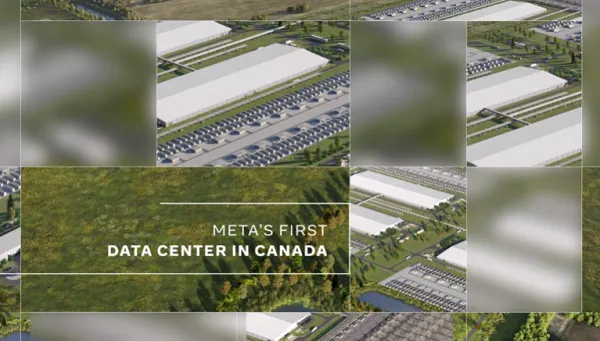
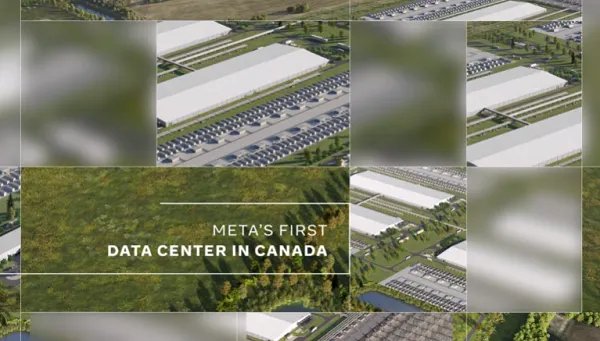
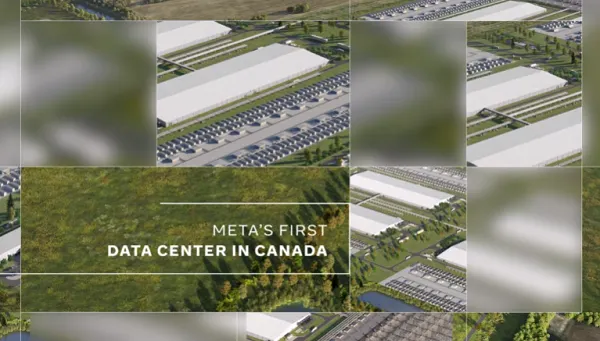
In a move that signals both supreme confidence in its technological roadmap and a potentially risky escalation in capital expenditure, Meta has officially broken ground on its first-ever data center in Canada. Situated in Sturgeon County, Alberta, the $10 billion project marks the 33rd facility in the tech giant’s rapidly expanding global infrastructure footprint.
While the scale of the 1-gigawatt (1GW) facility is a testament to Meta’s commitment to the future of generative artificial intelligence, the announcement arrives at a precarious moment for the industry. As skepticism grows regarding the long-term profitability of AI and the sustainability of massive infrastructure spending, Meta’s move is being viewed by analysts as both a bold offensive play and a potential point of over-extension.
The Core Facts: A Gigantic Footprint in Alberta
Meta’s new facility in Sturgeon County is not merely a warehouse for servers; it is a critical node in the company’s global AI ecosystem. Designed to be optimized specifically for intensive AI workloads, the 1GW site will provide the computational "muscle" required to power the next generation of Meta’s machine learning models.
Beyond the raw hardware, the project promises significant economic stimulation for the region. Meta estimates that the construction phase will generate thousands of jobs, while the operational phase will require 300 permanent, highly skilled staff members. Furthermore, the company has pledged to adhere to rigorous environmental standards, committing to sustainable electricity and water usage practices—a necessary concession in an era where data centers are increasingly under fire for their massive resource consumption.
A Chronology of Unprecedented Infrastructure Growth
To understand the scale of the Alberta project, one must view it as the latest chapter in a multi-year, multi-billion-dollar infrastructure sprint.
- 2024–2025: Meta accelerates its pivot toward "AI-first" infrastructure. The company begins retrofitting existing facilities and greenlighting new, specialized data centers across the U.S. to handle the power requirements of its Llama series of Large Language Models (LLMs).
- Q1 2026: Meta releases its quarterly performance update, shocking markets by revising its 2026 capital expenditure guidance upward. The company announced plans to spend between $125 billion and $145 billion, a significant hike from the previously stated $115 billion to $135 billion range.
- July 2026: Meta confirms it has officially broken ground in Sturgeon County, Canada. This marks the transition of its strategy from purely domestic U.S. investment to an international expansion of its compute capacity.
- Present Day: Industry reports suggest Meta is now exploring the viability of a cloud infrastructure business—a pivot intended to monetize the excess capacity created by its aggressive building spree.
Supporting Data: The Cost of the AI Arms Race
Meta’s investment in Canada is a drop in the bucket compared to its total global commitment. The company has already pledged over $600 billion in the United States alone to support AI-related infrastructure.
The rationale is simple: in the race to achieve Artificial General Intelligence (AGI) or near-equivalent capabilities, compute is the ultimate currency. Meta’s leadership believes that by out-spending and out-building the competition, they can secure a "moat" that rivals will find impossible to cross. However, the data reveals a looming tension:
- The Capex Trajectory: Meta’s consistent upward revision of its annual spending highlights a "build-it-and-they-will-come" philosophy. Investors are growing wary, as these costs weigh heavily on free cash flow.
- The "Cloud" Contingency: The fact that Meta is considering a cloud infrastructure business suggests that the company is preparing for a scenario where its own internal AI workloads do not consume all the capacity it is currently building. This is a defensive move to ensure that $10 billion assets don’t become "stranded costs."
- The Efficiency Gap: Perhaps most concerning for investors is the emergence of lean competitors. While Meta builds massive, expensive facilities, labs in China (such as those behind the DeepSeek and Z.ai models) are reportedly achieving similar performance benchmarks with a fraction of the hardware footprint.
Official Responses and Corporate Strategy
Meta’s official stance remains one of unwavering focus. In their press release regarding the Alberta facility, the company emphasized that the data center is "helping bring to life the technologies that billions around the world use to connect, find communities, grow businesses, and experience the power of our wearables."

The company frames the project as a necessary evolution of its social media and hardware business. By integrating AI deeper into Facebook, Instagram, and its Ray-Ban Meta smart glasses, the company argues that the infrastructure costs will eventually be offset by increased engagement, advertising efficiency, and the development of entirely new revenue streams through AI-driven commerce.
However, the silence from the executive suite regarding the mounting pressure from lower-cost foreign competitors is telling. While Meta highlights the 300 permanent jobs in Alberta, it has offered less clarity on how it plans to maintain its profit margins if the AI market experiences a price war driven by more efficient, lower-cost models from overseas.
Implications: Strategic Masterstroke or Expensive Albatross?
The Alberta project serves as a microcosm of the current state of the global tech industry. There are three primary implications for the road ahead:
1. The Monetization Crisis
Meta is currently betting that the utility of its AI will be so high that users and advertisers will pay a premium for it. If that hypothesis proves false—if users are indifferent to the "AI-ness" of their social media feeds—Meta will be left with hundreds of billions of dollars in hardware that costs a fortune to cool and power, but generates little incremental revenue.
2. The Geopolitical Competitiveness of AI
The shift toward efficient AI (doing more with less) is becoming a geopolitical issue. If U.S. companies continue to rely on a "brute force" model of building massive data centers, they may find themselves at a disadvantage against labs that have mastered algorithmic efficiency. The Canadian project is a gamble on hardware dominance; if the future of AI belongs to software-driven efficiency, Meta may have built the world’s most expensive, obsolete monument.
3. The Environmental and Social Impact
By establishing a presence in Alberta, Meta is tethering its image to the region’s energy profile. Even with commitments to "sustainable" practices, the massive electricity draw of a 1GW data center creates political risks. As AI power demands skyrocket, local communities may become less tolerant of the resource strain, potentially leading to increased regulatory scrutiny and higher costs for future facilities.
Conclusion
Meta’s $10 billion investment in Alberta is a bold, high-stakes signal of intent. It confirms that the company is unwilling to cede even an inch of ground in the AI race. However, the sheer scale of the expenditure—coupled with reports of more efficient AI models emerging from smaller, nimbler labs—suggests that Meta is playing a game of chicken with the laws of economics.
Is this data center the engine of the next great era of human connectivity, or is it the beginning of a costly over-reach that will haunt the company’s balance sheet for a decade? As the concrete sets in Sturgeon County, the entire tech industry waits to see if Meta’s massive infrastructure bet will pay off or become a cautionary tale of the AI bubble. For now, Meta is betting everything on the idea that in the future, the company with the most "compute" will win the world. Whether that is a winning strategy or an albatross remains the multi-billion-dollar question of our time.