Jia Lissa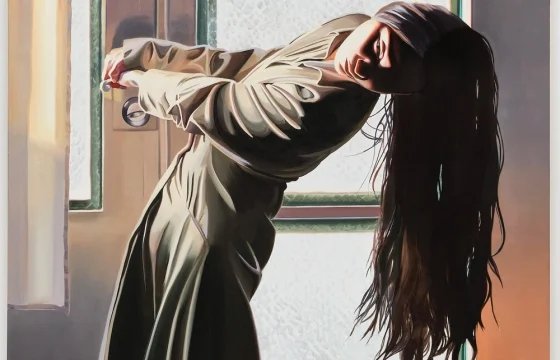
Introduction: A Vernal Arrival
In the shifting landscape of the contemporary New York art scene, few debuts carry the quiet, atmospheric weight of Molly Bounds’ latest collection. Mrs. Gallery, situated at 6040 56th Drive, has officially unveiled The Light That Loses, The Night That Wins, a solo exhibition that marks the Los Angeles-based artist’s significant introduction to the New York City art world.
Opening on the vernal equinox—a date chosen with deliberate, symbolic precision—the exhibition serves as a meditation on the precarious balance between shadow and illumination. Following her successful presentation at The Armory Show in September 2025, this solo show cements Bounds’ position as a painter of psychological depth, capable of translating the ephemeral nature of time into static, yet vibrating, canvas. The exhibition will remain open to the public through May 2, 2026.
Main Facts: The Protagonist of Light
At the core of The Light That Loses, The Night That Wins is a fundamental inquiry into the duality of light. For Bounds, light is not merely a technical element of composition; it is the protagonist. It acts as an active agent that obscures and unveils, serving as a visual metaphor for the relentless, forward-marching nature of time.
Bounds’ paintings capture the liminality of human existence. Her subjects are depicted in states of transition, caught between the stillness of contemplation and the urgency of movement. Much like the vernal equinox—the moment when the Earth’s tilt aligns to equalize daylight and darkness—Bounds’ figures exist on the precipice of change. Her work asks the viewer to consider the moments that define us: those quiet, often unnoticed thresholds where rest dissolves into unease, or where despair surrenders to the promise of renewal.
Chronology of a Creative Trajectory
To understand the significance of this exhibition, one must look at the trajectory of Bounds’ recent career.
- September 2025: Bounds makes her initial impact on the New York art market through a curated presentation at The Armory Show. The reception of her work, which emphasized interiority and light, drew significant attention from curators and private collectors alike.
- Winter 2025–2026: During the months leading up to the exhibition, Bounds developed the series in her Los Angeles studio. This period of isolation and intense focus allowed for the crystallization of themes related to the cyclical nature of seasons.
- March 20, 2026: The vernal equinox marks the opening of The Light That Loses, The Night That Wins at Mrs. Gallery. The timing is non-accidental, anchoring the work in a universal rhythm of rebirth.
- May 2, 2026: The exhibition is slated to conclude, marking the end of the spring cycle and the completion of the current narrative arc of the gallery’s programming.
Supporting Data: Psychological Portraits and Interior Narratives
Bounds’ work is characterized by a unique tension between the domestic interior and the internal landscape of the psyche. Her paintings are not merely depictions of people; they are psychological portraits that capture what lies beneath the surface of the "dormant state."
The Domestic Tension: The Armchair
In the piece titled The Armchair, Bounds demonstrates her mastery of contrast. The painting depicts an interior scene where the warm, flickering glow of a fireplace meets the cold, encroaching blue of an early evening sky visible through a window. The subject is slumped, suggesting a state of repose, but as the viewer lingers, the mood shifts. The upholstery seams appear to be unraveling, mirroring the psychological unraveling of the figure. Her vacant stare suggests a mind caught in a cycle of planning and regret, perfectly capturing the "bliss or something else" that defines the human experience of solitude.
The Vanitas Influence: Privacy Glass
Drawing on the tradition of Baroque masters like Georges de La Tour, Privacy Glass employs dramatic chiaroscuro to explore the concept of the vanitas. The figure in the painting is shielded from the outside world by glass, which acts as both a barrier and a lens. The light, diffusing through the glass, illuminates the subject from behind while a sharp, singular beam cuts through the interior space. This technique obscures the face, forcing the viewer to focus on the textures of the draped clothing and the inevitability of the encroaching darkness. It is a profound commentary on the fleeting nature of time.
The Shift Toward Optimism: Escapism and Renewal
While much of the exhibition dwells on the pensive and the interior, Bounds provides a necessary counterpoint through her outdoor landscapes. In works such as It Sings in Me and Among of Green, Again, the figures are no longer confined by the walls of a room or the weight of introspection.
Instead, these figures move with a sense of freedom across lush, rolling hills. The sunlight here is not a source of tension, but one of celebration. When questioned on the realism of these landscapes—whether they are based on specific locations or imagined—Bounds suggests that the veracity of the landscape is secondary to the utility of the emotion. These pieces are designed to build a framework for optimism. After the darkness of the winter months, these paintings argue that spring is not just a seasonal shift, but an emotional necessity. They represent the "wins" in the exhibition’s the victory of light over the prolonged, cold stillness of the dark.
Official Perspectives and Critical Implications
The arrival of The Light That Loses, The Night That Wins in New York serves as a barometer for current trends in figurative painting. Critics have noted that while the art world has seen a surge in interest regarding hyper-realistic portraits, Bounds differentiates herself by prioritizing the "mood" of the subject over the anatomical precision of the form.
The Gallery’s Vision
Mrs. Gallery has long championed artists who challenge the boundaries between the physical and the psychological. By hosting Bounds’ debut, the gallery is signaling a commitment to work that requires "slow looking." The curatorial choice to present the exhibition through the lens of the equinox highlights a desire to foster a dialogue between the art object and the external environment.
The Artist’s Intent
Molly Bounds has stated in previous interviews that she views her paintings as a way to "map the architecture of feeling." By painting the threshold—that thin line between the night that wins and the light that loses—she invites the viewer to acknowledge their own liminal moments. The implication for the viewer is one of validation: the exhaustion, the quiet planning, the moments of despair, and the sudden bursts of optimism are all part of the same human cycle.
The Broader Implications: Why Now?
In a post-pandemic, hyper-digitized world, the resonance of Bounds’ work cannot be overstated. The digital age is characterized by constant output and the illusion of perpetual sunshine. Bounds, conversely, forces the viewer to confront the "night"—the necessary periods of rest, decay, and introspection.
Her work functions as a mirror for the contemporary condition. We are currently navigating a collective moment of transition, emerging from a long, metaphorical winter. The urgency, celebration, and possibility found in her landscapes provide a path forward, while her interior scenes provide the space for necessary reflection.
As The Light That Loses, The Night That Wins continues its run at 6040 56th Drive, it remains an essential destination for those interested in the evolution of contemporary figurative art. It is a show that rewards the patient viewer, one that asks us to stand still in the doorway between the light and the dark and appreciate the transformative shift occurring within.
For those looking to experience the exhibition, Mrs. Gallery offers a space that is as quiet and contemplative as the works on its walls. It is a rare opportunity to witness an artist in the midst of a significant creative breakthrough, capturing the exact moment when the night finally yields to the morning.


 Asro
Asro
 Sagoh
Sagoh