

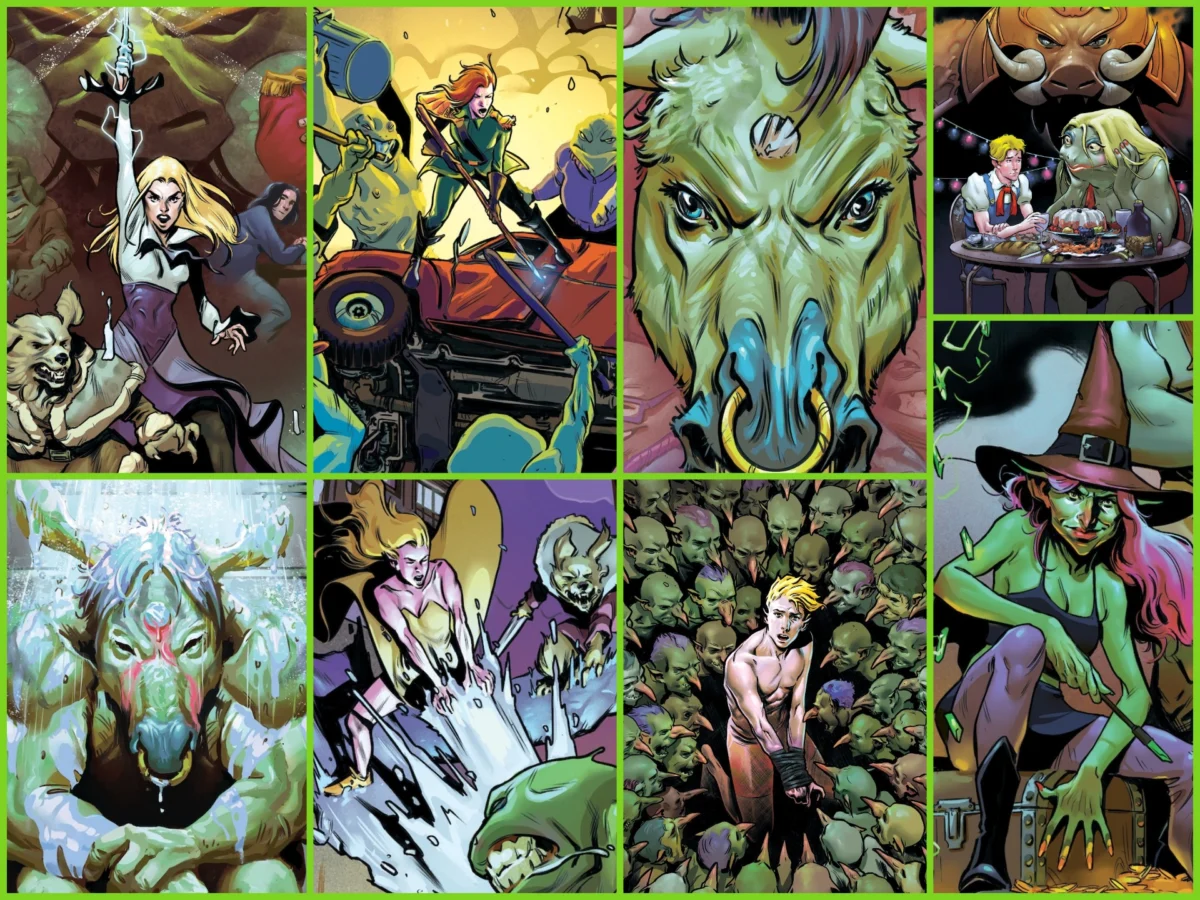
The comic book industry has long served as a mirror for the anxieties of the contemporary world. From the Cold War tensions that birthed the Marvel Age to the existential dread of the modern era, the medium excels at using the fantastical to parse the mundane. With the arrival of Empiria #1, published by Rocketship Entertainment, readers are invited into a realm that feels hauntingly familiar—a place where magic has been commodified, and the soul of a kingdom is being hollowed out by the relentless pursuit of profit.
Available now in comic shops and digital storefronts, Empiria marks an ambitious entry into the high-fantasy genre, though it resists the traditional tropes of swords and sorcery. Instead, it offers a biting social commentary wrapped in the aesthetic of a world transformed by, and addicted to, magical crystals.

The Core Premise: A Kingdom of Crystals
The setting of Empiria is a kingdom redefined by the discovery and exploitation of magic crystals. In this world, these glowing conduits are not merely curiosities for wizards; they are the bedrock of the entire socio-economic structure. They power everything from communication networks and urban transportation to mass entertainment and sophisticated weaponry.
By replacing electricity and fossil fuels with magical crystals, author David K. Wilson has created a setting that functions as an allegory for modern American life. The kingdom is a place of stark contrasts: technological marvels exist alongside the grinding poverty of a working class that has been left behind by the very innovations that were supposed to improve their lives. It is a world where the “American Dream” has been translated into a high-fantasy idiom, only to reveal the same cracks in the foundation that many observers note in our own 21st-century society.

The Human Faces of Economic Disparity
The narrative of Empiria is intentionally fragmented, utilizing three distinct, intersecting storylines to provide a panoramic view of a society in decline.
Princess Mae: The Insider at Odds
At the center of the royal intrigue is Princess Mae. Having dedicated her life to the scholarly pursuit of magic, Mae possesses the expertise to understand the true cost of the kingdom’s dependency on crystals. Her arc is one of disillusionment; she seeks to leverage her knowledge for the public good, only to find herself in direct opposition to her father, the architect of the kingdom’s unchecked “crystal empire.” Her struggle serves as the political heart of the story, highlighting the tension between duty to one’s family and duty to one’s conscience.

Randy: The Punk-Rock Unicorn
Perhaps the most striking character design in the book is Randy, a punk-rock unicorn struggling to navigate the urban sprawl of Dragon City. Randy’s existence subverts the traditional fantasy archetype of the unicorn as a symbol of purity or grace. Instead, he represents the disaffected youth, an individual trying to maintain his identity and survive in an environment that seems built to crush his spirit. His narrative provides a ground-level look at the cultural degradation that accompanies unchecked corporate dominance.
Justin: The Forgotten Farmer
Rounding out the trio is Justin, an out-of-work farmer whose life is defined by the systemic failure of the agricultural sector in an age of magical industrialization. His path changes abruptly after a chance encounter with a mysterious figure named Petra. Justin’s story is the most grounded of the three, reflecting the struggles of the working class whose labor has been rendered obsolete by the very technology they are forced to rely upon.

The Philosophy of Greed: An Interview with David K. Wilson
In a recent discussion regarding the launch of the series, writer David K. Wilson articulated the core mission behind Empiria. For Wilson, the fantasy elements are not an escape from reality, but a lens through which to examine the corrosive nature of avarice.
“The main theme of Empiria is how greed destroys a society,” Wilson told AIPT. “In order to do that, I think we need to see the country of Empiria from a few different angles. There are three main storylines that all work independently of each other and sometimes intersect briefly, but in order to get a sense of how this whole country is being affected, we need to see it from a few different POVs.”

The Asimovian Influence
Wilson cites the legendary science fiction writer Isaac Asimov as a primary creative influence. Much like Asimov used the vast expanse of space to strip away the specific cultural baggage of our time, Wilson uses the “fantasy” label to create enough distance for the reader to engage with the material objectively.
“There is a lot of commentary about modern life, and some exploration of the misery of living in America right now,” Wilson noted. “I’ve always been inspired by the way writers like Isaac Asimov wrote about social issues in a space that abstracted the issues a bit from our current context.”

The Metaphor of the Crystal
The crystals that serve as the narrative’s “MacGuffin” are, in fact, a sophisticated metaphor for contemporary technology. They are the engines of the kingdom, serving as functional replacements for cars, televisions, cellular devices, and military ordnance. By casting these items as magical, Wilson illustrates how seamlessly technology has integrated into our lives—and how we have become just as dependent on our silicon and fiber-optic “crystals” as the citizens of Empiria are on their glowing rocks.
The Search for Heroes in a Cynical Age
Perhaps the most poignant aspect of Wilson’s commentary is his admission that the book was born out of a sense of helplessness. In a world where the news cycle seems to offer nothing but stories of corporate overreach and social fracturing, Wilson felt a moral imperative to create characters who might represent the antithesis of these forces.

“This story is really about living in the USA in the 21st century,” Wilson explained. “For me, every time I turn on the news, I feel increasingly like we are trapped in the first part of a fantasy trilogy where all of these awful forces are starting to combine and conspire against the good people of the world, and it seems like nothing will be able to stand up to them.”
He continued, “I’m not seeing any heroes on TV. I felt like I needed to write some heroes to take to the fight against these evil forces, or I would just lose hope in our society. It really feels like the fairytale of the American dream has gone wrong for a huge swath of the population. Empiria is that kind of storybook.”

Implications for the Industry
The release of Empiria #1 carries significant implications for the independent comic market. In an era where legacy publishers are often criticized for rehashing decades-old continuity, Rocketship Entertainment has leaned into a creator-driven, high-concept model. By focusing on timely, socially conscious narratives, they are appealing to a demographic of readers who are looking for stories that challenge them intellectually while satisfying their appetite for world-building.
The sheer number of cover variants—eight in total—also highlights the promotional strategy surrounding the book. By offering a wide array of artistic interpretations, Rocketship is signaling that they view this title as a major tentpole in their publishing catalog. For collectors and fans of speculative fiction alike, the aesthetic diversity of these covers reflects the multifaceted nature of the story itself.

Conclusion: A Must-Read for Modern Readers
Empiria is more than just a new ongoing series; it is a declaration of intent. Through the eyes of Princess Mae, Randy, and Justin, readers are forced to confront the question: What happens when the tools we created to make our lives easier become the mechanisms by which we are controlled?
As the story unfolds, the intersections of these characters’ lives will likely reveal a broader tapestry of resistance and reclamation. Whether you are a fan of traditional fantasy or someone looking for a sharp, cynical look at the state of modern affairs, Empiria promises to be a challenging and rewarding read. Interested readers are encouraged to visit their local comic book retailers to secure copies of the debut issue, as the buzz surrounding this title continues to grow. In a world that often feels like a dark fairy tale gone wrong, Empiria serves as a much-needed reminder that, even in the most entrenched systems, there is always room for a few unlikely heroes to push back.









No comments yet. Be the first to join the conversation!