In the quiet, historic city of Hirosaki, Aomori Prefecture, a provocative narrative of Japan’s path toward modernization is currently unfolding. The Hirosaki Museum of Contemporary Art is hosting Kazama Sachiko: Clairvoyance in a 9 m² room, a sprawling retrospective that serves as a sobering mirror to the nation’s socio-political trajectory. Through the meticulous, labor-intensive medium of woodcut prints, artist Sachiko Kazama crafts "dark fairy tales" that weave together knights, robots, nuclear warships, and the haunting specters of Japanese history.
The exhibition, which runs through November 15, brings together over 60 works, spanning nearly four decades of the artist’s career. It offers a rare, comprehensive look at how one of Japan’s most unflinching satirists has navigated the intersection of state power, collective memory, and the aesthetic of dystopia.
The Architecture of Satire: The “Dyslympics” Phenomenon
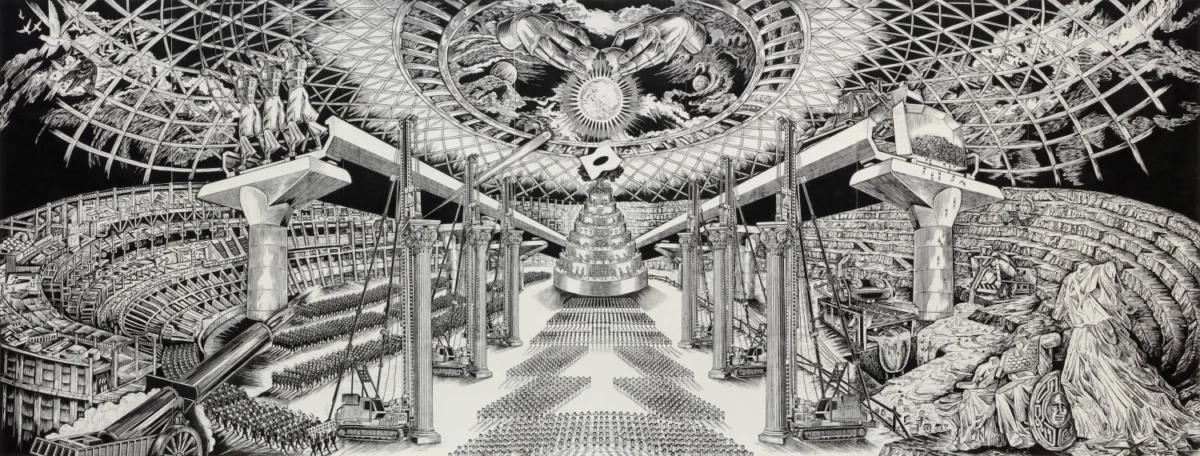
At the heart of the exhibition stands Dyslympics 2680, a colossal woodcut print that serves as the anchor for the retrospective. Created in 2018, as Japan was accelerating its preparations for the 2020 Tokyo Olympics, the work functions as a scathing critique of the nationalistic fervor and historical erasure that often accompany such mega-events.
The print is a dense, black-and-white tapestry of fascist iconography, state-sanctioned violence, and bureaucratic coldness. Kazama draws direct parallels between the 1964 Tokyo Olympics—often remembered as the dawn of Japan’s "economic miracle"—and the 2020 iteration. By incorporating imagery of uniformed soldiers and the forced displacement of the marginalized, Kazama strips away the veneer of "international harmony" that the International Olympic Committee (IOC) and the Japanese government sought to project.
The inclusion of imagery depicting people being bulldozed off highways is not merely symbolic; it is a direct historical reference to the systematic removal of homeless populations and the eradication of working-class neighborhoods to make way for Olympic infrastructure in the early 1960s. In Dyslympics 2680, the "miracle" is transformed into a mechanical, dehumanizing nightmare, suggesting that the structural violence of the past remains embedded in the DNA of the present.
Chronology: Four Decades of Dissent
To understand the weight of the current exhibition, one must look at the evolution of Kazama’s artistic trajectory. Since the mid-1990s, she has utilized the woodcut print—a medium historically associated with both political protest (as seen in the sosaku-hanga movement) and traditional Japanese artistry—to dismantle narratives of progress.
- 1990s: The Formative Years. Kazama began her career by exploring the tension between the individual and the crushing weight of the corporate state. Her early works often featured isolated figures dwarfed by architectural giants, hinting at the alienation inherent in the bubble-era Japanese landscape.
- 2000s: The Nuclear Shadow. Following the onset of the 21st century, her work took a more overtly political turn. She began to focus on Japan’s militaristic history and the shadow of the atomic age. Her prints from this era often featured naval warships and industrial machinery, treated with an aesthetic that blended steampunk mechanical detail with the starkness of woodblock carving.
- 2010s: The Dystopian Turn. The 2011 Great East Japan Earthquake and the subsequent Fukushima Daiichi nuclear disaster served as a catalyst for her most biting work. During this period, her prints began to feature more complex, apocalyptic scenes, questioning the ethics of nuclear energy and the government’s response to crisis.
- 2018–Present: The "Dyslympics" Era. The culmination of her focus on state narratives, Dyslympics 2680 represents her most ambitious synthesis of historical critique and contemporary observation.
Supporting Data: The Cost of Progress
The exhibition does not exist in a vacuum. It forces viewers to engage with the uncomfortable data of Japan’s rapid urban development. Historical archives confirm that the 1964 Tokyo Olympics were indeed a period of significant social displacement. Data from urban historians indicate that large swaths of Tokyo’s downtown districts were "cleared" to make way for expressways and stadium complexes.
In the case of the 2020 Games, which were delayed until 2021 due to the COVID-19 pandemic, the economic data was equally contentious. With an initial budget of approximately 734 billion yen ballooning to over 1.4 trillion yen (according to official audit figures), the financial burden placed on taxpayers became a major point of public contention. Kazama’s work visualizes the human cost of these figures, translating budget deficits and construction logistics into visual metaphors of crushing machinery and buried identities.

Official Responses and Public Sentiment
The reception of Kazama’s work has historically been a barometer for the state of political discourse in Japan. While art institutions have increasingly recognized the intellectual value of her critiques, government-affiliated entities have remained largely silent.
During the lead-up to the 2020 Games, the "Olympic spirit" was heavily guarded by government agencies and PR firms. Public dissent was often sidelined in favor of narratives emphasizing national pride. Kazama’s work, however, provides a space for the "unsaid." Her retrospective in Hirosaki marks a significant shift in how these critiques are curated; by placing her work in a museum context, the institution validates the necessity of artistic dissent, even when it challenges the foundational myths of the state.
Critics have noted that the "9 m² room" mentioned in the exhibition title acts as a claustrophobic metaphor. It represents the space of the individual—a prison cell, a cramped apartment, or a mind trapped in the machinery of bureaucracy.
Implications: Why Art Matters in an Era of Misinformation
We live in an age characterized by what experts call "information overload," where the sheer volume of news often leads to public apathy. In this context, Kazama’s work serves a critical function: it acts as a visual shorthand for complex geopolitical realities.
The implications of the Clairvoyance in a 9 m² room exhibition are twofold:
- The Role of the Artist as Historian. By documenting the "hidden" costs of progress, Kazama ensures that the experiences of the marginalized—those who were bulldozed, relocated, or ignored—are not erased from the collective consciousness.
- The Necessity of Critical Pedagogy. As Japan faces new challenges, from demographic decline to shifting geopolitical alliances in East Asia, the ability to view national narratives with skepticism is vital. The exhibition encourages visitors to question not just the past, but the current systems of power that continue to shape their daily lives.
As one navigates the Hirosaki Museum, the message is clear: modernization is not a linear path toward prosperity. It is a process that leaves victims in its wake, and it is the role of the artist to ensure those victims are seen, heard, and remembered.
Conclusion
Sachiko Kazama does not offer easy answers. She provides no utopian visions. Instead, she offers a mirror. Her woodcuts are not merely images; they are indictments of a society that prizes efficiency over humanity. Through the dark fairy tales of her prints, we are forced to confront the reality that the "Dyslympics" are not a one-time event, but an ongoing condition of a world obsessed with spectacle.
For those visiting the exhibition, the experience is designed to be uncomfortable. It is a prompt to look closer at the infrastructure of our daily lives and ask: Who was moved for this to be built? What was lost for this to be celebrated? In answering these questions, Kazama invites us to reclaim our own agency from the relentless, grinding gears of the machine.