

By International Affairs Desk
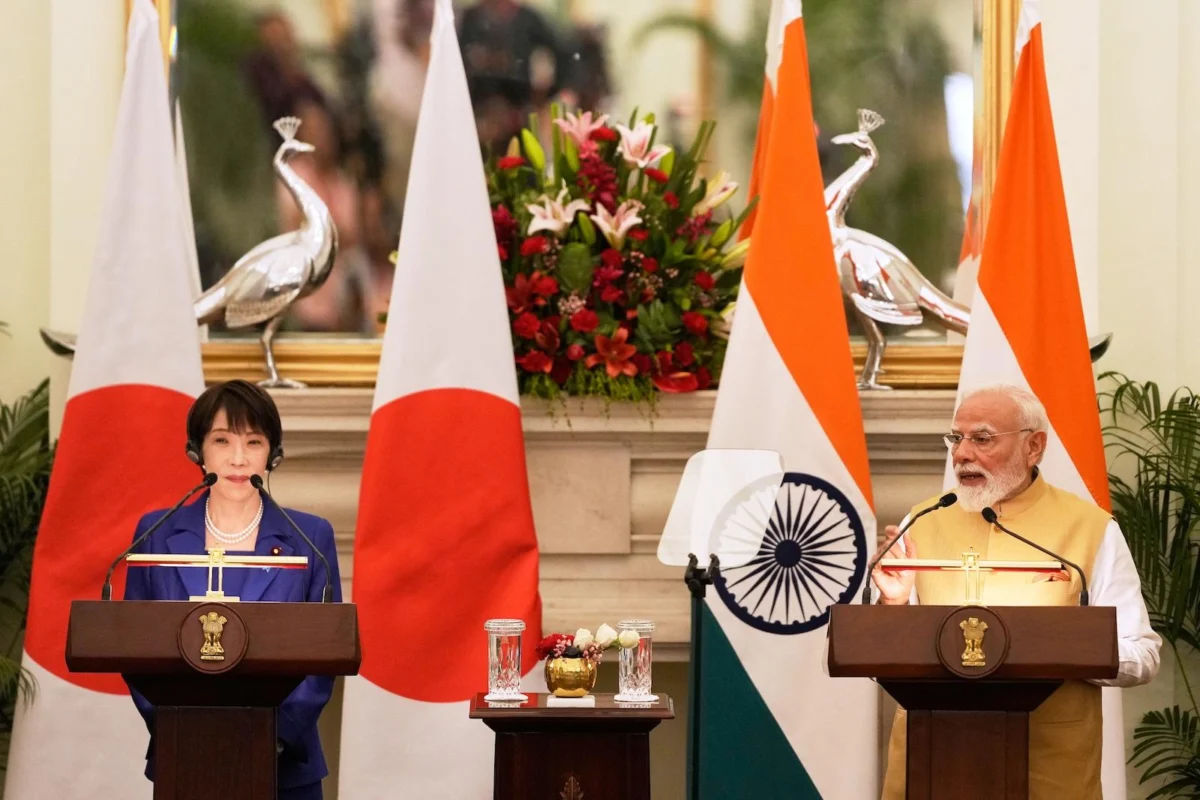
In a move that signals a significant recalibration of geopolitical alliances in the Indo-Pacific, India and Japan have formalized a high-stakes agreement to bolster cooperation in critical technology and supply chain security. The pact, finalized during a summit in New Delhi between Japanese Prime Minister Sanae Takaichi and Indian Prime Minister Narendra Modi, focuses on securing the future of semiconductors, artificial intelligence, and the procurement of critical minerals.
However, the rapprochement has drawn sharp condemnation from Beijing, which views the strengthening of the Tokyo-New Delhi axis as a thinly veiled attempt to contain China’s regional influence. The diplomatic friction highlights the deepening chasm between the democratic "like-minded" partners and an increasingly assertive Chinese state.
The Core of the Agreement: Securing the Tech Frontier
The bilateral framework agreed upon by Prime Minister Takaichi and Prime Minister Modi is designed to insulate both economies from the volatility of global supply chains. By focusing on semiconductors and critical minerals—the bedrock of modern defense and civilian technology—the two leaders are moving to reduce their reliance on Chinese-dominated supply lines.
The agreement emphasizes:
- Semiconductor Sovereignty: Joint investment and research initiatives to ensure a stable supply of chips.
- Mineral Security: Collaboration on the extraction and processing of rare earth elements, essential for clean energy and high-tech manufacturing.
- AI Governance: Ethical development and collaborative innovation in artificial intelligence, aimed at setting regional standards that contrast with state-surveillance models.
The joint statement issued after the summit did not mince words regarding the current global climate, expressing "grave concerns" over "economic coercion" and "non-market policies," a direct allusion to Beijing’s recent implementation of export controls on essential materials.
Chronology of Escalation: From Trade to Geopolitics
The current diplomatic impasse is not an isolated event but the culmination of months of deteriorating relations between Japan and China.
- November 2023: Prime Minister Takaichi ignited a diplomatic firestorm with parliamentary remarks regarding Taiwan. She suggested that a Chinese military incursion against the self-ruled island would necessitate a response from the Japan Self-Defense Forces (JSDF) to support U.S. interests. Beijing characterized the comments as a dangerous provocation.
- Early 2024: China responded to Japan’s increasingly vocal stance on regional security by implementing targeted export restrictions, citing "national security." These moves hit Japanese manufacturing hard, particularly in the automotive and electronics sectors.
- Mid-2024: India, while maintaining a policy of strategic autonomy, has increasingly aligned with Japan’s vision for a "Free and Open Indo-Pacific" (FOIP), citing concerns over China’s growing naval footprint in the Indian Ocean.
- Friday, Current Week: The formalization of the India-Japan economic security pact, which triggered immediate verbal backlash from the Chinese Foreign Ministry.
Official Responses: A War of Narratives
The diplomatic fallout from the summit has been swift, with Beijing and Tokyo engaging in a public battle over the definition of regional stability.
Beijing’s Stance: "Exclusive Small Groupings"
Chinese Foreign Ministry spokesman Guo Jiakun utilized a press conference to warn against the dangers of "exclusive small groupings." Guo argued that the India-Japan pact is inherently exclusionary and serves to "stoke division and confrontation."
"Cooperation between countries should be conducive to safeguarding peace and stability in the region," Guo stated. He dismissed the FOIP vision promoted by Tokyo as a "sugarcoated" scheme designed to sow rivalry, asserting that such maneuvers would never win "genuine recognition" from neighboring states. Beijing’s narrative insists that it is the victim of a containment strategy, with its own export controls framed as necessary responses to Western-led protectionism.
Tokyo’s Rebuttal: An Inclusive Vision
In Tokyo, Japanese Foreign Minister Toshimitsu Motegi offered a staunch defense of the Indo-Pacific strategy. Addressing the allegations of exclusion, Motegi characterized the FOIP as an "inclusive and open vision."
"It is clearly not intended to fuel conflict or confrontation," Motegi told reporters. He argued that the alliance is predicated on the rule of law and the protection of international trade routes, rather than the suppression of any single nation. Japan’s stance is that by diversifying supply chains, they are actually contributing to global stability by preventing any one power from wielding economic dependence as a weapon.
Implications: The New Calculus of Power
The India-Japan partnership carries profound implications for the global order, moving beyond mere trade into the realm of integrated security.
1. Supply Chain Decoupling
The joint focus on "resilient and reliable supply chains" indicates that both Tokyo and New Delhi are committed to a degree of "de-risking" from China. For industries that have long relied on Chinese manufacturing, this represents a significant shift toward "friend-shoring," where critical components are sourced from politically aligned nations.
2. The Taiwan Factor
Prime Minister Takaichi’s explicit linking of Japan’s security to the defense of Taiwan has effectively ended the era of Japanese strategic ambiguity. By bringing India into this orbit, Tokyo is signaling that the defense of democratic values in the Indo-Pacific is now a multilateral priority. India, historically cautious about taking a stance on Taiwan, is increasingly finding common ground with Japan as it experiences its own border pressures from China.
3. Economic Coercion as a Catalyst
China’s tendency to use trade as a cudgel—evidenced by its export restrictions—has backfired by accelerating the formation of the very coalitions it fears. Instead of forcing Japan and India into submission, Beijing’s "economic coercion" has served as a catalyst for closer cooperation, prompting both nations to pool their technological and financial resources to build an alternative infrastructure.
Supporting Data: The Economic Stakes
The economic stakes of this partnership are immense. Japan remains one of India’s largest sources of foreign direct investment (FDI), particularly in the automotive, infrastructure, and telecommunications sectors.
- Trade Volume: Bilateral trade between India and Japan has hovered near $20 billion annually, with significant potential for expansion in the high-tech sector under the new framework.
- Critical Minerals: India’s "Make in India" initiative and Japan’s "Society 5.0" program are both heavily dependent on lithium, cobalt, and rare earth elements. China currently controls approximately 60% of global rare earth production and 85% of processing capacity. The India-Japan pact seeks to break this monopoly through joint exploration in third-party countries and shared processing technology.
- Semiconductor Ambition: India’s ambition to become a global chip manufacturing hub aligns perfectly with Japan’s advanced manufacturing expertise. The agreement includes provisions for the transfer of precision-machining technology, which will be vital for India’s growing tech sector.
Conclusion: A Turning Point for the Indo-Pacific
The deepening of the India-Japan relationship marks a transition from a cooperative economic partnership to a strategic security alliance. While Beijing labels this move as the creation of an "exclusive bloc," Tokyo and New Delhi describe it as a necessary defense of the rules-based international order.
As the region braces for further shifts in the geopolitical landscape, the success of this partnership will likely be measured by its ability to provide a viable alternative to the Chinese-centric economic model. With the U.S. watching closely and the Quad (the U.S., Japan, India, and Australia) providing the broader backdrop for these interactions, the India-Japan summit may be remembered as the moment the Indo-Pacific solidified its response to an era of great-power competition.
For the international community, the message is clear: the era of reliance on a single, dominant manufacturing hub is waning, replaced by a complex, interconnected web of "like-minded" partners determined to secure their own economic and political futures against the backdrop of an increasingly fractured world.











