

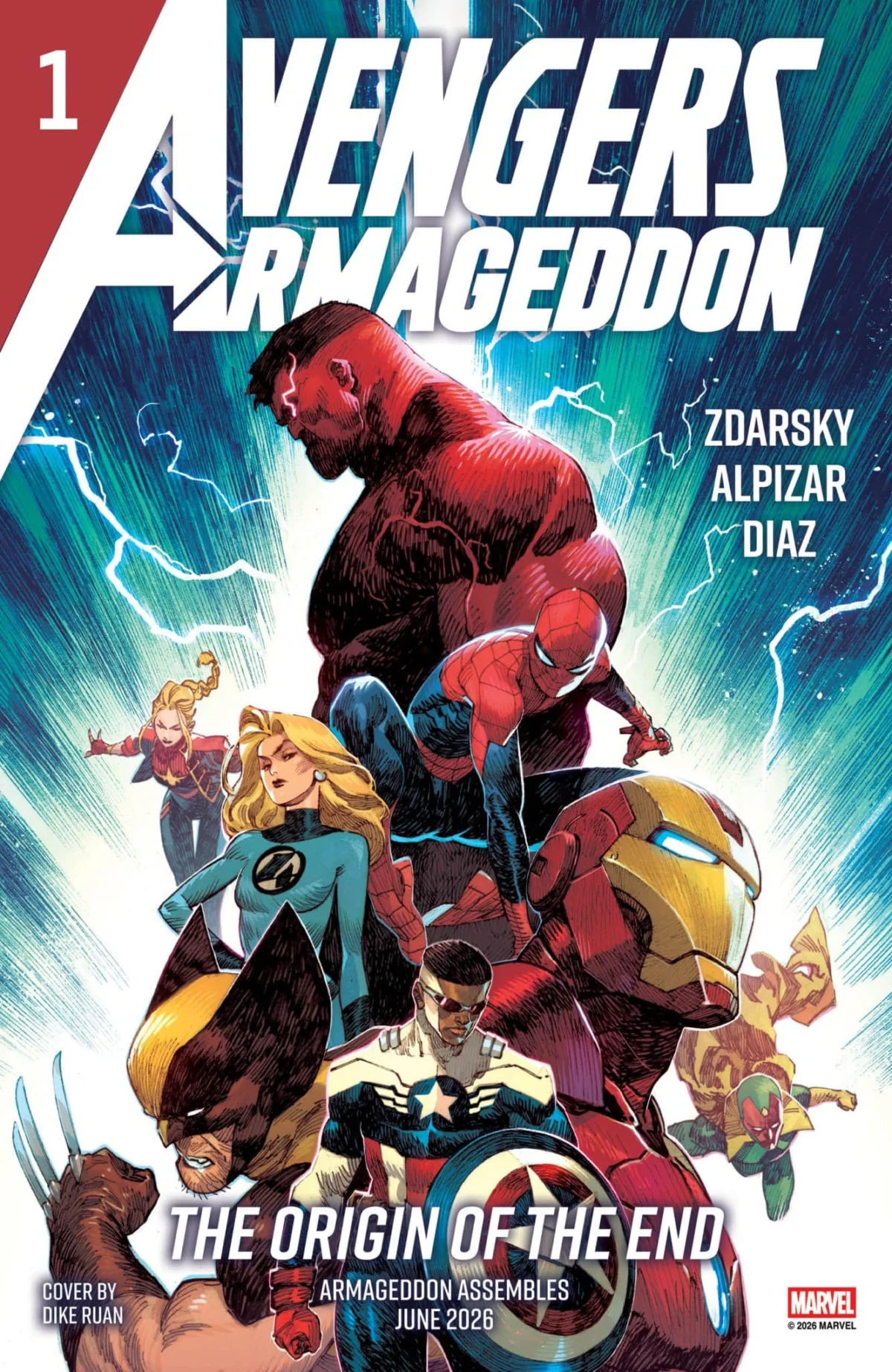
The landscape of the Marvel Universe is poised for a tectonic shift. As the hype cycle reaches a fever pitch, Marvel Comics has confirmed that next week marks the debut of Avengers: Armageddon, a monumental event series that promises to be the most consequential turning point for the franchise since the seminal Avengers: Disassembled storyline. Spearheaded by the creative powerhouse of writer Chip Zdarsky and artists Delio Diaz and Frank Alpizar, this new saga positions Earth’s Mightiest Heroes against an adversary who possesses an unfair, game-changing advantage: the gift of prophecy.
Scheduled for release on June 10, Avengers: Armageddon #1 is not merely a new story arc; it is a fundamental reconfiguration of the Marvel status quo. With the Red Hulk—Thaddeus “Thunderbolt” Ross—having successfully seized control of the sovereign nation of Latveria, the geopolitical and supernatural stability of the world is hanging by a thread. As Ross turns his sights toward total global domination, the Avengers find themselves forced into a conflict where their experience, strength, and tactical brilliance may no longer be enough to secure victory.
The Chronology of Conflict: From Latveria to Global Chaos
To understand the stakes of Avengers: Armageddon, one must look at the recent narrative trajectory leading to this moment. The story does not emerge in a vacuum; it is the direct, brutal result of the most recent arc of Captain America. Following a harrowing confrontation, Steve Rogers, the Sentinel of Liberty, has been left in a coma, effectively decapitating the moral center of the Avengers’ tactical command.
With the vacuum created by Rogers’ absence, Thaddeus Ross has successfully maneuvered his forces to solidify his control over Latveria, the former seat of power for Doctor Doom. This is not a standard military conquest; it is a technological and mystical takeover. The trailer for the series—which has sent shockwaves through the comic book community—reveals that Ross has unearthed a machine left behind by Victor Von Doom. This device grants the user the terrifying ability to witness and analyze infinite possible futures.
Consequently, the Avengers are not fighting a standard brute-force villain. They are fighting an enemy who has already studied their tactical failures, mapped their emotional weaknesses, and observed the specific sequences of events that lead to their total defeat. The chronology of the coming conflict is already being written in the Red Hulk’s mind, forcing the heroes to attempt to break the cycle of destiny before it consumes the planet.
Supporting Data: The Stakes and the Strategic Imbalance
The strategic imbalance in this conflict is unprecedented. When an adversary knows the outcome of a battle before the first punch is thrown, the traditional "assembling" of heroes becomes an exercise in futility—unless they can introduce an element of chaos that the machine cannot predict.
The Arsenal of the Red Hulk
The Red Hulk has evolved beyond his previous iterations. By utilizing Doom’s predictive technology, Ross is effectively playing a grandmaster game of chess while the Avengers are still learning the rules. Reports from Marvel editorial indicate that the series will explore the following strategic elements:
- Predictive Warfare: Ross’s ability to bypass defensive formations by anticipating every strategic counter-move.
- Latverian Resources: The fusion of Ross’s military tactical acumen with the esoteric, high-tech weaponry left behind by Doctor Doom.
- Psychological Attrition: By targeting the heroes’ families and moral foundations, Ross aims to break the Avengers’ resolve before they even reach the battlefield.
The Emergence of the "New Hero"
To counter this, the Avengers are turning to a mysterious, yet-to-be-fully-revealed hero. Marketing materials have teased a character whose raw, untapped power defies the constraints of conventional superhero physics. This individual acts as the "wild card" in the machine’s calculations. However, the cost of utilizing this power is hinted to be severe. Sources suggest that the intervention of this hero will force the public to view the Avengers through a darker, more suspicious lens, effectively ending the "Golden Age" of hero worship that has defined recent Marvel history.
Official Responses and Creative Vision
The creative team behind Avengers: Armageddon has spoken at length about the weight of this project. Chip Zdarsky, known for his nuanced character work in Daredevil and Batman, has described this project as a "necessary deconstruction" of the Avengers’ brand.
"We aren’t just looking to put the Avengers in a tough fight," Zdarsky noted in a recent press release. "We are looking to strip away the armor—both literal and figurative—to see what remains when the heroes can’t rely on their usual victory conditions. Ross isn’t just a monster; he’s a man who has calculated that the current world order is broken, and he’s using a dead dictator’s machine to force a new one. It’s a battle of ideologies as much as it is a battle of fists."
Delio Diaz and Frank Alpizar have echoed these sentiments, focusing on the visual storytelling of a world under siege. "The art reflects the crushing weight of the Red Hulk’s conquest," Diaz stated. "When we draw these scenes of the Fantastic Four, Iron Man, and Captain Marvel, we aren’t just drawing heroes. We are drawing people who are realizing, for the first time in their lives, that they are outplayed."
Implications for the Marvel Universe
The ramifications of Avengers: Armageddon are expected to echo through the publisher’s entire line for the next eighteen months. The implications are three-fold:
1. The Death of Idealism
If the Avengers lose their status as the world’s protectors due to the collateral damage caused by the "new hero," the void will be filled by other, perhaps less benevolent, organizations. We may see a return to the era of government-mandated oversight or a resurgence of private-sector heroics that prioritize profits over protection.
2. The Power Vacuum
With Steve Rogers incapacitated and the Avengers fractured, the international community is forced to look elsewhere for stability. Will the X-Men step in? Will the Midnight Suns or the Thunderbolts be tasked with cleaning up the mess? The series promises a major "changing of the guard," implying that the roster of the Avengers will look radically different by the conclusion of the first volume.
3. The "Magic: The Gathering" Integration
In a unique cross-promotional effort, Marvel has partnered with Wizards of the Coast. Each copy of Avengers: Armageddon #1 will include an exclusive Magic: The Gathering "Warstorm Surge" promo card featuring original art by Ryan Stegman. This initiative highlights Marvel’s push to bridge the gap between comic book collectors and the broader gaming market, turning the release into a cultural event that transcends traditional media.
Conclusion: A Turning Point for Fans
As June 10 approaches, the excitement surrounding the release is palpable. For long-time readers, Avengers: Armageddon represents the kind of high-stakes, narrative-shifting storytelling that defines the legacy of Marvel Comics. Whether the heroes can overcome a foe who knows their every move remains the central question, but one thing is certain: the Avengers of tomorrow will not look like the Avengers of yesterday.
The smoke is clearing, the battlefield is set, and the cost of victory is rising. Fans are encouraged to head to their local comic shops on release day, not only to secure their copies of this pivotal first issue but to participate in a piece of comic book history. Whether this event marks the end of the line for some of Marvel’s most beloved icons or the beginning of a darker, more complex chapter, the era of Armageddon has officially begun.









No comments yet. Be the first to join the conversation!