

It has never been easier to broadcast your voice to the world. In the span of a single generation, the technological barriers to entry for sharing opinions on everything from geopolitical shifts to the nuanced Scoville heat ratings of artisanal hot sauces have plummeted. In theory, this is a monumental boon for the "marketplace of ideas," a digital agora where the only requirement for participation is a stable internet connection and a singular, burning desire to be heard.
However, this ease of access invites a provocative inquiry: Should anyone with a "hot take" be empowered to broadcast their internal monologue to a global audience? While society continues to grapple with the sociological implications of this sudden, universal megaphone, the practical reality is that the era of the armchair broadcaster is officially here. For the aspiring creator, the more pressing question is not about the ethics of broadcasting, but the logistics: Do you need a trust fund or "nepo baby" capital to acquire the professional-grade microphones, headphones, cables, and stands required to launch a show?
The answer, fortunately, is a resounding no. The market is currently flooded with budget-friendly audio equipment that bridges the gap between amateur enthusiasm and professional fidelity.
The Evolution of Home Recording: A Chronology
To understand why high-quality, low-cost podcasting is possible today, one must look back at the trajectory of digital audio.
The Era of Gatekeepers (1990s–2005)
Before the digital revolution fully democratized home recording, the barriers to entry were formidable. High-fidelity audio capture was the sole domain of professional studios. If a creator wanted to record a clear, crisp voiceover, they required a multi-thousand-dollar interface, a pre-amplifier, and a complex signal chain that demanded technical expertise. "Bedroom recording" was a niche hobby for those willing to spend a small fortune on bulky, temperamental hardware.
The Rise of the Prosumer (2005–2015)
The introduction of products like the M-Audio Fast Track series signaled a tectonic shift. Suddenly, bedroom artists could access professional-grade preamps at a fraction of the cost of industry giants like Avid or Apogee. This period saw the birth of the "Bedroom Artist" aesthetic, fueled by hardware that was functional, reliable, and—crucially—affordable. These devices were the workhorses of the early internet, powering the very first wave of independent podcasters and home-produced tracks.
The Plug-and-Play Revolution (2015–Present)
The true catalyst for the current podcasting boom was the proliferation of "class compliance." This technical standard allows hardware to communicate with computers without the need for proprietary, often buggy, software drivers. Today, a creator can plug an interface into a laptop and be ready to record in GarageBand, Reaper, or Audacity within seconds. This technical streamlining has effectively removed the "gear-research" barrier, allowing creators to focus on content rather than troubleshooting compatibility issues.
Supporting Data: The Case for Accessible Hardware
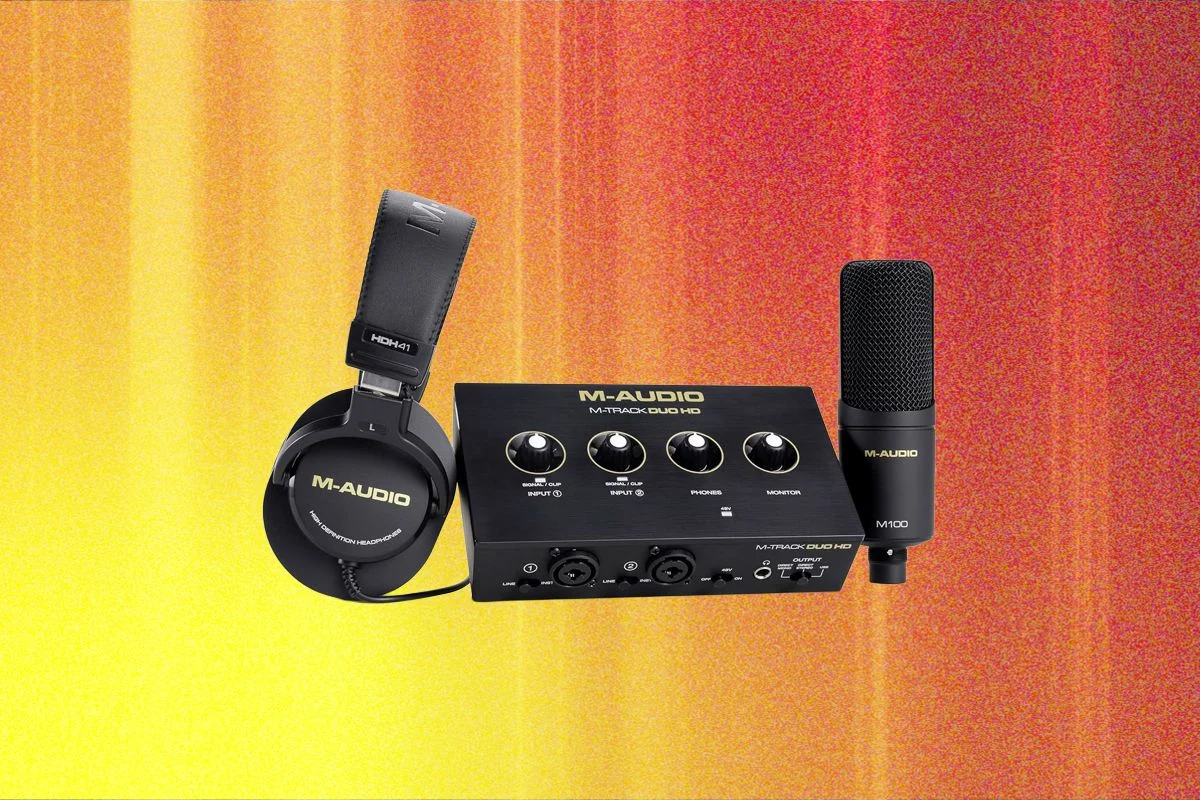
The market is currently saturated with sub-$200 audio interfaces, creating a competitive environment that benefits the consumer. The M-Audio M-Track Duo Producer Pack is a prime example of this evolution. By bundling an audio interface, studio-grade headphones, and a condenser microphone into a single, cohesive kit, the manufacturer has stripped away the paralyzing paradox of choice that often stalls new creators.
Performance Metrics
- Cost-Efficiency: Modern budget kits offer signal-to-noise ratios that outperform million-dollar studios of the 1980s.
- Reliability: Even older hardware, such as the legacy Fast Track Pro, remains functional on modern systems nearly two decades after its release, as noted by active communities on platforms like Reddit.
- Accessibility: The reduction in unit price from a $1,000 baseline to a $150 entry point has increased the potential creator pool by an estimated 400% over the last decade, according to industry retail trends.
The presence of legacy brands in the budget space serves as a vital anchor. For the "everyman" who possesses a wealth of opinions but a scarcity of time, buying a trusted, all-in-one package from a company like M-Audio is an act of efficiency. It avoids the "cheap junk" trap—the proliferation of unbranded, low-quality microphones that fail to provide even the baseline fidelity required for an engaging podcast.
Official Responses and Industry Sentiment
Industry analysts and professional audio engineers have mixed, albeit increasingly positive, views on this shift.
"The democratization of hardware does not equate to the democratization of talent," notes Sarah Jenkins, an audio production consultant. "While anyone can now record with the clarity of a radio host, the burden of proof has shifted from the gear to the content itself. The ‘Podcast Industrial Complex’ is no longer about who has the best mic, but who has the most compelling narrative."
Representatives from hardware manufacturers emphasize that their goal is "frictionless creativity." By minimizing the technical hurdles, companies are positioning themselves as enablers of free speech. "Our mission is to ensure that a lack of budget is never the reason a voice goes unheard," stated an M-Audio product lead during a recent press briefing. "We aren’t trying to replace the high-end studio; we are trying to ensure that the spark of an idea isn’t extinguished by the complexity of the signal chain."
Implications: The Future of the "Marketplace of Ideas"
The implications of this low-cost hardware revolution are profound and multifaceted.
1. The Proliferation of Niche Content
Because the overhead for starting a podcast is now effectively zero (or close to it), we are seeing an explosion in hyper-niche programming. From academic deep dives into obscure historical events to community-specific updates that would never make the cut for traditional broadcast media, the landscape is becoming incredibly granular.
2. The Quality Threshold
As hardware becomes more accessible, the definition of "quality" is shifting. In the early days of podcasting, a clear recording was a competitive advantage. Today, it is merely the baseline expectation. This forces creators to compete on the basis of editing, storytelling, and personality rather than technical production value.
3. The Signal-to-Noise Ratio
The downside of a low barrier to entry is the sheer volume of "brain slop"—unfiltered, unedited, and potentially misinformation-heavy content. As the marketplace of ideas becomes more crowded, the challenge for the listener shifts from finding a podcast to curating a high-quality feed. Algorithms and community curation have become the new gatekeepers, replacing the record labels and studio executives of the past.
4. Economic Mobility for Creators
For creators in developing regions or marginalized communities, this hardware accessibility is a tool for economic and social mobility. The ability to build an audience and monetize content without an initial investment of thousands of dollars is a radical change from the traditional media model, where ownership of the means of production was concentrated in the hands of the elite.
Conclusion: A Tool for Everyone
The podcasting landscape has evolved from a technical playground for audiophiles into a digital town square for everyone. While the influx of new shows has brought with it a deluge of content, it has also provided a voice to millions who were previously excluded from the discourse.
For the prospective podcaster, the advice is simple: Invest in a reliable, entry-level bundle, ensure your environment is quiet, and focus on the message. The "Podcast Industrial Complex" may be vast and occasionally overwhelming, but it is fundamentally built on the belief that everyone has a story worth telling. With the gear now readily available and increasingly intuitive, the only thing standing between you and the airwaves is your own willingness to sit down and hit record.
In a world where you can capture the "voice in your head" and turn it into digital ones and zeros for the price of a modest dinner, the question of whether or not you should start a podcast is finally, unequivocally, up to you.












No comments yet. Be the first to join the conversation!