Laily UPN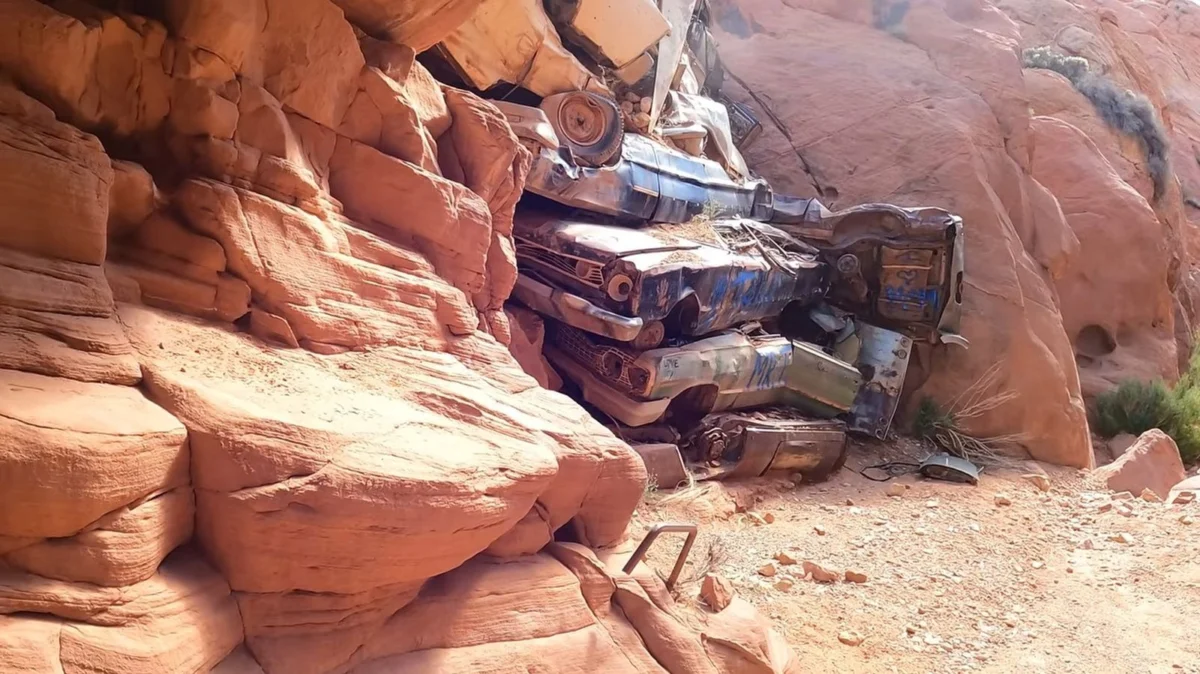
While Utah is globally celebrated for its "Mighty 5"—the sprawling, iconic landscapes of Arches, Bryce Canyon, Canyonlands, Capitol Reef, and Zion—the state holds secrets that blend ancient geological wonders with unconventional 20th-century engineering. Along the winding expanse of U.S. Route 89, a highway often referred to as "Utah’s Heritage Highway," travelers often find themselves mesmerized by the stark beauty of the desert. Yet, near the 24.5-mile marker east of Kanab, a modern anomaly sits nestled within the depths of Catstair Canyon: a retaining wall constructed entirely from crushed, mid-century automobiles.
Known locally as the "Detroit Rip-Rap," this curious monument to automotive history serves a far more practical purpose than art or tourism. It is a testament to an era of "make-do" engineering, where discarded vehicles from the Motor City were repurposed to battle the relentless forces of desert erosion.
Main Facts: A Highway Held Together by Steel
The Detroit Rip-Rap is an extraordinary example of civil engineering born from necessity. In the 1960s, the integrity of U.S. Route 89 was under constant threat. The steep, narrow terrain of the Catstair Canyon, prone to flash flooding and rapid soil displacement, created a precarious situation for the highway’s foundation.
Rather than relying solely on traditional quarried stone or concrete, engineers and local road crews—utilizing the materials readily available at the time—deployed a fleet of junked automobiles. These vehicles were crushed, stacked, and layered with a mixture of rock, gravel, and earth to create a structural bulwark. Over time, these metallic skeletons became fused with the earth, creating a permanent, armored embankment that shields the highway from the erosive power of seasonal storms.
Chronological Evolution: From Assembly Line to Canyon Floor
To understand the presence of the Detroit Rip-Rap, one must look at the mid-20th-century approach to infrastructure in rural America.
The 1960s: The Era of Creative Resourcefulness
During the mid-1960s, the U.S. Department of Transportation and local Utah authorities faced a recurring problem: the "undercutting" of the roadbed at Catstair Canyon. Flash floods, common in the high-desert environment, would sweep through the canyon, washing away the soft sandy soil and threatening to collapse the road above.
Construction crews of the era, operating with smaller budgets and fewer environmental regulations than those in place today, turned to an ingenious, if unorthodox, solution. By utilizing scrapped cars—which were abundant and inexpensive—they created a mass-density barrier that could withstand the impact of water and debris flow far better than loose dirt alone.
The 1970s–1990s: Natural Integration
As decades passed, the "junk" aspect of the wall began to fade. The empty cavities of the cars were filled with sediment, and the steel rusted into the iron-rich soil of the canyon. Vegetation began to sprout through the gaps, effectively camouflaging the metallic wall. During this period, the Rip-Rap transitioned from a "construction project" to a piece of local folklore.
The Modern Era: A Cult Landmark
Today, the site is recognized by geologists, off-road enthusiasts, and history buffs as a unique intersection of human history and environmental management. While the vehicles are largely unrecognizable as individual sedans or trucks, the jagged, metallic silhouettes poking out from the canyon wall serve as a stark reminder of the highway’s unique history.
Supporting Data: Understanding Rip-Rap Engineering
In the construction industry, the term "rip-rap" refers to rock or other material used to armor shorelines, streambeds, bridge abutments, and other structures against water erosion.
Technical Specifications of the Detroit Rip-Rap
- Purpose: Erosion control and slope stabilization.
- Mechanism: Energy dissipation. By introducing heavy, solid objects (cars) into the flow path, the velocity of the water is significantly reduced, preventing the removal of foundational soil.
- Durability: While traditional rip-rap uses angular stone to interlock, the Detroit version utilized the structural integrity of steel car frames to provide a "skeletal" support system that remains in place even during high-velocity flooding.
- Environmental Impact: While modern standards would likely discourage the use of non-biodegradable vehicle waste, the 1960s installation has effectively created a localized ecosystem where the metal acts as a trellis for native scrub brush and desert flora.
Official Responses and Perspectives
The Utah Department of Transportation (UDOT) has historically managed Route 89 with an eye toward safety and preservation. While the Detroit Rip-Rap is not an "official" historical landmark in the traditional sense, it is acknowledged in the context of the Heritage Highway’s history.
Local historians often highlight the irony of the site: the cars, which were once the pride of Detroit’s industrial might, ended their life cycles in the solitude of the Utah desert. Archaeologists, meanwhile, point to the contrast between the Detroit Rip-Rap and the ancient pictographs located in the same canyon. These indigenous carvings, etched into the sandstone centuries before the internal combustion engine was even a concept, offer a jarring juxtaposition: one set of markings represents the transient nature of modern industrial society, while the other reflects a deep, enduring connection to the land that has lasted for millennia.
Implications: A Lesson in Adaptive Infrastructure
The existence of the Detroit Rip-Rap raises several important questions about the legacy of infrastructure and the ethics of environmental stewardship.
The Sustainability of "Make-Do" Solutions
The Detroit Rip-Rap is a relic of a "throwaway" culture that paradoxically became a tool for preservation. By repurposing waste, the builders of the 1960s inadvertently created a structure that has outlasted the very cars that composed it. However, modern environmental science cautions against this practice, noting that the leaching of automotive fluids—oil, transmission fluid, and lead—into the desert water table could be a long-term consequence of such projects.
Tourism vs. Preservation
As more travelers stop at the 24.5-mile marker, the canyon faces the risk of over-tourism. Protecting the delicate pictographs and petroglyphs nearby is now a priority for the Bureau of Land Management (BLM). Visitors are often caught between the intrigue of the "Detroit Rip-Rap" and the necessity of respecting the fragile archaeological treasures located just a few hundred yards away.
The Future of the Rip-Rap
There is no plan to remove the Detroit Rip-Rap. Doing so would likely destabilize the embankment that supports Route 89. Instead, the site remains a "living" exhibit. It serves as a reminder that human ingenuity, even when it manifests as junk, is inextricably linked to the geography of the American West.
Conclusion: A Monument to the American Journey
The Detroit Rip-Rap is more than just a wall of rusted steel; it is a chapter in the story of the American road. It represents a time when the highway was king, and the resources to maintain it were limited only by the imagination of the crews working in the field.
As travelers journey along U.S. Route 89, they are encouraged to look past the stunning vistas of the "Mighty 5" and acknowledge the smaller, stranger, and often more fascinating details that make Utah’s Heritage Highway so unique. Whether you view it as an eyesore or a marvel of mid-century ingenuity, the Detroit Rip-Rap is a permanent part of the canyon’s geology—a metallic skeleton that continues to hold the road to the future together.
For those passing through, the site offers a rare opportunity to reflect on how we impact the landscapes we travel through, and how, sometimes, our discarded past becomes the foundation for our present.


 Muslim
 Evan Lee Salim