

By Joe George | May 29, 2026
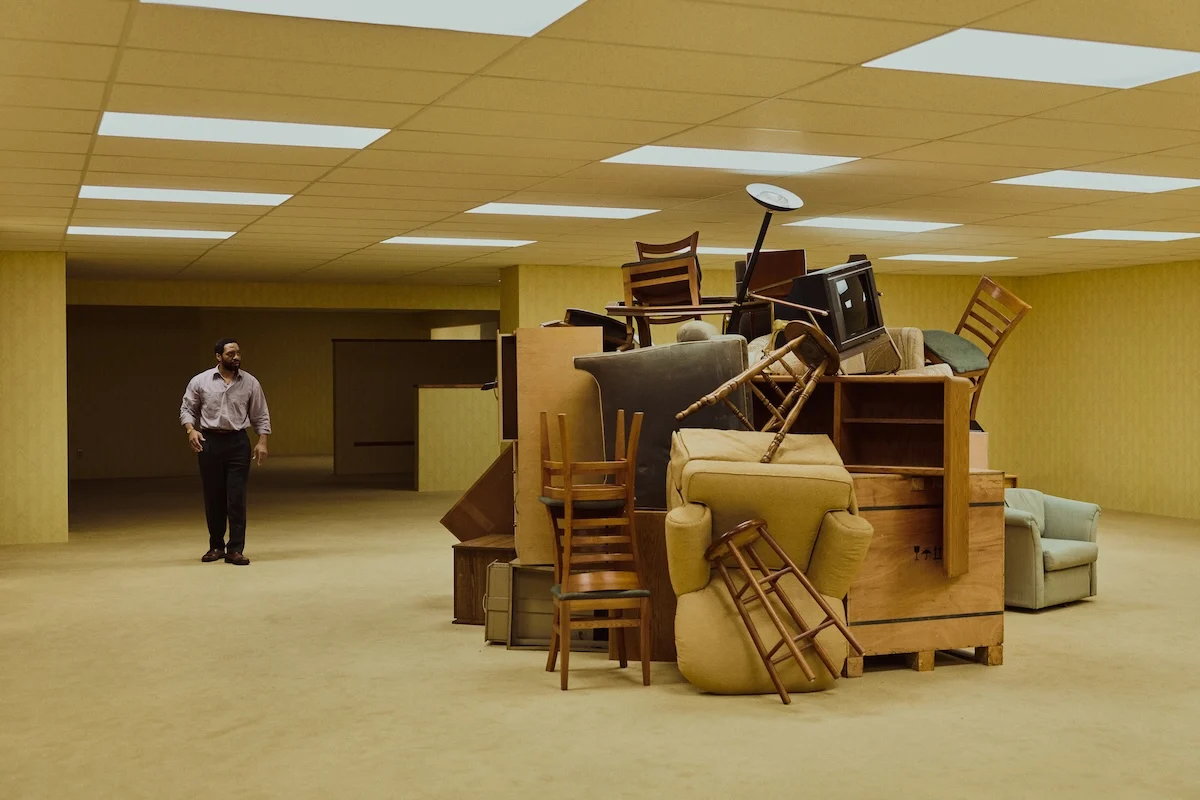
In the early, disorienting sequences of Backrooms, the latest psychological horror venture from A24 and director Kane Parsons, we find Clark (Chiwetel Ejiofor), a furniture salesman, stumbling through the bowels of a structure that defies Euclidean geometry. In one desperate moment, he claws his way up a steep incline toward a small, brown door, frantic to escape a sound he perceives as a predatory beast. He reaches the door, only to find three handles—two are decorative illusions, and only one leads to an exit.
Clark’s panic is palpable, but as the film unfolds, the audience realizes his fear is misplaced. Backrooms is not a creature feature in the traditional sense; it is a profound meditation on the uncanny, the distorted, and the soul-crushing replication of reality. By focusing on spaces that are "almost" right—fluorescent lights in the wrong places, architectural impossibilities, and human figures that flicker with glitchy, non-human geometry—director Kane Parsons has crafted the first true horror film of the Artificial Intelligence era.
The Architecture of Inhumanity: A Chronology of Dread
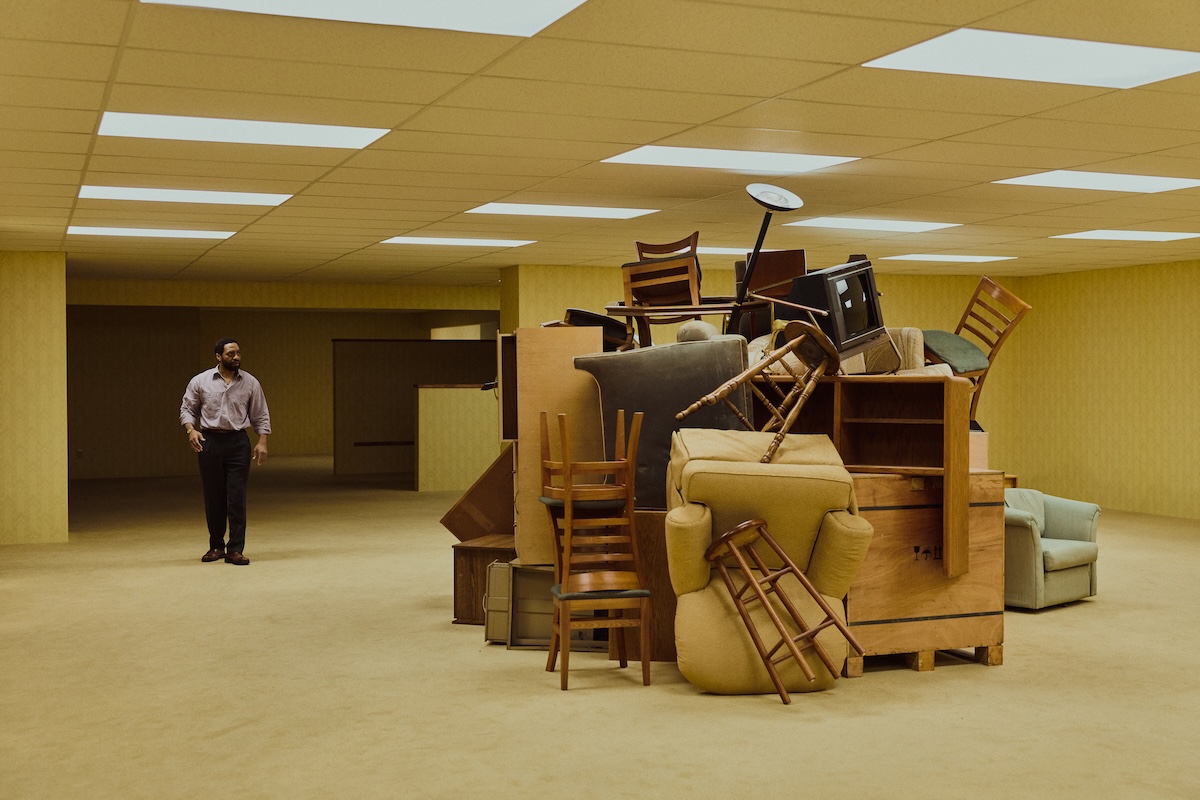
The premise of Backrooms feels like a digital fever dream brought to life. The film begins with the mundane—a basement in a furniture store—before slowly unraveling into a labyrinth of nonsensical office corridors and windowless rooms.
The film’s progression acts as a narrative mirror to the way generative AI processes data. Initially, the environment seems consistent with reality: an electrical box looks standard, save for three rogue switches placed diagonally. As Clark ventures deeper into the "Backrooms," the logic of the environment deteriorates. Couches are placed where no human would sit; windows allow for no view of the outside; hallways fold into themselves.
This is not a haunted house in the traditional, supernatural sense. It is a world that "remembers" reality but fails to comprehend it. As the narrative progresses, the entities Clark encounters—a man fused to a wheelchair, a titan with redundant facial features, a shuddering woman—serve as a visual manifestation of the "Uncanny Valley." These figures are not monsters born of magic, but horrors born of bad data and incomplete synthesis, echoing the way AI struggles to render human anatomy, often leaving behind extra fingers, blended limbs, and vacant, dead-eyed expressions.
Supporting Data: The Uncanny Valley in Modern Media
The terror of Backrooms is not confined to the screen. In a chilling meta-narrative moment, the theatrical experience itself highlights the encroaching reality of the film’s themes. Before the feature presentation, many audiences are subjected to advertisements—some created entirely by generative AI.
One particular ad for a local insulation company features a woman whose movements are unnervingly fluid, whose eyes possess a hollow, digital sheen, and whose vocal cadence crackles with synthetic artifacts. While the other commercials for soda or vehicles are merely mundane, this AI-generated spot is genuinely frightening. It highlights the fundamental disconnect: the AI is programmed to sell comfort, yet it is fundamentally incapable of feeling the temperature it speaks of.
Historically, cinema has grappled with the fear of the "artificial" since Mary Shelley’s Frankenstein and Karel Čapek’s R.U.R. From The Terminator to M3GAN, the genre has long warned of a "Singularity"—a point where machines gain sentience and choose to eradicate humanity. However, Backrooms suggests that this fear was misaligned. The threat isn’t a sentient machine wielding a weapon; the threat is the systematic dehumanization of human labor and creativity by corporate entities.
The Socio-Economic Implications of the Synthetic Age
The horror of Backrooms is deeply rooted in contemporary anxiety regarding generative AI. The real-world threat, as portrayed in the film’s subtext, is not that robots will "wake up" and kill us. The threat is that companies are burning vast resources—water, electricity, and human capital—to feed data farms, effectively stealing the intellectual property of humans to create cheap, "good enough" imitations.
When a company lays off its creative workforce to use an algorithm that scrapes the internet for aesthetic patterns, it is a form of violence. Backrooms captures this by depicting a world that is a "copy of a copy." Much like the internet trend of asking ChatGPT to iterate an image until it becomes a grotesque, unrecognizable mass of pixels, the film’s entities represent the ultimate failure of AI to "understand" humanity.
When we watch a deepfake of a beloved actor or an AI-generated script, we feel a specific, existential unease. It is the feeling of being replaced by something that has no concept of the human experience. As Clark notes in his confrontation with his own reality, the attempt to replicate life only makes a mockery of it, twisting our shared existence into something grotesque.
Official Perspectives and Thematic Core
Director Kane Parsons, in collaboration with A24, has created a work that refuses to provide a neat, scientific explanation for the Backrooms. Even when characters like the scientist (Mark Duplass) appear, they offer no solace. They, too, are lost in the logic of the system.
The film’s climax serves as a scathing critique of stagnation. In a pivotal moment of heartbreak, Clark pleads, "I don’t want to change." This declaration, while seemingly a rejection of growth, is actually a tragic surrender to the comfort of the familiar. In the context of the AI debate, it mirrors the current societal struggle: do we cling to human tradition and the messy, beautiful reality of our imperfections, or do we surrender to the sanitized, efficient, and ultimately hollow promises of the machine?
The film argues that maturity, growth, and the ability to change are inherently human traits. By refusing to evolve—by fearing the future—we leave ourselves vulnerable to the false, distorted depictions offered by Generative AI. We find ourselves trapped in a room of our own making, surrounded by mirrors that show us a version of ourselves that is technically accurate but soul-less.
Conclusion: The Mirror We Dare Not Look Into
Backrooms is a masterclass in atmospheric horror, but its lasting impact will be its status as a cultural document. It serves as a warning that the most terrifying aspects of technology are not the ones that explode or shoot lasers, but the ones that slowly, subtly replace the human touch with a simulation that feels "a little bit off."
As we stand on the precipice of a new technological epoch, Backrooms forces us to ask: If we allow the machines to define our reality, what happens to the human spark? If we allow the algorithm to write our stories, paint our pictures, and provide our services, will we even recognize the world when we finally try to leave the room?
The monster in Backrooms is not a creature with sharp teeth. It is the realization that we are looking at a world that doesn’t need us—a world that is perfectly capable of mimicking our existence without ever having lived it. For audiences worldwide, the film is now available in theaters. It is a haunting, necessary watch for anyone who has felt the creeping dread of the digital void, and it serves as a stark reminder that the most human thing we can do is reject the simulation and choose the messy, unpredictable reality of our own lives.











No comments yet. Be the first to join the conversation!