Neng Nana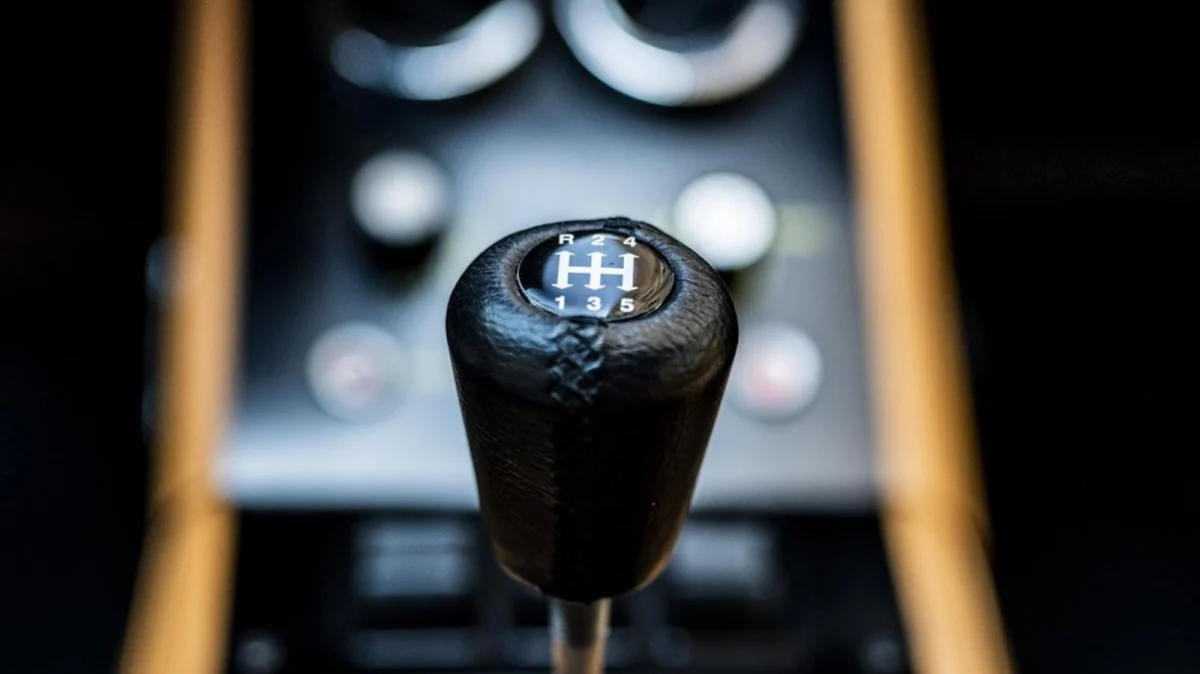
For the vast majority of drivers who have mastered the art of the manual transmission, the "H-pattern" is the universal language of the gearstick. It is intuitive, symmetrical, and predictable: first gear is up and left, second is straight down, and the progression continues logically through the gears. However, for those who have spent time behind the wheel of vintage European performance icons, there exists an outlier that often causes initial confusion: the "dog-leg" gearbox.
With first gear tucked away to the far left and down, the dog-leg configuration turns the traditional shifting logic on its head. While it may seem like an eccentric engineering choice designed to differentiate European marques from their American counterparts, the layout was a deliberate, performance-oriented decision rooted in the high-stakes world of circuit racing.
The Anatomy of the Dog-Leg
In a standard H-pattern shifter, first gear is located at the top-left corner. This is designed for the stop-and-go nature of city driving and the rapid-fire acceleration required for drag racing. Conversely, the dog-leg pattern places first gear in a recessed position—left and down—meaning that second and third gears fall into a direct, vertical line.
This specific arrangement creates a "dog’s leg" shape in the shifting diagram, hence the moniker. To move from second to third gear, the driver performs a simple, straight flick upward, rather than navigating the lateral "gate" required in an H-pattern. This physical architecture was not merely a stylistic quirk; it was a response to the specific demands of road racing.
A Chronology of the Shift: From Track to Tarmac
To understand why the dog-leg gained prominence, one must look at the evolution of European touring car racing during the mid-20th century.
The 1960s and 1970s: The Birth of the Configuration
During the 1960s, racing gearboxes were becoming increasingly complex. Engineers at manufacturers like ZF and Getrag—the primary suppliers for performance marques—began optimizing transmissions for road courses that featured long straights punctuated by tight, technical hairpins. It was during this era that the dog-leg became a staple in European GT cars. By isolating first gear, engineers ensured that it was only used for the initial launch from the pit lane or a standing start—scenarios that happened exactly once per race.
The 1980s: The Golden Age of the Dog-Leg
The 1980s served as the peak for the dog-leg configuration, popularized by the homologation specials of the Group A touring car era. The BMW E30 M3, arguably the most famous proponent of the layout, utilized a Getrag dog-leg box. For the E30 M3, which was designed primarily for the track and adapted for the street, the transmission was perfectly suited for the rhythmic shifting between second, third, and fourth gears on a winding circuit.
During this same period, Italian supercar manufacturers, specifically Lamborghini, adopted the pattern for the Countach and later the Diablo. These cars were designed for high-speed grand touring and track performance, where the rapid, linear shift between second and third was considered more critical than the ease of finding first gear in a traffic jam.
The 1990s to Present: The Fade into Obscurity
As the 1990s progressed, the rise of sophisticated synchromesh technology and the eventual emergence of paddle-shifted dual-clutch transmissions (DCTs) began to erode the relevance of the dog-leg. By the early 2000s, most manufacturers had abandoned the pattern in favor of standardized H-patterns, which were easier for the average consumer to adapt to. Today, the dog-leg exists primarily as a relic of a bygone era, preserved in classic car collections.
Supporting Data: The Physics of the Shift
The primary justification for the dog-leg layout is found in the frequency of gear changes during a lap.
The Second-to-Third Ratio
On a typical road course, a driver spends the vast majority of their time oscillating between second, third, and fourth gears. In an H-pattern, the driver must move the shifter across the "neutral gate" to transition from second to third. This requires lateral movement, which introduces a slight delay and a potential point of failure—the dreaded "missed shift."
By placing second and third in a straight line, the dog-leg gearbox allows the driver to move the shifter vertically. This reduces the mechanical complexity of the throw and minimizes the risk of accidentally slipping into the wrong gear during high-G cornering.
Drag Racing vs. Circuit Racing
The contrast between American and European automotive philosophies is highlighted by their respective gearboxes. American muscle cars, designed for the quarter-mile, prioritize the 1-2 shift. The H-pattern allows for a quick, aggressive "slam" from first to second gear. Because drag races are won in the first few seconds, ease of access to first gear is paramount.
European GT racing, however, is a game of endurance and corner exit speed. The ability to downshift from third to second while braking hard into a hairpin—and then immediately upshifting to third on the exit—is a maneuver performed dozens of times per race. The dog-leg makes this specific sequence faster and more fluid.
Official Industry Perspectives
While there are no "official responses" in the modern sense—as the technology has been largely phased out—historical interviews with engineers from Getrag and BMW provide insight into the mindset of the era.
Engineering leads of the 1980s frequently cited "driver ergonomics during high-load maneuvers" as the primary design driver. According to historical archives, the goal was not to make the car difficult to drive, but to ensure that the transmission felt like an extension of the engine’s power band. The shift was seen as a tactile feedback mechanism; a short, straight pull into third gear provided the driver with a level of confidence that a lateral, gate-crossing shift simply could not match.
Furthermore, some automotive historians note that the dog-leg was also a result of transmission packaging. In some older rear-wheel-drive configurations, the physical architecture of the gearbox housing favored the dog-leg shift rails, making it a more efficient use of space within the transmission tunnel.
Implications for Modern Performance
The dog-leg vs. H-pattern debate has effectively been rendered moot by the digital revolution. Modern high-performance vehicles, such as those from Porsche, Ferrari, and McLaren, have moved away from manual sticks entirely.
The Rise of the Paddle Shifter
The modern dual-clutch transmission can execute a gear change in milliseconds—far faster than any human hand can move a lever. Furthermore, electronic rev-matching has eliminated the need for complex footwork like "heel-and-toe," which was once a requirement for smooth downshifts in dog-leg equipped cars.
The Nostalgia Factor
For the modern enthusiast, the dog-leg remains a symbol of an era when the driver was the final arbiter of performance. Driving a dog-leg car requires a cognitive adjustment; it is a reminder that the machine requires total concentration. When you are in a car with a dog-leg shifter, you cannot drive on "autopilot." You must be deliberate with every movement.
The Preservation of Heritage
As manual transmissions become an endangered species, the value of cars with unique mechanical quirks like the dog-leg has skyrocketed. Collectors now seek out E30 M3s or Countaches not just for their performance, but for the visceral experience of the shift itself. The dog-leg is a tactile bridge to a period when engineering was defined by the specific needs of the race track rather than the convenience of the commute.
Conclusion
The dog-leg shifter is a fascinating case study in functional design. While it may appear counterintuitive to the modern driver, it was a perfectly logical solution to the specific problems faced by racing drivers in the latter half of the 20th century. It prioritized the most common gear transitions at the expense of the least common, optimizing the human-machine interface for the rigors of the circuit.
While the industry has moved toward the efficiency of computer-controlled gearboxes, the legacy of the dog-leg remains a testament to a time when manufacturers were willing to prioritize the purity of the driving experience above all else. For those lucky enough to operate one, it offers a rare glimpse into the history of automotive performance—a reminder that sometimes, the "wrong" way to shift is actually the best way to race.


 Azzam Bilal Chamdy
 Layla Zulfa