Jia Lissa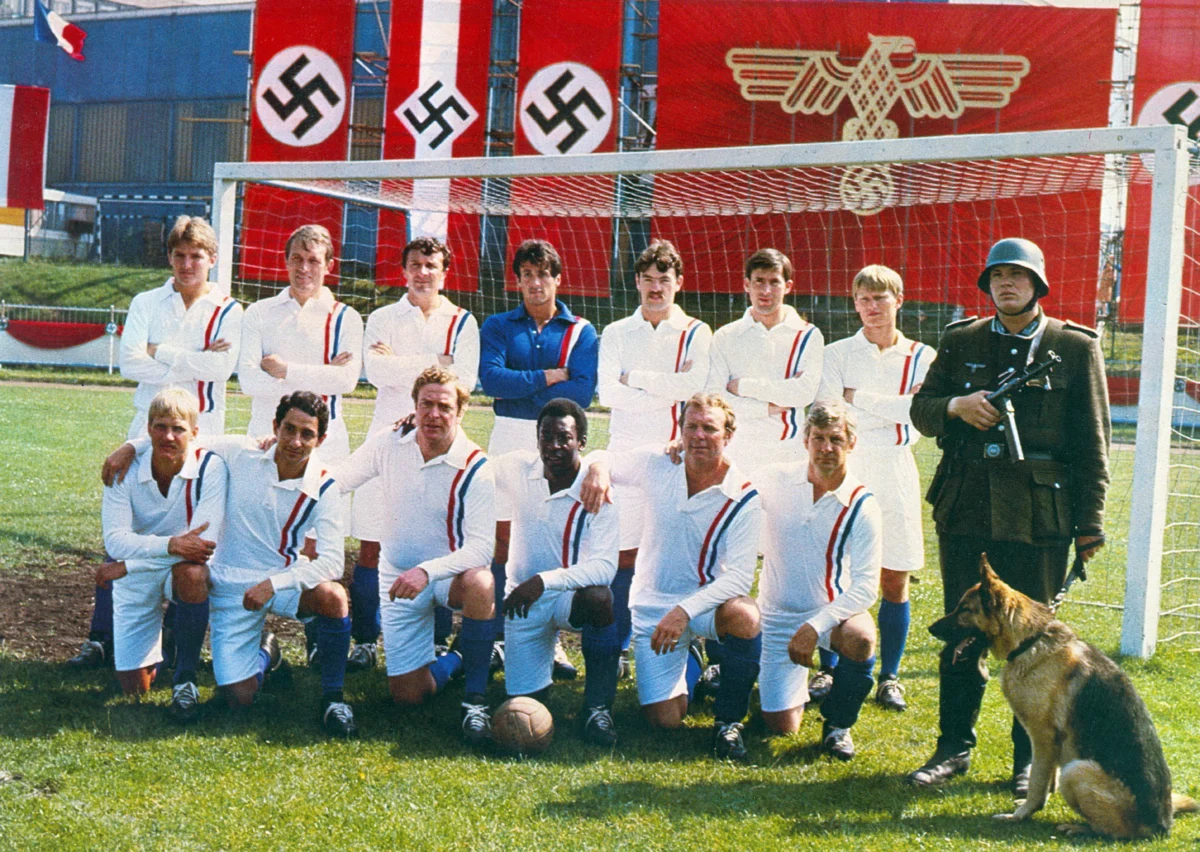
Every Friday, IndieWire After Dark delves into the fringes of cinematic history to spotlight films that defy easy categorization. This week, we examine the curious 1981 sports-war hybrid Victory (released as Escape to Victory in international markets). Directed by the legendary John Huston, the film is an outlier in a storied career defined by moral ambiguity and cynical grit. As we navigate the complexities of the 2026 World Cup, Victory serves as both a time capsule of 1980s star power and a haunting reminder of how the intersection of sport and politics has evolved—and arguably curdled—over the last half-century.
The Bait: Witnessing the Weirder Work of a Cinematic Titan
In 1981, the film industry witnessed an unlikely convergence of talent. John Huston, a director whose early works like The Maltese Falcon and The Treasure of the Sierra Madre defined the "hard-boiled" era of Hollywood, helmed a big-budget, earnest sports drama starring Michael Caine, Sylvester Stallone, and Max von Sydow. The film’s premise—Allied prisoners of war playing a high-stakes soccer match against their Nazi captors—was bolstered by the presence of football legends including Pelé and Bobby Moore.

The film serves as an intriguing counterpoint to Robert Aldrich’s 1974 classic, The Longest Yard. While the latter is a cynical, shaggy-dog comedy reflective of the Watergate era’s disillusionment, Victory is surprisingly straight-faced. It is a product of a more conformist era, a stylistic shift for a director who had spent decades deconstructing the American Dream.
Chronology: The Evolution of a Legend’s Late Career
To understand Victory, one must look at the trajectory of John Huston’s late career. Following the release of The Maltese Falcon in 1941, Huston spent forty years crafting films that were often bleak and confrontational, such as The Asphalt Jungle and The Misfits. By the late 1970s, however, Huston began a curious final act.

- 1979: Huston directs the hypnotic adaptation of Flannery O’Connor’s Wise Blood, signaling a renewed intensity.
- 1980: In a move that shocked industry historians, he helms the Canadian tax-shelter slasher film Phobia.
- 1981: The release of Victory.
- 1982: Huston directs the big-budget musical Annie, a behemoth that tested his physical and creative limits.
- 1984–1987: The director closes his career with a triumphant trifecta: Under the Volcano, Prizzi’s Honor, and The Dead.
The fact that Victory exists sandwiched between Phobia and Annie is a testament to Huston’s ability to pivot between the roles of the iconoclastic maverick and the studio-hired craftsman. While the film is often dismissed as a mere "celebrity vehicle," it represents a rare moment where a master director attempted to synthesize the earnestness of the sports genre with the life-or-death stakes of the Second World War.
Supporting Data: The Reality Behind the Fiction
The narrative of Victory is loosely inspired by the "Death Match" of 1942—a series of games played in Nazi-occupied Kyiv. In popular memory, this event has been mythologized as a moment of heroic defiance where athletes chose martyrdom over surrender.

Historical evidence suggests a much darker reality. The team, largely comprised of workers from a local bakery, did face severe repercussions, but the timeline and nature of their imprisonment were far more complex than the silver screen suggests. Several players were arrested, sent to labor camps, and eventually executed. The contrast between this tragic historical footnote and the film’s triumphant, escapist conclusion provides a stark look at how Hollywood has historically sanitized the brutality of the 20th century to satisfy the demands of the box office.
Official Responses and Cultural Impact
Upon its release, Victory was received as a curiosity. Critics were polarized by the sight of Sylvester Stallone—at the height of his Rocky fame—attempting to hold his own against a cast of professional footballers and seasoned thespians like Caine and von Sydow.

In the decades since, the film has undergone a re-evaluation. It is no longer just a movie about soccer; it is a film about the propaganda value of spectacle. The Nazi antagonists in the film are fully aware that the match is a tool for soft-power manipulation, a concept that feels eerily resonant in 2026. With the current World Cup facing intense scrutiny over human rights, labor abuses, and the use of sports to sanitize authoritarian regimes, Victory’s depiction of a staged, propaganda-driven match feels less like a historical period piece and more like a mirror held up to contemporary global events.
Implications: The Legacy of the ‘Death Match’
The film’s legacy is defined by its uncomfortable intersection of art, politics, and reality. As we examine the film today, the "baggage" attached to its stars—specifically Stallone’s modern political associations—adds a layer of friction to the viewing experience.

A Displaced Narrative
The presence of Eastern European players in the film, who are pulled from labor camps and thrust into the match, carries a heavy weight. Given the current geopolitical climate, watching these characters fight for dignity on a pitch feels unsettling. It forces the audience to confront the distance between the "heroic" Hollywood ending and the grim fate that befell the real men who inspired the story.
The Future of the Remake
Warner Bros. has occasionally flirted with the idea of a Victory remake. If such a project were to move forward, the challenge would be immense. A modern iteration would likely need to abandon the escapism of the 1981 version in favor of a deeper, more somber examination of the "Death Match." As it stands, the 1981 film remains a bizarre, fascinating, and uniquely flawed monument to a director’s willingness to take on any assignment, regardless of the genre or the stakes.

Conclusion: Is It Worth Watching?
Is Victory worth recommending? If you are looking for a gritty, historically accurate depiction of the horrors of the Second World War, the answer is no. However, if you are looking to witness a master craftsman like John Huston navigating the constraints of a major studio production while balancing an ensemble of disparate talents, the film offers a singular pleasure. It is a movie that shouldn’t work—a bizarre premise fueled by a fading star and a director in his twilight years—yet it remains a compelling piece of the cinematic puzzle.
Huston’s final years were a masterclass in versatility, and Victory is the pivot point upon which his late-career renaissance turned. It serves as a reminder that even in the most commercialized projects, the hand of an auteur can still leave a mark. Whether through the lens of sports history or the scrutiny of modern political spectacle, Victory continues to demand our attention—not because it is perfect, but because it is profoundly, and uniquely, weird.

 Nana Muazin
 Nana
Nana