

In the digital age, where metadata is king and algorithms dictate visibility, one would expect the visual branding of classic literature to be handled with at least a modicum of contextual accuracy. Yet, a recent discovery by Gereg Jones Muller in the Heinlein Forum on Facebook has reignited a long-standing debate among science fiction enthusiasts: why does the publishing industry—and specifically platforms like Audible—frequently produce cover art that is not just tangentially related, but fundamentally contradictory to the source material?
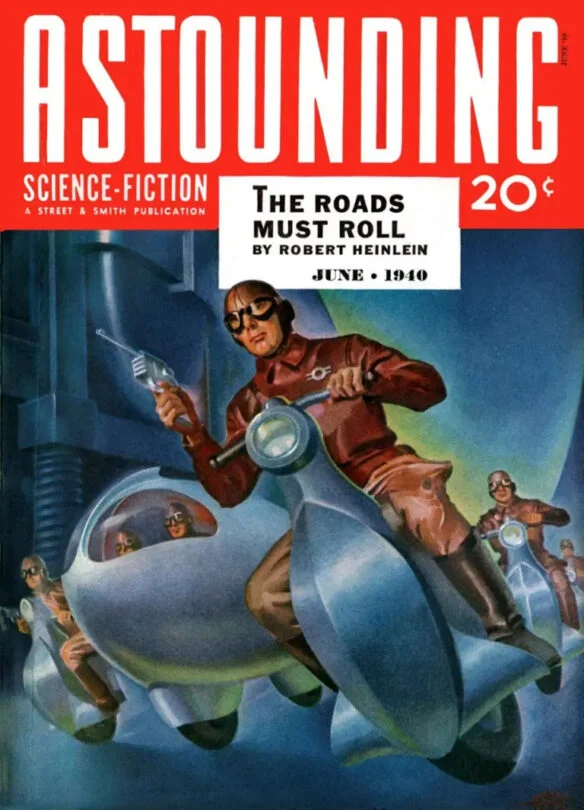
The subject of this particular scrutiny is the new audiobook version of Robert A. Heinlein’s 1940 classic, "The Roads Must Roll." Originally published in the June 1940 issue of Astounding Science Fiction, the story is a seminal work of engineering-focused speculative fiction. However, the cover art chosen for the modern audiobook edition serves as a glaring example of a "book-to-cover" disconnect that has left veteran readers and Heinlein scholars scratching their heads in collective disbelief.

The Anatomy of a Mismatch
The cover in question features a nostalgic, mid-century illustration of a serene, rural roadside scene—a aesthetic reminiscent of vintage travel posters. It is an image evocative of Route 66, rolling hills, and the gentle pace of a bygone era.
The disconnect is immediate and profound. Heinlein’s "The Roads Must Roll" is set in a near-future United States where the highway system has been entirely replaced by "roadtowns"—massive, wide, rapidly moving passenger platforms that travel at speeds of up to 100 mph. These are not scenic country lanes; they are industrial, high-speed, multi-lane conveyor belts that sustain the lifeblood of a technologically transformed civilization. By choosing an image that depicts a quaint, stationary, rural road, the producers of this audiobook have managed to create a visual identity that is the polar opposite of the story’s core premise.

This failure of communication between the text and the visual marketing raises an essential question: does anyone actually read the books they are assigned to package? Or has the reliance on stock image libraries and algorithmic tagging reached a point where the content of a story is viewed as a secondary concern to the "vibe" of a search result?
A Chronology of Artistic Indifference
To understand how such a mismatch occurs, one must look at the timeline of how this project—and others like it—likely moved from concept to marketplace.

- May 10, 2026: Gereg Jones Muller posts the Audible cover image to the Heinlein Forum, accompanied by the dry, biting observation: "Tell us you’ve never read the story for your cover assignment without saying…" The post quickly becomes one of the most engaged-with items in the group’s history, signaling that this was not merely a niche grievance, but a point of shared frustration among the community.
- The Sourcing Process: Subsequent investigation reveals that the image used is a work by Pacific Northwest artist Paul A. Lanquist, part of a series dedicated to Route 66. The imagery is objectively beautiful, but it is fundamentally a depiction of the American West as it existed in the mid-20th century, not a depiction of the technological marvels envisioned by Heinlein.
- The "Search and Replace" Culture: The proliferation of digital audiobook storefronts has created a high-volume demand for cover art. When a publisher—in this case, Strelbytskyy Multimedia Publishing—opts to license existing art rather than commission original pieces, they are often at the mercy of stock libraries. If the person selecting the art searches for "roads" or "travel," they are statistically likely to land on images of Route 66 or scenic highways. The nuance of the story’s "rolling" mechanics is lost in a sea of keywords.
Supporting Data: Why "The Roads Must Roll" Matters
Heinlein’s story is not just any piece of fiction; it is a foundational text in the history of science fiction. The "roadtown" concept represents a serious, albeit speculative, attempt at urban planning and infrastructure design.
The story opens with the iconic line: "Who makes the roads roll? Who does the dirty work ‘down inside’—so that Joe Public can ride at his ease?" The entire narrative conflict centers on the mechanical, societal, and labor-related realities of these moving platforms. To swap this for a pastoral landscape is akin to illustrating a biography of an astronaut with a picture of a park bench.

Furthermore, there is no shortage of historical inspiration available for an artist willing to do the legwork. A cursory look at 20th-century urban planning archives reveals a plethora of actual, albeit failed, proposals for moving sidewalks, "carveyors," and high-speed conveyor transit systems. From the 1924 Atlanta sub-surface platform proposals to the "Carveyor" systems pitched for 42nd Street in the 1950s, the visual language of "The Roads Must Roll" is rich with historical, technical, and industrial motifs. Choosing to ignore this history in favor of a generic Americana aesthetic is a choice of convenience over craft.
Official Responses and Industry Silences
As of this writing, there has been no official statement from Audible or the publisher regarding the choice of artwork. In the modern publishing ecosystem, such "failures" are often corrected quietly—if at all—by swapping out the file behind the scenes.

However, the lack of transparency is telling. When platforms prioritize volume and speed, the "curatorial" aspect of publishing—ensuring that a work is presented in a way that honors its internal logic—is frequently relegated to the background. This is not an isolated incident. Audible’s catalog contains numerous instances of misaligned art for classic titles. Whether it is The Star Beast being depicted with anatomically incorrect creatures or Gentlemen, Be Seated receiving art that bears no resemblance to its narrative content, the pattern suggests a systematic disconnect between administrative asset management and literary editorial oversight.
The Implications: A "Cyberpunct" Crisis
What does this mean for the future of literary digital media? We are moving toward a state of "algorithmic homogenization," where content is treated as a generic data point. If the cover of an audiobook is selected by a search algorithm or a harried graphic designer who has never read the source material, the integrity of the work is subtly undermined.

The community reaction, described by some as a moment of "elliptical ellipsis" (a neologism for a pause that implies a complete, albeit unspoken, conclusion), highlights a deeper hunger for authenticity. Fans of science fiction are often obsessive about details; they read the "fine print" of the world-building. When the gatekeepers of these stories display such profound ignorance of the text, it creates a "trust deficit" between the provider and the audience.
Furthermore, the rise of AI-generated imagery threatens to exacerbate this trend. If human designers are currently failing to match art to text, the introduction of generative AI—which is famously prone to "hallucinating" visual representations based on loose, keyword-based prompts—could lead to a future where cover art is technically impressive but narratively incoherent.

Conclusion
The controversy surrounding the cover of "The Roads Must Roll" is, on the surface, a minor point of annoyance for a group of SF fans. Yet, it serves as a microcosm of a larger issue within the digital publishing industry: the erosion of editorial standards in the face of mass-market efficiency.
A book cover is the first point of contact between a reader and a story. It should serve as a gateway, an invitation, and a promise of what is to come. When that promise is broken—when the cover depicts a quiet country road for a story about high-speed industrial innovation—it disrespects both the author’s vision and the reader’s intelligence. Perhaps it is time for platforms like Audible to implement a "literary vetting" process for their assets. Or, at the very least, they might consider hiring designers who are willing to spend the ten minutes required to read the first paragraph of the book they are illustrating. Until then, the community will continue to roll its eyes—if not the roads.










No comments yet. Be the first to join the conversation!