

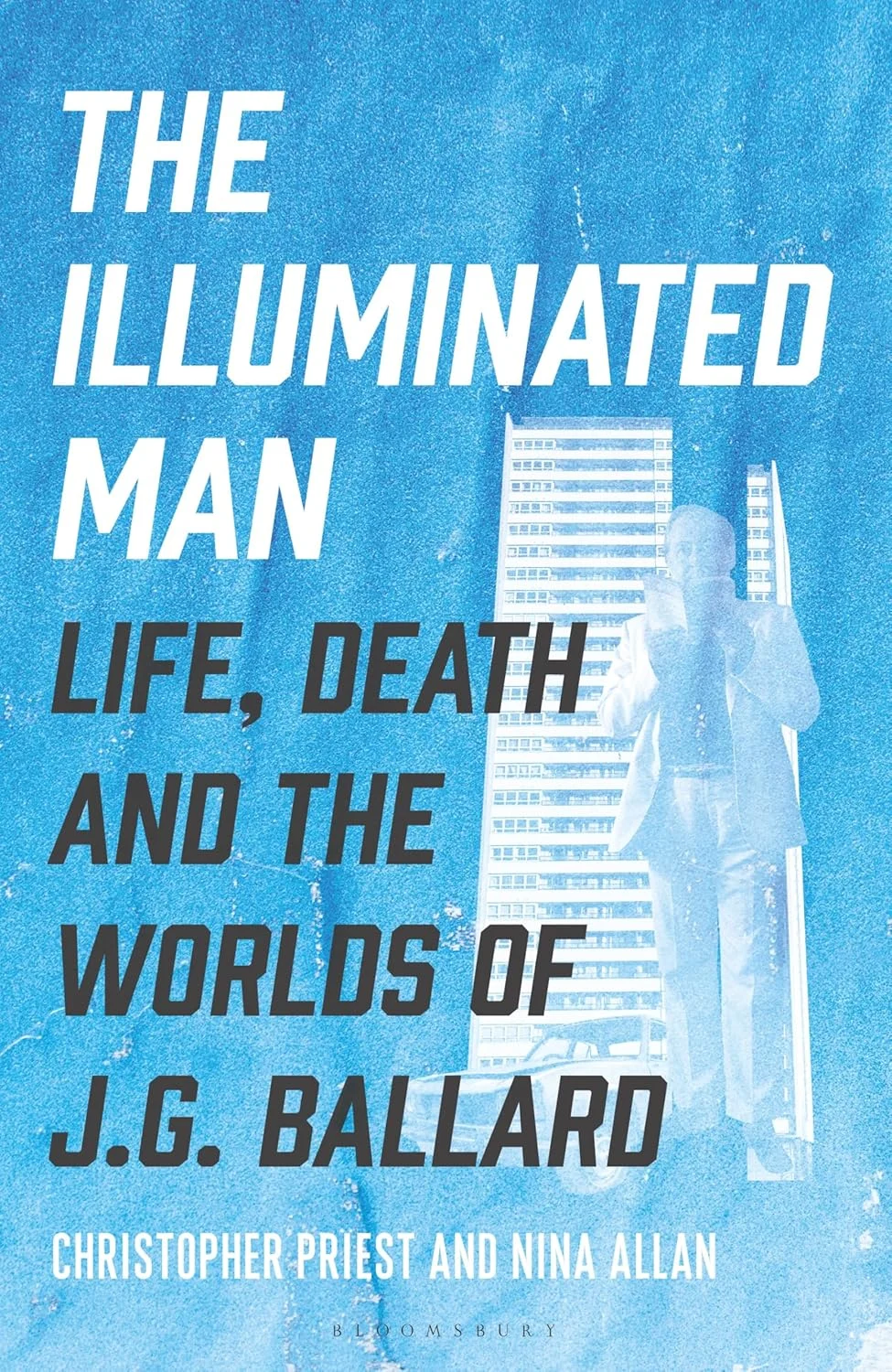
In the landscape of contemporary literary biography, few works have arrived with as much narrative dissonance—and emotional gravity—as The Illuminated Man: Life, Death and the Worlds of J. G. Ballard. Published under the names of the late Christopher Priest and his partner, Nina Allan, the volume is far more than a standard academic survey of one of science fiction’s most influential architects. It is a physical artifact of a literary life interrupted, a hybrid text that struggles, triumphs, and ultimately collapses the boundaries between critic, subject, and biographer.
To read The Illuminated Man is to engage with a "three-books-in-an-overcoat" structure. It is a biography of J. G. Ballard; it is a critical analysis of the "Ballardian" aesthetic; and, most hauntingly, it is an intimate memoir of a marriage facing the finality of terminal illness.
The Genesis of a Collaborative Rupture
The project began in early 2023, driven by the esteemed British science fiction writer Christopher Priest. Best known for seminal works like The Inverted World, The Prestige, and The Separation, Priest sought to finally secure J. G. Ballard’s place in the canon of "true and permanent greatness." Priest’s ambition was to strip away the myths surrounding Ballard, focusing on a rigorous examination of the work itself, informed by an unpublished chronology by editor David Pringle.
However, the trajectory of the book shifted irrevocably when, six months into the project, Priest was diagnosed with terminal cancer. The realization that the manuscript would remain unfinished forced a pivot. Nina Allan, an accomplished novelist and critic in her own right, stepped in to complete the work. What emerged is a "beast with two heads"—a narrative where the blunt, often prickly prose of Priest is periodically interrupted, softened, and eventually superseded by the luminous, empathetic observations of Allan.
A Chronology of Uneven Inquiry
The book’s structure is chronological, yet it suffers from the erratic nature of its construction. The first several chapters, penned entirely by Priest, focus on Ballard’s formative years in Shanghai during the Second World War and his subsequent relocation to the "drab" postwar Britain of the 1950s.
Priest’s approach here is characterized by an obsession with minor biographical details—the "hapless" White Russian governesses and the mundane logistics of Ballard’s life—often relying on sanitized, repetitive anecdotes drawn from Ballard’s own autobiography, Miracles of Life. Critics have noted that Priest’s reliance on these sources often lacks the critical distance one expects from a seasoned biographer. He treats these accounts as objective reality, missing the opportunity to interrogate the gulf between the seventy-six-year-old Ballard’s retrospective narration and the twelve-year-old boy who lived the experience.
It is only when the reader moves past the first hundred pages—the "Priest section"—that the book begins to find its true footing. As Allan takes the mantle, the focus shifts from a rigid, almost detached summary of events to a more profound investigation into the psychological and emotional architecture of Ballard’s world.
Supporting Data: The Disparity of Perspective
The friction within the text is not merely a byproduct of two writers with different styles; it is a fundamental clash of philosophies. Priest openly distrusted the conventions of traditional biography, viewing it as a secondary, perhaps even lesser, form of inquiry. He famously remarked that the latter part of Ballard’s life was "relatively free of external incident," a statement that Allan’s subsequent chapters elegantly dismantle.
By contrast, Allan’s intervention represents the heart of the book. Where Priest saw "unanswered questions" regarding Ballard’s methods of transport, Allan sees an opportunity to interview survivors and analyze the subtle threads of influence that shaped the author’s prose. Her inclusion of personal anecdotes regarding their own shared life—and the shadow cast by Priest’s decline—provides the necessary "thickening" of the narrative.
A particularly harrowing instance of this contrast occurs in Chapter 27. Priest, struggling with his waning health, had left a portion of his work unfinished, resorting to "panic-buying" words by pasting in Wikipedia summaries. Allan’s documentation of this moment—not with judgment, but with a profound, tender clarity—serves as the emotional anchor of the entire volume. It is a stark reminder that the act of writing, for Priest, had become an act of endurance.
Official Responses and Editorial Decisions
The decision to leave Priest’s chapters "untouched and intact" has been a point of significant discussion. While some suggest that a more thorough integration of the two voices would have resulted in a cleaner, more cohesive narrative, Allan’s refusal to "edit" her partner’s final thoughts is clearly an act of devotion.
As Allan notes in the text, she had to respect the fact that "Chris was a writer. He told his own stories." To overwrite his struggle, even where it appeared at its weakest, would have been to strip away the reality of his final months. This editorial choice creates a jarring reading experience—the reader is constantly toggling between two distinct intellectual temperaments—but it also renders the book an honest document of a life in transition.
Implications for the Future of Literary Biography
The Illuminated Man forces us to reconsider the limitations of the biographical form. Is a biography meant to be a detached, objective timeline, or is it an act of communion between two writers? Priest’s chapters represent the former, a traditionalist’s attempt to canonize a subject through logic and critique. Allan’s chapters represent the latter, a modern, emotive exploration of how we preserve the stories of those who can no longer speak for themselves.
The book’s final hundred pages, written entirely by Allan, are perhaps some of the most moving in recent literary history. They interleave a memoir of Priest’s death with a synthesis of Ballard’s late-period work, creating a culminating effect that is both intellectually satisfying and devastatingly sad.
The Verdict: A Privilege of Participation
Ultimately, The Illuminated Man is an inconsistent, often confounding read. It is, by standard metrics, a flawed book. However, it succeeds in its primary goal: it serves as a "shared endeavor" that maintained the togetherness of its authors even as their time together drew to a close.
For the reader, the experience of engaging with this work is a privilege. We are not just learning about J. G. Ballard; we are witnessing the final, heroic effort of a writer to complete his work, and the grace of a partner stepping in to ensure the light didn’t go out before the story was told.
While the literary critic in us might wish for a more unified voice or a tighter narrative structure, the human in us recognizes that The Illuminated Man is exactly what it needs to be. It is a testament to the fact that, when it comes to the life and work of great writers, the "scaffolding" of the book is secondary to the truth of the experience. It is a book that refuses to be ignored, a haunting hybrid that stands as a singular entry in the canon of literary studies. Whether one is a devotee of Ballard’s surrealist landscapes or a student of the craft of biography, The Illuminated Man offers a mirror, reflecting not just the subjects it examines, but the very fragility of the act of writing itself.










No comments yet. Be the first to join the conversation!