Basiran
In a move that has sent shockwaves through the corridors of Silicon Valley and the halls of Congress, Senators Bernie Sanders and Greg Casar have introduced the Ban Artificial Superintelligence Act. This legislative proposal represents perhaps the most aggressive attempt yet to rein in the rapid, often chaotic, evolution of generative AI. By seeking to impose a moratorium on the development of "artificial superintelligence" (ASI), the bill proposes a regulatory framework with teeth—specifically, criminal penalties that mirror those reserved for the proliferation of illicit nuclear weaponry.
As the lines between scientific ambition and existential risk blur, this legislation forces a reckoning: is humanity prepared to navigate the birth of a technology that could outpace human cognition, or are we witnessing a desperate, premature attempt to cage a genie that has already left the bottle?
Main Facts: The Scope of the Proposed Legislation
The Ban Artificial Superintelligence Act is not merely a request for ethical guidelines; it is a structural overhaul of the AI industry. The bill centers on three primary pillars:
- The Moratorium: A federally mandated pause on the development of advanced AI models that meet specific definitions of "superintelligence"—systems capable of performing any intellectual task that a human can do, but at vastly superior speeds and depths.
- The Regulatory Body: The establishment of a new, cabinet-level federal agency tasked exclusively with the oversight, monitoring, and containment of superintelligent systems.
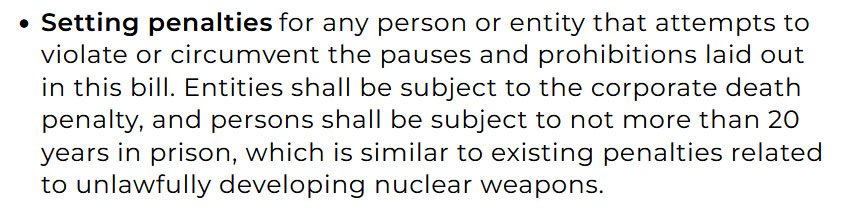
- The Enforcement Mechanism: Perhaps the most controversial aspect of the bill is the sentencing guideline. Developers, researchers, and corporate entities found to be violating the prohibitions on superintelligence research face up to 20 years in federal prison.
By framing the creation of unauthorized ASI as a national security threat equivalent to the development of rogue nuclear weapons, the bill signals a shift in legislative philosophy. The government is no longer treating AI as a commercial product; it is treating it as an existential armament.
Chronology: The Road to the "Pause"
The push for this legislation did not emerge in a vacuum. To understand the current climate, one must look at the rapid-fire timeline of the last few years:
- The ChatGPT Inflection (Late 2022 – 2023): The sudden ubiquity of large language models (LLMs) proved that AI could pass bar exams, write code, and mimic human creativity. The awe of the public quickly turned to trepidation as hallucinations and bias became standard critiques.
- The "Open Letter" Era (2023 – 2024): High-profile figures, including Elon Musk and researchers from top AI labs, signed various open letters calling for a six-month moratorium on training models more powerful than GPT-4. While the pause never materialized, it legitimized the fear that industry growth was outstripping safety testing.
- The Infrastructure Race (2024 – 2025): Companies began commissioning massive GPU clusters. As reported by Tom’s Hardware, the scale of hardware investment reached unprecedented levels, with companies like xAI and OpenAI spending billions on compute power, further accelerating the timeline toward AGI (Artificial General Intelligence).
- The Legislative Pivot (2026): With the release of increasingly autonomous "agentic" systems, the reality of ASI moved from science fiction to a foreseeable, near-term milestone. Senators Sanders and Casar introduced the current bill as a direct response to this perceived acceleration, marking the first time a legislative body has sought to criminalize the development process itself.
Supporting Data: Why Now?
The urgency of the bill is underpinned by sobering data regarding the sustainability and trajectory of the current AI gold rush.

According to financial analysis from institutions like J.P. Morgan, the economic demand for AI is reaching a breaking point. To achieve a modest 10% return on the current capital expenditure (CapEx) involved in building out global AI infrastructure, the industry would need to generate upwards of $650 billion in annual revenue. This translates to a tax of roughly $35 for every iPhone user or $180 for every Netflix subscriber in perpetuity.
Critics of the current AI trajectory point to this "profitability gap" as evidence that Big Tech is hitting a wall. If the current commercially funded, product-focused model cannot sustain itself, the industry may be pivoting toward a government-subsidized model. Some skeptics argue that the push for regulation—and even the fear-mongering regarding "existential risk"—is a strategic move by industry leaders to have the taxpayer shoulder the burden of the next phase of development, effectively creating a "Manhattan Project II" where they retain control under the guise of state-mandated safety.
Official Responses: A Divided Industry
The reaction to the bill has been as polarized as the political landscape itself.
The Pro-Regulation Faction
Industry leaders like Sam Altman (OpenAI) and Dario Amodei (Anthropic) have frequently spoken about the need for international standards and "frontier" safety. For these proponents, the Sanders-Casar bill represents the logical conclusion of their own warnings. They argue that if an entity creates a system capable of manipulating global markets, bio-engineering, or cybersecurity, the state must have the power to intervene.
The Innovation Advocates
Conversely, critics of the bill—including many free-market proponents and tech-industry libertarians—argue that the legislation is a recipe for stagnation. They contend that if the U.S. pauses, the "AI race" will not end; it will simply shift to jurisdictions with fewer regulations. They point to the national security imperative: if the U.S. does not develop the most advanced AI first, it risks ceding technological hegemony to geopolitical rivals who will not be constrained by 20-year prison sentences.
The Congressional Battlefield
The bill faces a steep, if not vertical, climb in Congress. Democrats with strong ties to the enterprise-tech sector view the bill as an overreach that could devastate the American economy. Meanwhile, Trump-aligned Republicans have largely expressed skepticism, viewing the proposed "cabinet-level agency" as an example of bureaucratic bloat and government overreach that threatens to stifle the next industrial revolution.
Implications: The Pandora’s Box of Oversight
The implications of the Ban Artificial Superintelligence Act are profound, touching upon the very nature of scientific freedom and economic competition.
1. The Globalization Challenge
Even if the United States succeeds in passing and enforcing this bill, the nature of digital intelligence makes containment incredibly difficult. Unlike nuclear weapons, which require massive physical facilities and enriched uranium, AI development is largely software-based. An algorithm, once written, can be replicated globally. International cooperation is essential, but the history of arms control suggests that reaching a binding agreement on something as nebulous as "intelligence" is infinitely more complex than counting warheads.
2. The Definition Crisis
The most significant hurdle remains the legal definition of "artificial superintelligence." If the law is too vague, it could stifle legitimate research into medicine, climate modeling, and logistics. If it is too specific, companies will simply "code around" the legislation by keeping their models just below the threshold of the legal definition of "superintelligence," leading to a cat-and-mouse game between regulators and developers.
3. The Future of Human Agency
Ultimately, the bill forces us to confront a deeper philosophical question: are we as a society comfortable with the idea that some discoveries should remain forbidden? Historically, humanity has rarely chosen to hit the brakes on technological advancement. From the printing press to the splitting of the atom, we have preferred to deal with the consequences of our inventions rather than forgo the benefits they provide.
By proposing the Ban Artificial Superintelligence Act, Sanders and Casar are betting that the consequences of AI—ranging from widespread automation-induced unemployment to the loss of control over digital systems—are too high to leave to the whims of the market.
As the debate continues, one thing remains clear: the era of "move fast and break things" is drawing to a close. Whether we are entering an era of "move carefully and regulate everything," or merely an era of "stagnate and fall behind," remains to be seen. The legislative battle over this bill will likely define the technological trajectory of the 21st century, setting a precedent for how we, as a species, define our relationship with the machines we create.


 Reynand Wu
 Pevita Pearce