

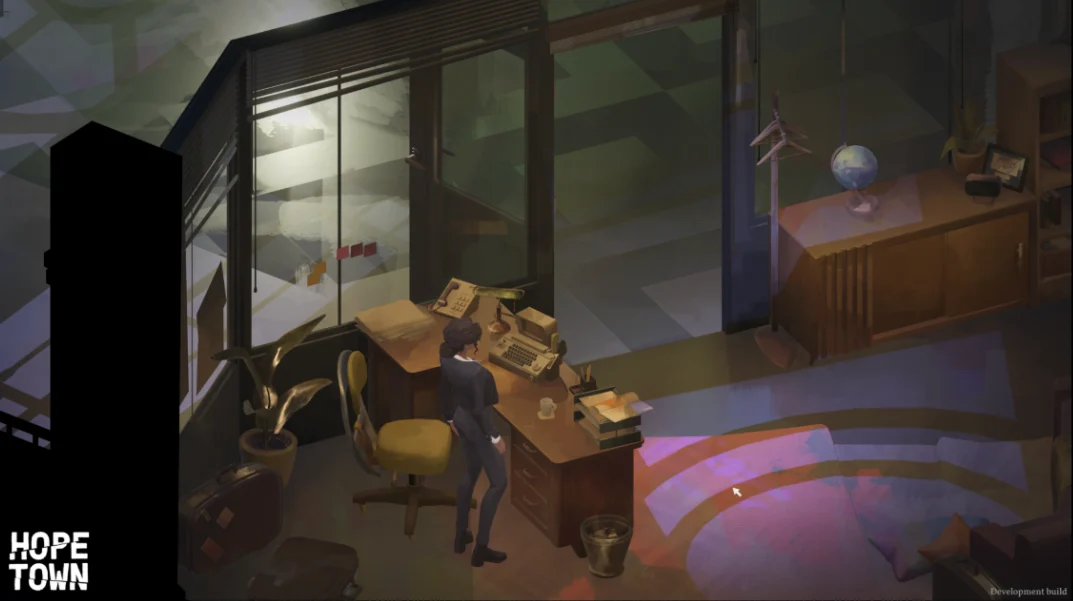
In the landscape of modern narrative-driven gaming, few titles have left as indelible a mark as Disco Elysium. Its focus on internal monologue, political philosophy, and the grit of urban decay set a new benchmark for what roleplaying games could achieve. Now, a new studio—Longdue Games—is stepping into the spotlight, helmed by veteran developers who cut their teeth on the very systems that defined that modern classic. Their debut project, Hopetown, has officially emerged from the shadows, promising to shift the focus from the detective’s magnifying glass to the journalist’s notepad.
With the release of its first in-game screenshots and a major update on the project’s development status, Hopetown is quickly becoming one of the most anticipated titles for fans of reactive, dialogue-heavy storytelling.
Main Facts: A New Kind of Narrative RPG
Set on the island of Entre, Hopetown is a narrative RPG that eschews the traditional tropes of swords, sorcery, or interstellar combat in favor of the high-stakes world of investigative journalism. Players step into the shoes of a reporter navigating the labyrinthine social and political landscape of the island, operating out of a central organization known as "The Newshouse."
The core conceit of the game is its dedication to the "writer’s craft." Unlike traditional RPGs where the player’s agency is expressed through combat proficiency or physical navigation, Hopetown mandates that the player’s primary tool for interacting with the world is the written word. Every article composed by the player serves as a mechanism for change; the tone, the factual accuracy, and the narrative framing of these pieces can shift the political climate of Entre, alter the fate of its citizens, and redefine the player’s standing within The Newshouse.

The studio has confirmed that the game has successfully exited its pre-production phase. Having grown from a lean team of three part-time developers to a robust studio of nearly 20 full-time creatives, Longdue Games is signaling that Hopetown is a project of significant ambition and scale.
Chronology: The Evolution of Longdue Games
The journey of Hopetown is a testament to the organic growth of an independent studio. When Longdue Games first formed, it was a modest effort—a small collective of industry veterans unified by a shared vision of creating a game that prioritized complex, emergent narrative systems.
The Incubation Phase
In its earliest days, the project existed as a conceptual experiment. The founders, drawing from their previous experiences on projects like Disco Elysium, sought to build an engine that could handle the immense, branching complexity of journalism-based gameplay. During this period, the team remained small, focusing primarily on writing, mechanics prototyping, and building the architectural "bones" of Entre.
The Expansion
As the vision for the island of Entre expanded, so did the necessity for a larger, more specialized workforce. Over the last 18 months, Longdue Games underwent a period of rapid recruitment. By moving from part-time collaboration to a dedicated full-time workforce of 20 professionals, the studio signaled that Hopetown had evolved from a "passion project" into a high-fidelity commercial endeavor. This growth has allowed for the implementation of the game’s distinctive art style—a painterly, atmospheric aesthetic that brings the grounded, urban environments of Entre to life.

The Reveal
The recent unveiling of the first in-game screenshots marks a turning point in the game’s public lifecycle. By showcasing the visual identity of the project—alongside key figures like "The Editor"—Longdue Games has transitioned the conversation from "what is this game?" to "how will it play?"
Supporting Data: Understanding the "Newshouse" Mechanics
To understand Hopetown, one must understand the environment in which the player operates. The Newshouse is not merely a setting; it is a central antagonist, a mentor, and a tool.
The Editorial Pressure
The concept art released by Longdue highlights a character known as "The Editor." This figure acts as the player’s primary point of contact and, at times, their greatest hurdle. In Hopetown, the player is not a free agent. They are bound by the editorial standards, political leanings, and corporate pressures of the newspaper.
- The Editorial Feedback Loop: When a player finishes a draft, it must be submitted to the Editor. The quality of this interaction is based on how well the player navigated the story’s political landmines.
- Consequence-Driven Gameplay: The game’s systems do not track "XP" or "Hit Points" in the traditional sense. Instead, they track influence and reputation. If a player publishes an article that exposes corruption within the city government, the world state changes. Protests might erupt, NPCs might become hostile, or new areas of the city might open up. Conversely, choosing to suppress the truth might yield monetary rewards or favor with powerful entities, but at the cost of the player’s integrity and, ultimately, the city’s health.
Visual and Narrative Synergy
The newly shared screenshots emphasize a "grounded urban atmosphere." The painterly style is not merely an aesthetic choice; it serves to ground the player in a world that feels lived-in, melancholic, and deeply textured. The visual design reinforces the feeling of being a small cog in a massive, crumbling machine—a feeling that Disco Elysium fans will find familiar, yet here, it is viewed through the lens of a weary journalist rather than a broken detective.

Official Responses and Studio Philosophy
Longdue Games has been vocal about their desire to create a game that forces the player to consider the weight of their words. In recent statements, representatives from the studio have highlighted that Hopetown is "roleplaying as a writer."
"The goal," one developer noted in a recent update, "is to bridge the gap between the player’s intention and the game’s reaction. When you write an article, you are not just selecting a dialogue option; you are synthesizing information. You are deciding what matters, what is left out, and how that information is perceived by the people of Entre."
This philosophy is a direct extension of the "Disco" school of design, where the player’s inner state is often more important than the external challenges they face. However, by introducing the editorial filter, Longdue is adding an extra layer of conflict: the struggle between the truth as the player sees it, and the truth as the publication demands it.
Implications: A New Era for Narrative RPGs
The emergence of Hopetown carries significant weight for the RPG genre. We are currently witnessing a renaissance of "talk-heavy" games where the primary mechanic is social engineering and deduction.

Changing the Player’s Role
Most RPGs demand that the player be the "Hero" or the "Savior." By placing the player in the role of a journalist, Hopetown democratizes the RPG experience. The player is not necessarily meant to "win" in the traditional sense; they are meant to observe, report, and deal with the consequences of their exposure. This shifts the focus from combat mastery to empathy, analytical thinking, and moral fortitude.
The Legacy of ‘Disco Elysium’
It is impossible to discuss Hopetown without acknowledging the shadow of Disco Elysium. While Longdue Games is clearly building on the structural innovations of that title, Hopetown seems poised to differentiate itself through its specific focus on the mechanics of media and the power of information. If Disco was a game about the internal ruin of the soul, Hopetown appears to be a game about the external ruin of a society—and the journalist’s role in documenting that collapse.
Looking Ahead
While the studio has not yet announced a firm release window, the fact that the project is in active development and available for wishlisting on Steam suggests a level of confidence in the current build. The industry is watching closely; if Longdue Games can successfully balance the intricate, systemic nature of a complex RPG with the specific, delicate craft of journalistic writing, Hopetown may well become the next definitive experience for narrative-focused gamers.
As the development team continues to scale and the world of Entre becomes more fleshed out, one thing remains clear: Hopetown is not asking players to save the world with a sword. It is asking them to save—or perhaps destroy—it with the truth. For those who find joy in the weight of a well-chosen word, the wait for this release will be long, but likely worth every second.










No comments yet. Be the first to join the conversation!