By Danica Davidson
August 28, 2025
In the modern era, the influence of social media and pop culture often blurs the lines between entertainment and reality. However, a recent phenomenon in Japan has demonstrated the tangible, economic consequences of this intersection. Even weeks after a highly publicized "doomsday" prediction passed without incident, the Japanese tourism sector—particularly regional hubs—finds itself grappling with the lingering aftershocks of a manga artist’s alleged psychic vision.
The incident highlights a growing concern among officials: how can a nation combat the irrational, yet powerful, spread of misinformation when it begins to dictate the travel habits of millions?
The Origin: Ryo Tatsuki and the Architecture of Fear
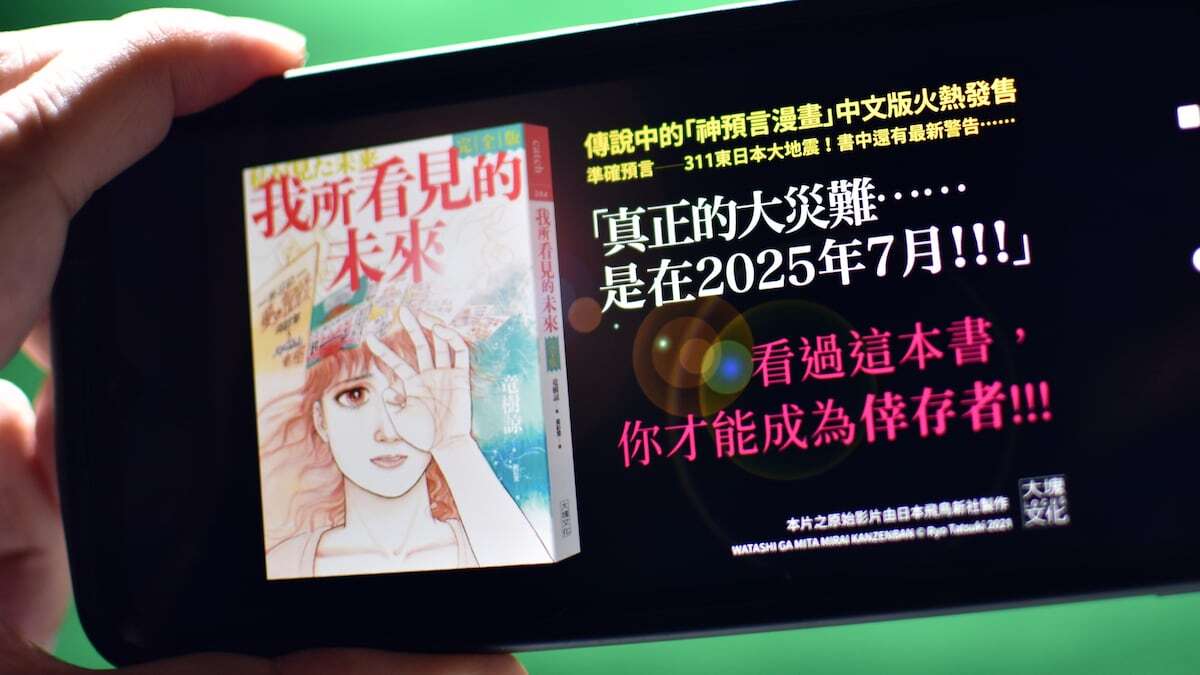
To understand the current crisis, one must look at the source: Ryo Tatsuki, a manga artist who gained notoriety for her book The Future I Saw. The work, which chronicles her dreams, purportedly predicted the catastrophic 2011 Tohoku earthquake and tsunami. For many, this served as "proof" of her clairvoyant abilities, elevating her from a niche creator to a cultural figure whose words are treated by some as literal warnings of impending doom.
In the lead-up to July 5, 2025, anticipation—and anxiety—reached a fever pitch. Tatsuki had forecasted a massive, civilization-altering earthquake to strike Japan on that specific date. The prediction went viral, moving far beyond the manga community and into the mainstream consciousness of East Asia. As the date approached, the digital ecosystem was flooded with "prepper" content, safety guides, and, crucially, a sharp decline in international travel bookings to Japan.
The impact was most acute in Hong Kong. As the date neared, tourism agencies reported a significant uptick in cancellations, with travelers citing safety concerns linked to the predicted disaster. Despite reassurances from seismologists and government officials that earthquakes are not predictable with such pinpoint accuracy, the psychological weight of the prophecy held sway over potential visitors.
Chronology of a Failed Prophecy
The timeline of the July 5 incident serves as a case study in how misinformation can distort market behavior:
- Pre-July 2025: The prophecy gains significant traction on social media platforms, fueled by influencers and forums that treat Tatsuki’s manga as historical documentation rather than creative fiction.
- Late June 2025: Travel agencies in Hong Kong report a measurable "wait-and-see" approach among tourists, leading to a dip in summer bookings for Japanese destinations.
- July 5, 2025: The day passes uneventfully. Japan remains seismically stable. The prophecy is debunked by the reality of a quiet, ordinary day.
- Late July 2025: As the initial fear subsides, a new wave of internet discourse emerges. Users point to an 8.8 magnitude earthquake in Russia on July 30, attempting to retroactively "validate" the prediction by claiming geographical proximity or simply noting that it occurred within the same calendar month.
- August 2025: Despite the failure of the prediction, tourism numbers from Hong Kong to specific regional Japanese airports remain depressed, indicating that the initial fear successfully dampened consumer confidence for the entire season.
The "Post-Truth" Survival of the Prophecy
One of the most confounding aspects of this situation is the resilience of the prediction. Even after the deadline of July 5 passed, the narrative did not vanish; it mutated.
By pivoting to the July 30 earthquake in Russia, proponents of the prophecy have attempted to preserve the "accuracy" of the manga. This phenomenon, often observed in conspiracy theory circles, is known as "moving the goalposts." By broadening the scope of the prediction—arguing that "July" was the important factor, or that "Russia is close enough"—the true believers have managed to maintain a level of skepticism toward travel in Japan.
This shift in the narrative has had a cooling effect on the tourism recovery. While it might seem illogical to the casual observer, the fear has become ingrained in the travel decision-making process for those who subscribe to such supernatural beliefs. For these individuals, the risk, however statistically negligible, is perceived as high enough to warrant staying home.
Official Responses and Economic Implications
The economic reality is being felt most sharply at local infrastructure hubs. Takamatsu Airport, which relies heavily on international transit, recently addressed the issue during a city council meeting. Officials openly admitted that they have yet to see their visitor numbers return to pre-prediction levels.
The decline is not merely a statistical anomaly; it is a budgetary challenge. For regional Japanese cities, international tourism is a lifeblood that supports local hospitality, transport, and retail industries. When that flow is interrupted—even by a "ghost" of a disaster—the local economy suffers.
The Industry Debate
The response from the Japanese public has been varied, as captured by reporting from SoraNews24. The sentiment among locals reveals a deep frustration with the intersection of entertainment and economic damage:
- The Argument for Liability: Many argue that the creator of the manga bears a moral, if not legal, responsibility. One citizen noted, "Someone made a profit by predicting a disaster without any basis. The affected businesses have a right to seek compensation." This raises complex questions about free speech versus the harm caused by irresponsible, commercially driven fear-mongering.
- The Economic Context: Others point out that blaming a manga for tourism drops ignores larger macroeconomic factors, such as the volatility of the Chinese real estate market, which has undoubtedly impacted the spending power of the demographic in question.
- The Sentiment of Urban vs. Rural: A poignant observation was made regarding the necessity of tourism: "People in big cities may be tired of tourists, but rural areas need them the most." This highlights the disparity in how tourism is perceived—as a nuisance in Tokyo or Kyoto, but as a vital survival mechanism in prefectures like Kagawa.
The Broader Implications for Japanese Tourism
The "July 5 Effect" poses a significant question for Japan’s tourism strategy moving forward: How do you market against a myth?
The Japanese government and regional tourism boards are now tasked with rebuilding trust in areas where "supernatural" fear has taken root. This involves not only traditional marketing campaigns but also a concerted effort to communicate safety and stability to international audiences.
The irony is that Japan is arguably one of the most well-prepared nations on earth when it comes to earthquake readiness. The infrastructure is designed to withstand seismic events that would be catastrophic elsewhere. Yet, the persistent fear of a "prophesied" disaster has overridden the reality of Japan’s robust disaster prevention systems.
A Call for Digital Literacy
This incident serves as a clarion call for the tourism industry to address digital literacy. As travel planning becomes increasingly influenced by social media algorithms and viral content, the tourism sector must become more proactive in countering misinformation. Relying solely on official government statistics is no longer enough when the competition for the traveler’s attention is a compelling, if false, narrative.
Moving forward, Japanese tourism boards will likely need to employ more aggressive, fact-based digital outreach. This includes collaborating with influencers who can debunk pseudoscience and highlighting the scientific reality of Japan’s geological status.
Conclusion: The Long Road to Recovery
As of late August 2025, the shadow of the prophecy continues to linger. While the initial panic has subsided, the "wait-and-see" attitude among potential tourists from Hong Kong remains a hurdle for airports like Takamatsu.
The lesson here is clear: in an era of global connectivity, a single piece of misinformation can have the power to disrupt international travel patterns. The challenge for Japan is to ensure that the allure of its culture, history, and natural beauty remains more compelling than the fear of the unknown.
For now, the country continues its efforts to welcome the world back, betting that the passage of time—and the absence of further "predicted" disasters—will eventually restore the confidence of those who were scared away by the pages of a manga. The incident stands as a stark reminder that while we live in an age of science, the power of a story remains one of the most potent forces in the global marketplace. Whether that story is one of wonder or one of fear remains, in part, up to those who tell it—and those who choose to listen.