

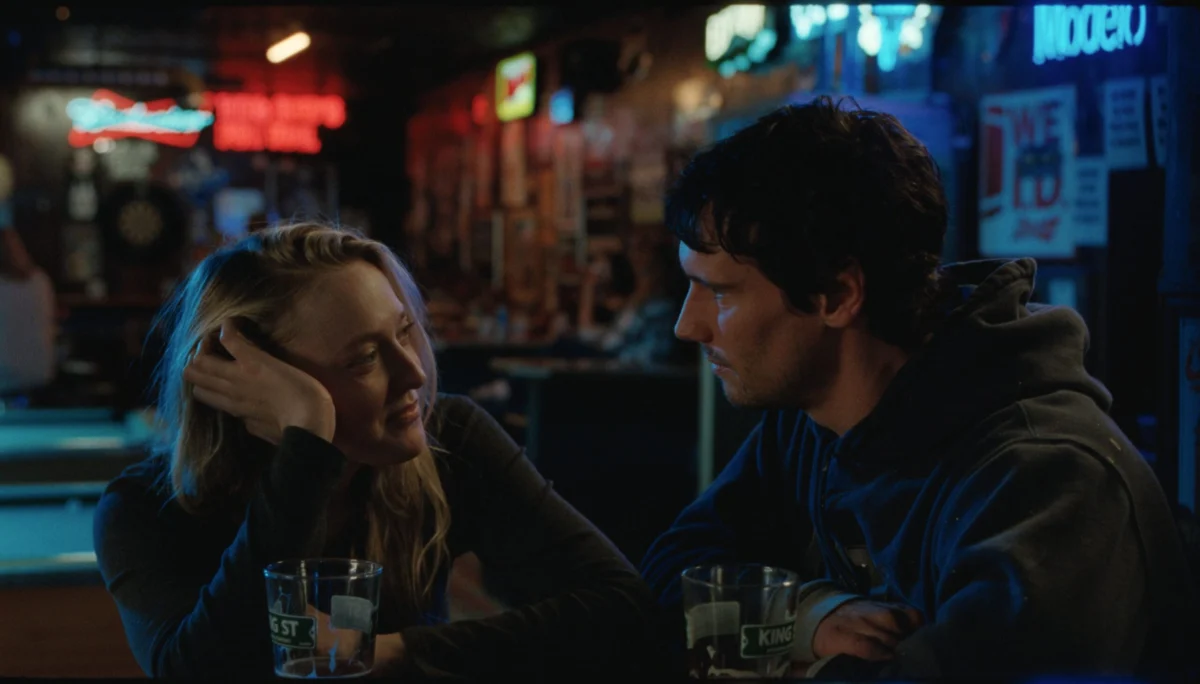
After a near-decade hiatus from the feature film landscape, Joe Swanberg, the filmmaker synonymous with the improvisational, low-stakes intimacy of the "mumblecore" movement, has returned. His latest offering, The Sun Never Sets, is not the soaring, melodramatic romance its trailer might suggest; rather, it is a grounded, grit-heavy exploration of the complexities of long-term commitment, set against the vast, unforgiving beauty of the Alaskan wilderness.
With a career-best performance from Dakota Fanning and a reunion with longtime collaborator Jake Johnson, the film marks a significant tonal pivot for a director who spent the last several years navigating the shifting tides of the streaming era. As the film makes its way from a successful debut at the 2026 SXSW Film and TV Festival to theatrical screens, it serves as both a homecoming for Swanberg and a masterclass in modern character study.
The Core Conflict: A Triangulated Romance
At its heart, The Sun Never Sets deals in the uncomfortable spaces between stability and spontaneity. Dakota Fanning stars as Wendy, a woman whose life feels meticulously calibrated. She is settled in a long-term, age-gap relationship with Jack (Jake Johnson), a divorced father who represents maturity, consistency, and the quiet comfort of a domestic rhythm.
However, the equilibrium is shattered when Jack—motivated by his own baggage and a desire to ensure Wendy isn’t settling for a life without the traditional milestones of marriage and children—insists on a "break." This forced separation serves as the film’s inciting incident, pushing Wendy into the orbit of her ex-boyfriend, Chuck (Cory Michael Smith). Where Jack represents the weight of the future, Chuck represents the unburdened past, reigniting a sense of playfulness and spontaneity in Wendy that she had long suppressed.
While the logline might suggest the mechanics of a conventional soap opera, Swanberg’s direction eschews melodrama in favor of the nuanced, dialogue-heavy realism that defined his early work. The result is a film that feels less like a high-concept romance and more like an authentic, occasionally chaotic, meditation on why we choose the partners we do.
Chronology: From ‘Win It All’ to the Alaskan Frontier
To understand the significance of The Sun Never Sets, one must look at the trajectory of Swanberg’s career over the last ten years. His last feature-length project, Win It All (2017), also starring Jake Johnson, was a critical darling for Netflix, cementing a productive period of collaboration between the two. However, following that release, Swanberg’s relationship with feature filmmaking began to wane.

Between 2016 and 2019, Swanberg shifted his creative energies toward television, specifically the Netflix anthology series Easy. The show, which explored the romantic and social lives of various Chicagoans, became a mirror for the director’s own life; the series was deeply shaped by the dissolution of his two-decade marriage to fellow filmmaker Kris Rey.
The onset of the global pandemic and his subsequent divorce signaled a period of professional introspection. During this time, Swanberg largely retreated from the director’s chair, opting instead to focus on "for-hire" television work, the curation of his subscription-based video store—Analog—in his hometown of Chicago, and taking on smaller acting roles in microbudget indie projects. This retreat was not a retirement, but a reset. The Sun Never Sets is the product of that period of silence, signaling a newfound maturity in his filmmaking—one that trades the loose, handheld aesthetics of his early work for the deliberate, tactile quality of 35mm film.
Supporting Data: A Critical and Professional Triumph
The film has already garnered significant acclaim, with IndieWire’s own Christian Zilko praising the project for its refusal to provide "easy catharsis." The aesthetic choice to shoot in Alaska on 35mm film adds a layer of grit and texture that elevates the film above the standard romantic drama.
The timing of the film’s release coincides with a banner year for its lead, Dakota Fanning. On the very Wednesday the film’s distribution plans were finalized, Fanning received an Emmy nomination for Outstanding Supporting Actress in a Limited or Anthology Series or Movie for her role in Peacock’s All Her Fault. This recognition highlights the critical momentum surrounding her current work, with many critics pointing to her performance in The Sun Never Sets as the most compelling, layered turn of her career to date.
Official Perspectives and The Industry Shift
The shift in Swanberg’s approach reflects a broader trend in independent cinema, where directors who cut their teeth on low-budget digital projects are increasingly looking to return to the tangible, physical medium of celluloid to distinguish their work in an oversaturated streaming market.
"The transition back to features was a deliberate choice to slow down," sources close to the production noted. By moving away from the rapid-fire production schedules of episodic television and back to the solitary, grueling process of a feature film shot on location, Swanberg has signaled a return to the auteur-driven model of filmmaking that first put him on the map.

The production was marked by a commitment to location-based authenticity. By shooting in the Alaskan wilderness, the crew was forced to contend with environmental challenges that mirrored the emotional volatility of the characters. The result, according to early reviews, is a film that feels physically lived-in, a stark contrast to the sterile, soundstage-heavy productions that have dominated the landscape in recent years.
Implications: The Future of Mumblecore
The success of The Sun Never Sets at SXSW and its upcoming national rollout suggest that there is still a robust appetite for character-driven, mid-budget dramas. For Swanberg, the film serves as a proof-of-concept for his "second act."
The implications for the indie film circuit are significant. As major studios continue to prioritize franchise intellectual property, filmmakers like Swanberg are finding a renewed space in the market by doubling down on human-scale storytelling. By revisiting the themes of his earlier work—the fragility of long-term relationships, the inevitability of change, and the messy, unscripted nature of love—with a decade of additional life experience, Swanberg has crafted a film that feels both nostalgic and profoundly modern.
As The Sun Never Sets opens in Chicago on August 28, followed by a national release on September 4, the industry will be watching closely. It represents a vital test case for the endurance of the "mumblecore" spirit: can a subgenre defined by youthful indecision evolve into something that speaks to the complexities of middle-age, divorce, and the hard-won clarity that comes with time?
If the critical reception is any indicator, the answer is a resounding yes. Joe Swanberg has returned to the feature film format not as a relic of a past era, but as a filmmaker who has successfully bridged the gap between his experimental roots and a mature, cinematic vision. The sun may have set on his period of relative obscurity, but for his career, it appears a new day has dawned.










