Neng Nana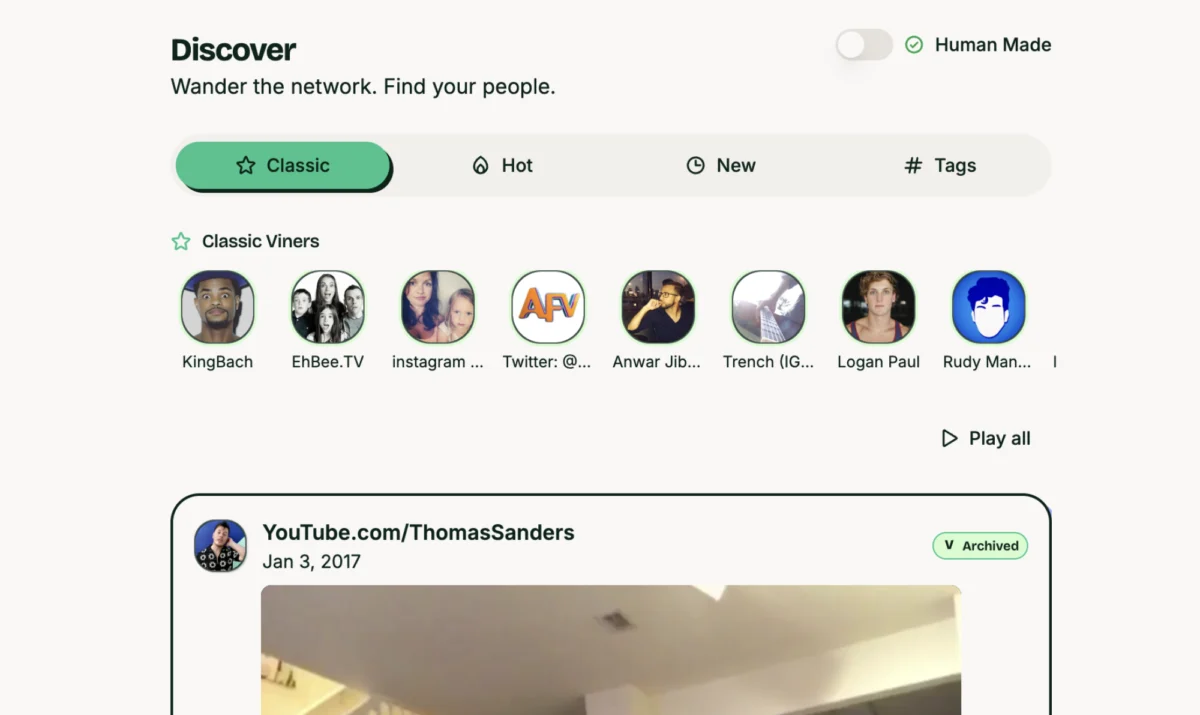
It is a sentence that would have sounded like a fever dream just a few years ago: Vine is back. In the landscape of 2026, where social media is dominated by massive, algorithm-driven conglomerates and an increasingly pervasive fog of synthetic, AI-generated content, the return of a platform synonymous with the "Golden Age" of short-form video feels both nostalgic and radical.
Rebranded as "Divine," the platform has risen from the digital ashes of its predecessor. Perhaps most striking is the identity of its benefactor: the project is funded by Jack Dorsey, the former Twitter CEO whose tenure saw the original Vine shuttered in 2017. In a move that observers are calling a complex act of corporate penance, Dorsey is pouring resources into the very ecosystem he helped dismantle.
The Resurrection: From Vine to Divine
The architecture of Divine is designed to serve two masters: the history of the internet and the future of human-centric content. At its core, Divine functions as a high-fidelity archive, hosting over 500,000 legacy videos from the original Vine platform. For a generation of digital natives, this represents the preservation of a cultural touchstone—a curated museum of the six-second comedy sketches, loops, and experimental video art that defined the early 2010s.
However, Divine is not merely a digital cemetery. It is an active social platform with a distinct, uncompromising mission: "freedom from AI slop." In an era where generative artificial intelligence can mimic human expression with unsettling accuracy, Divine has staked its existence on a firm commitment to human-only creation. To maintain this, the platform has implemented rigorous technical hurdles, requiring users to either capture video directly through the app’s native camera or submit their uploads to a sophisticated verification process. This validation is powered by the Guardian Project, a nonprofit organization dedicated to digital rights and secure communication, ensuring that every frame on the platform is verifiably "human-made."
A Chronology of a Digital Phoenix
The journey to the launch of Divine has been a winding road of pivots and prototypes. To understand its current form, one must look back at the trajectory of its predecessor:
- 2013: Vine launches to immediate, explosive popularity, eventually peaking at 100 million monthly active users. It becomes the launchpad for a new class of celebrity, including creators like Logan Paul.
- 2016-2017: Facing intense competition from Instagram and internal struggles, Twitter—under Jack Dorsey—announces the closure of Vine. The app is officially "killed" in early 2017, leaving a massive void in the short-form video space.
- 2023-2024: Following the acquisition of Twitter by Elon Musk, rumors circulate that the new ownership might revive Vine to compete with the meteoric rise of TikTok. Those plans never materialize.
- November 2025: Divine emerges in a limited test launch. Led by Evan Henshaw-Plath, a veteran developer and former Twitter employee known in tech circles as "Rabble," the project aims to test the viability of a non-algorithmic, human-first video platform.
- May 2026: Divine officially launches on the Google Play Store and the Apple App Store, marking the return of the six-second format to the global stage.
The Vision: Ownership and Autonomy
The guiding force behind Divine is not just technological, but philosophical. Evan Henshaw-Plath has positioned the platform as an antidote to the "engagement-at-all-costs" models that define modern tech giants.
In a recent interview, Jack Dorsey addressed the irony of his involvement, acknowledging the mistakes made during the original Vine era. A core tenet of the new platform is creator sovereignty. Unlike legacy platforms where creators are essentially tenants on rented land, Divine is built on the principle that creators own their content and their audience relationships.
"We want to move away from the model where the platform is the master of the creator," says a spokesperson for the project. By prioritizing decentralized principles and open-source infrastructure—backed by Dorsey’s nonprofit, and Other Stuff—the platform seeks to ensure that creators can monetize their work without being subject to the whims of a centralized, opaque algorithm.
The Competitive Landscape: A David vs. Goliath Scenario
Divine enters a market that is fundamentally different from the one Vine occupied in 2013. Today, the "attention economy" is saturated. TikTok has established a stranglehold on short-form video, while Instagram Reels and YouTube Shorts command massive, built-in audiences.

Current market data illustrates the magnitude of the challenge:
- YouTube Shorts: Reports indicate over 200 billion daily views, serving as the dominant player in the landscape.
- Instagram Reels: A primary engine for Meta’s advertising revenue, deeply integrated into the daily habits of billions.
- TikTok: Despite regulatory pressures and the rise of AI-generated content, it remains the standard-bearer for viral discovery.
In this environment, Divine’s proposition—a strict six-second limit and a "no-AI" mandate—is inherently niche. Critics argue that limiting content duration and enforcing strict verification might discourage the average user who is accustomed to the seamless, frictionless experience of scrolling through infinite, AI-curated feeds. Yet, supporters argue that this is precisely the point. By imposing constraints, Divine creates a "slow social" environment where quality and human intent are valued over the rapid-fire dopamine hits of the algorithm.
Implications: The Fight Against the ‘Slop’
The term "AI slop" has become a rallying cry for a growing segment of the digital population exhausted by the proliferation of synthetic media. As deepfakes and automated bot content clutter platforms like X and Facebook, the value of "authentic" human interaction is skyrocketing.
Divine’s partnership with the Guardian Project represents a significant intersection of human rights advocacy and social media architecture. By using cryptographic verification to prove that a human was behind the lens, Divine is positioning itself as a "trusted" space. This has profound implications for the future of digital discourse. If Divine succeeds, it could set a new industry standard, forcing other platforms to adopt similar verification methods to combat the erosion of trust in online content.
However, the cost of this verification is friction. In a world of "one-tap" uploads, requiring users to pass through a vetting process is a bold move. It effectively filters out the casual user in favor of the intentional creator. Whether this "walled garden" of authenticity will be enough to lure users away from the algorithmic behemoths remains the central question of the platform’s viability.
Looking Ahead: Can Authenticity Scale?
The return of Vine under the moniker of Divine is a test of the market’s appetite for nostalgia and digital purity. Can a platform built on the ethos of 2013 survive in the hyper-optimized, automated environment of 2026?
For Jack Dorsey, the project appears to be a passion play—a chance to correct the trajectory of a medium that, in its absence, evolved into something he no longer recognizes as healthy. By funding an open-source, human-only, creator-owned ecosystem, he is attempting to restart the clock.
For the users, Divine offers a refuge. It is a space where a six-second video of a pet, a joke, or a fleeting moment of beauty can exist without being optimized for a server farm, without being deepfaked, and without being subject to the unpredictable changes of a corporate algorithm.
As Divine begins its rollout, the industry will be watching closely. If it manages to cultivate a dedicated community of creators who prioritize the human experience over the scale of the audience, it may prove that the biggest threat to the current tech giants isn’t a better algorithm—it’s the return of the human touch. The six-second loop has returned, and this time, it’s fighting for its soul.


 Asep Darmawan
 Sagoh
Sagoh