

Nobody tells you that managing social media for eight clients doesn’t mean managing eight accounts. It means being eight different people.
It is 9:00 a.m. Your coffee hasn’t even cooled, yet three urgent Slack messages have already pinged your desktop. By 10:00 a.m., you have successfully toggled through the personas of a lifestyle brand, a B2B SaaS enterprise, and a local restaurant. By noon, you are staring down a collision of conflicting deadlines. By 5:00 p.m., you are behind on two accounts, and by 8:00 p.m., a client is texting you about an "urgent" typo.
This is not just a busy day; it is a fundamental misalignment of human capacity and operational structure. While the industry is finally beginning to acknowledge the reality of burnout, the current discourse remains hopelessly flawed. Every article on the subject seems written for the in-house manager—someone with one employer, one brand voice, and one set of expectations.
None of these resources address the unique, grinding reality of multi-client burnout. They offer advice on taking breaks or logging off at a set time—standard solutions for those whose exhaustion stems from volume. But for the agency professional or the freelancer, burnout is not a volume problem. It is a structural one.
The Reality of Fragmented Attention
According to Link in Bio (2025), a staggering 77% of social media professionals report experiencing burnout. However, this figure masks a more insidious truth: multi-client burnout does not originate from the sheer number of posts scheduled. It stems from fragmentation.
When a client hires a social media manager, they believe they are paying for strategy and content output. In reality, they are purchasing a portion of that individual’s "creative attention." Unlike output, which can be automated or scaled with software, creative attention is a finite human resource. It is the specific quality of mind required to inhabit a brand voice, identify nuanced errors, and intuit what will resonate with an audience.

This capacity does not collapse overnight. It degrades slowly, week by week, in a way that is easily rationalized as simple fatigue. Consequently, your first client of the week receives the sharpest version of you, while your eighth client receives the shell of a professional who has been stretched too thin. They are paying the same rate, but they are not receiving the same quality of service.
A Chronology of Cognitive Decline
To understand how this happens, we must look at the typical progression of a multi-client manager’s work week.
- Monday (The Setup): The manager starts with high cognitive clarity. They are able to switch between personas with relative ease. The "context-switching tax" is manageable.
- Wednesday (The Peak): The mid-week wall hits. The cumulative effect of switching personas 15–20 times a day begins to take its toll. "Voice bleed" occurs, where the professional tone of a B2B client begins to leak into the casual vernacular of a lifestyle brand.
- Thursday (The Erosion): The "Client-Anxiety Spiral" sets in. A single underperforming post for one client leads to a cascade of self-doubt that affects the manager’s confidence across the entire roster.
- Friday (The Exhaustion): The manager is operating on reactive survival mode. The "always-on" culture has left them with no recovery time. They are not creating; they are merely executing to avoid friction.
Supporting Data: The Anatomy of Burnout
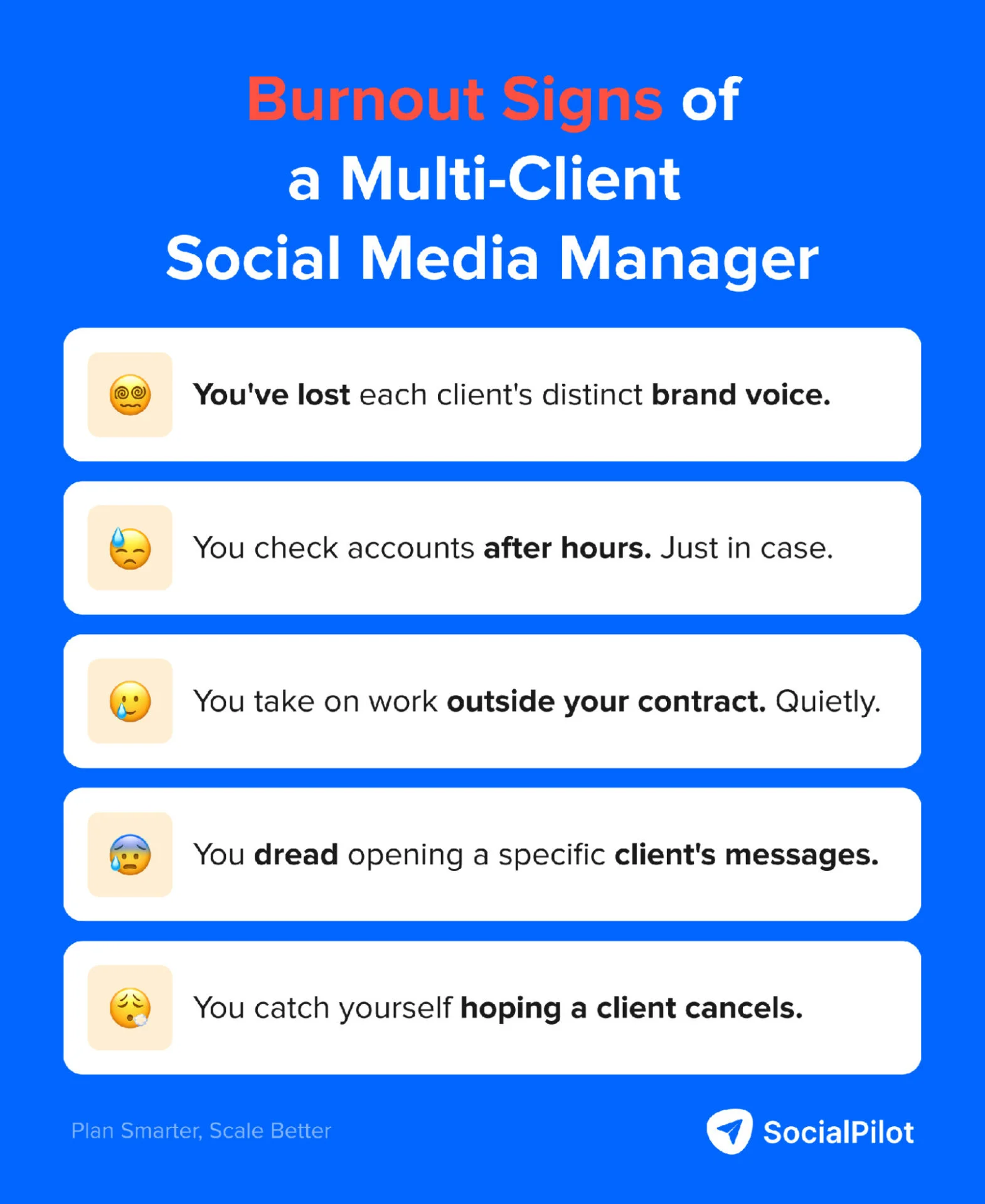
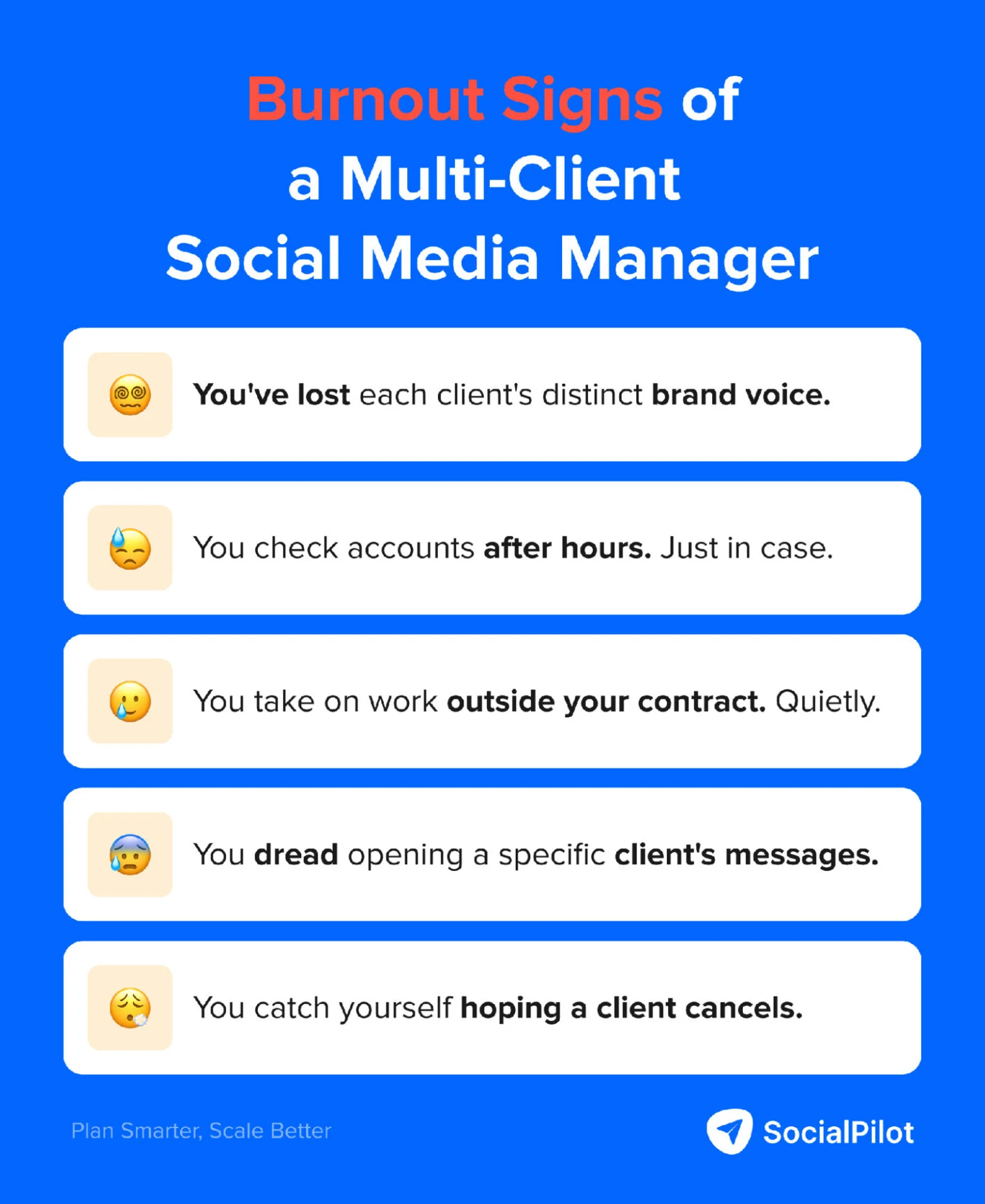
The indicators of multi-client burnout are distinct from standard workplace fatigue. When a professional finds themselves experiencing three or more of the following symptoms simultaneously, the issue is not personal inadequacy—it is a failed system:
- Voice Bleed: The inability to distinguish between the brand identities you manage.
- The "Checking" Obsession: A compulsive need to refresh apps, even when no work is pending.
- Chronic Indecision: An inability to make simple creative calls due to decision fatigue.
- Reactive Communication: Spending more time answering DMs and emails than performing the creative work clients actually pay for.
The "context-switching tax" is the primary driver here. Research into human cognition suggests that each time an individual shifts their focus, it takes several minutes to regain full "flow." For the social media manager who shifts personas dozens of times daily, they are effectively paying a massive "tax" on their focus that never appears on an invoice.
Furthermore, the "Always-On" trap is statistically significant. Data from Sprout Social (2023) indicates that 73% of social media managers feel an overwhelming pressure to be available at all hours. When a client texts at 9:00 p.m., the manager who responds immediately sets a dangerous precedent. Across eight clients, this creates a monthly toll of over 10 hours of reactive labor—time that should be spent in deep work, but is instead consumed by administrative noise.
Industry Perspectives: The "Always-On" Myth
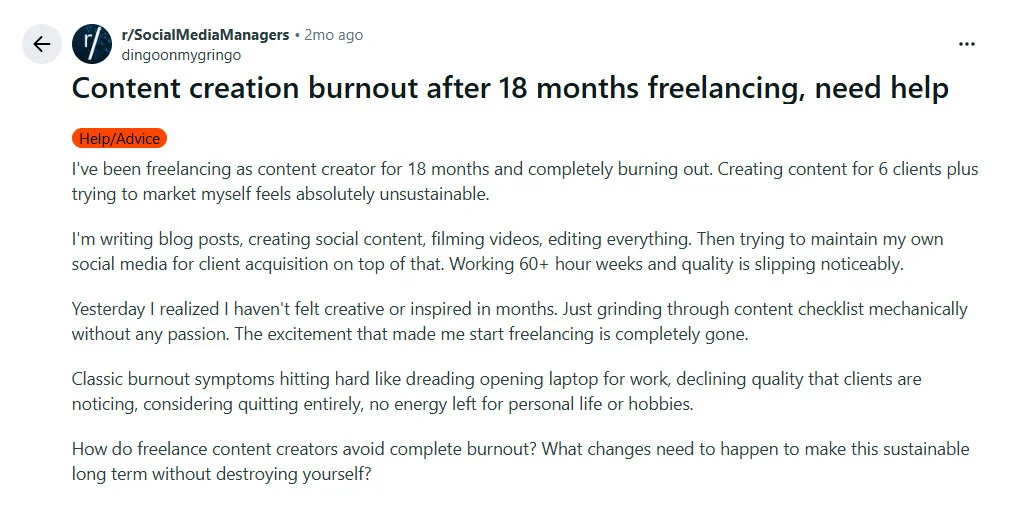
Professional forums, such as the r/socialmediamanagers subreddit, are filled with accounts of "voice bleed" and emotional exhaustion. One common theme is the "Client-Anxiety Spiral," where a single negative interaction with one client destabilizes the manager’s work for the other seven.
Industry experts argue that this is a byproduct of the "Agency Model" being applied to individual freelancers. "The problem," notes one industry consultant, "is that we are treating social media management as a commodity service rather than a high-value intellectual asset. When you treat a person as a content factory, you eventually break the factory."
The consensus is that until the industry formalizes "response windows" and "creative batching" as standard contract terms, the churn rate for social media managers will remain unsustainable.
Strategic Implications: Fixing the Structure
The solution is not to "take more lunch breaks." The solution is to restructure the environment to minimize the cost of switching.
1. Externalize the Brand Voice
Most managers carry their clients’ brand identity in their heads. This is a liability. By creating a comprehensive "Brand Bible" for each client—containing specific vocabularies, aesthetic guidelines, and "do-not-say" lists—you offload the cognitive burden. If the knowledge is on the page, the brain doesn’t have to strain to retrieve it.
2. The Batching Rhythm
Instead of managing eight clients every day, implement a batching schedule. Devote Monday to Client A and B, Tuesday to C and D, and so on. By minimizing context switches, you reduce the tax on your cognitive resources. This also creates a predictable workflow, allowing for better "deep work" sessions.
3. Institutionalizing Boundaries
Boundaries cannot be established through polite requests; they must be contractual. Explicitly stating "Response hours are 9:00 a.m. to 6:00 p.m." in your service agreement shifts the baseline. When a client signs the contract, they accept these terms. Consistency in behavior—not responding to texts outside of those hours—is what eventually trains the client to respect your time.
4. Auditing for Profitability
Many managers find that one "high-maintenance" client is actually costing them the profit margin of three other clients. By tracking the time spent on "reactive communication" versus "creative production," managers can identify which clients are effectively draining their business. If a client requires 10 hours of uncompensated communication per month, they are a net negative on your capacity.
Conclusion: The Path Forward
The fundamental question is not whether you are "tough enough" to handle a heavy client load. The right question is: Could the setup you are running right now sustain another five years without breaking you?
If the answer is no, then the setup is the problem. Professional success in the modern social media landscape requires moving away from the "heroic individual" model—where one person does everything—and toward a "system-first" model.
By leveraging tools like SocialPilot, which allow for centralized planning, automated approval workflows, and clear content scheduling, you remove the need to be in five places at once. The goal is to move from being a "doer" who handles every small task, to a "director" who manages a streamlined system.
The industry is built to break those who try to outwork their structure. The only way to survive, and eventually thrive, is to build a structure that doesn’t require you to be a martyr to your inbox. The change starts with your contract, continues with your schedule, and relies on the systems that allow you to produce high-quality work without losing your identity in the process.












No comments yet. Be the first to join the conversation!