Nana Wu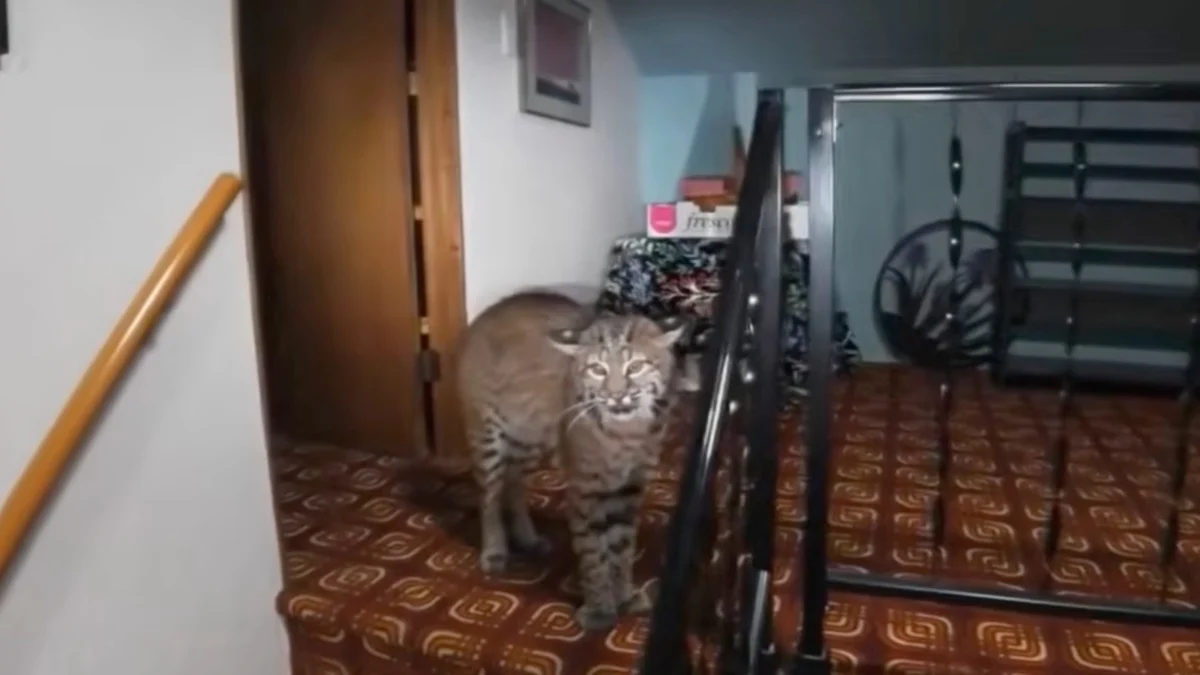
KIRKLAND, Washington — A routine police dispatch regarding a suspected residential burglary took an extraordinary turn last week, as officers responding to a home in Kirkland discovered that the intruder was not a human criminal, but a wild bobcat that had successfully navigated its way into the residence. The incident, which has since captured the attention of wildlife experts and social media users alike, underscores the increasingly blurred lines between suburban expansion and the natural habitats of Washington’s apex predators.
The Chronology of the “Burglary”
The events unfolded on a quiet afternoon when the Kirkland Police Department received a distress call from a homeowner reporting a suspected break-in. Given the nature of the emergency, officers arrived on the scene with standard protocol for a burglary in progress. However, upon clearing the perimeter and entering the home, law enforcement encountered a scenario for which they were distinctly unprepared.
Perched at the top of the residence’s staircase was not a human suspect, but an adult bobcat, appearing both disoriented and defensive. Recognizing the danger of the situation—both to the officers and the animal—the police immediately shifted their strategy from law enforcement to wildlife management.
"We were prepared for a burglary, but we were met with a wild animal in a confined space," said a spokesperson for the local precinct. "The primary objective immediately shifted to ensuring the safety of the residents and the animal, while minimizing the stress on the bobcat."
By maintaining a perimeter, officers prevented the animal from becoming more agitated. To track the feline’s movements without physically encroaching on its territory, the department deployed a tactical indoor drone. This allowed officials to observe the bobcat’s behavior in real-time, relaying crucial data to state wildlife authorities who were en route to the scene.
The Theory of Entry: A Suburban Gateway
Following the successful removal of the animal, investigators and wildlife biologists reconstructed the likely path of the intruder. Initial findings suggest that the bobcat, likely a young adult exploring its territory, scaled a mature tree adjacent to the property. From the vantage point of the tree, the animal leaped onto a balcony and squeezed through an open second-story window.
One prevailing theory, supported by animal behaviorists, suggests the bobcat may have been drawn to the home by the scent of the resident’s own domestic cat. "Domestic pets often act as beacons for wild predators," explains Dr. Elena Vance, a regional wildlife ecologist. "When an indoor-outdoor pet is present, or even an indoor pet visible through a window, they can inadvertently attract larger predators who are looking for territory or food. In this case, the bobcat likely viewed the residence as an extension of the local woods, and the window provided an irresistible entry point."
Technological Intervention: Drones in Wildlife Management
The use of an indoor drone during this incident marks a significant evolution in how law enforcement handles human-wildlife conflicts. Traditionally, such scenarios required physical containment, which often involved high-stress corralling or the use of heavy equipment that could cause structural damage to a home.
In this instance, the drone served as an "eyes-on" tool that allowed the team to pinpoint the bobcat’s exact location at all times. By hovering at a safe distance, the drone did not trigger the animal’s "fight or flight" response as aggressively as a human would have. This allowed wildlife officials to assess the animal’s physical state and prepare for a safe sedation without the risk of an aggressive encounter.
Once the team from the Washington Department of Fish and Wildlife (WDFW) arrived, they were able to use the drone’s footage to execute a precise, efficient, and humane extraction. The bobcat was successfully sedated, carefully transported out of the home, and subsequently released into a remote area of the wilderness, far from suburban development.
Official Responses and Public Safety
The Kirkland Police Department has lauded the cooperation between law enforcement and wildlife officials as a blueprint for future incidents. "This is a reminder that Washington’s urban-wildlife interface is active," the department stated. "We urge residents to keep windows and doors secured, especially if they live near forested areas, and to be mindful of how domestic pets can influence the behavior of local wildlife."
The WDFW issued a follow-up advisory, noting that bobcat sightings are becoming more frequent as the human population continues to expand into historically wild corridors. While bobcats are generally shy and avoid human contact, the allure of easy access to food or the curiosity of a young predator can lead them into residential zones.
The Implications of Suburban Wildlife Encounters
This incident is not an isolated event; rather, it is part of a broader trend of "urban infiltration" by wild animals. From black bears raiding pantries in the Northeast to mountain lions roaming suburban backyards in California, the phenomenon highlights a critical environmental shift.
As suburban sprawl consumes forest land, wild animals are forced to adapt. The bobcat incident in Kirkland is a microcosm of this adaptation. When a wild animal enters a home, it is often a desperate or exploratory measure. However, the psychological and physical impacts on both the homeowner and the animal are profound.
A Pattern of Unusual Visitors
This story follows a similar, high-profile case from August, where a woman in a neighboring state returned home to find a black bear had bypassed security measures to steal a bucket of KFC from her kitchen counter. These incidents, while appearing humorous at first glance, carry serious implications for human-wildlife coexistence.
Experts argue that as we continue to build, we must prioritize "wildlife-friendly architecture." This includes:
- Securing waste management: Ensuring trash cans are bear-proof and not left in accessible areas.
- Window and door maintenance: Installing high-quality screens that can withstand the weight of a curious animal.
- Pet management: Keeping domestic animals indoors during dusk and dawn, the peak hunting hours for many predators.
Moving Toward Coexistence
The successful extraction of the bobcat serves as a testament to the importance of professional intervention over vigilante action. Had the homeowner attempted to corner the animal or remove it themselves, the outcome could have been drastically different. The bobcat, while small compared to a mountain lion, is still a formidable predator with sharp claws and teeth capable of inflicting significant injury.
As the population of Washington grows, the frequency of such encounters is likely to increase. The goal for state officials is to manage this growth while maintaining the integrity of local wildlife populations. By providing the public with better education on animal behavior and investing in non-lethal, technology-driven intervention methods, communities can foster an environment where humans and wildlife can share the landscape safely.
The bobcat, now back in the wild and unharmed, represents the success of this approach. It serves as a living reminder that the woods are never truly far away, and that even the most secure home is still a part of the natural world. For the residents of Kirkland, the event has become a cautionary tale and a story of a community that, when faced with the unexpected, chose a path of caution, technology, and compassion.
As the dust settles, the homeowner is currently repairing the window used for entry, now reinforced with specialized hardware. For the rest of the neighborhood, the message is clear: when living on the edge of the wild, vigilance is the price of harmony.


 Evan Lee Salim
 Suro Senen